📚 New Blog Posts
1. What FSMA Really Requires From Food and Beverage Manufacturers
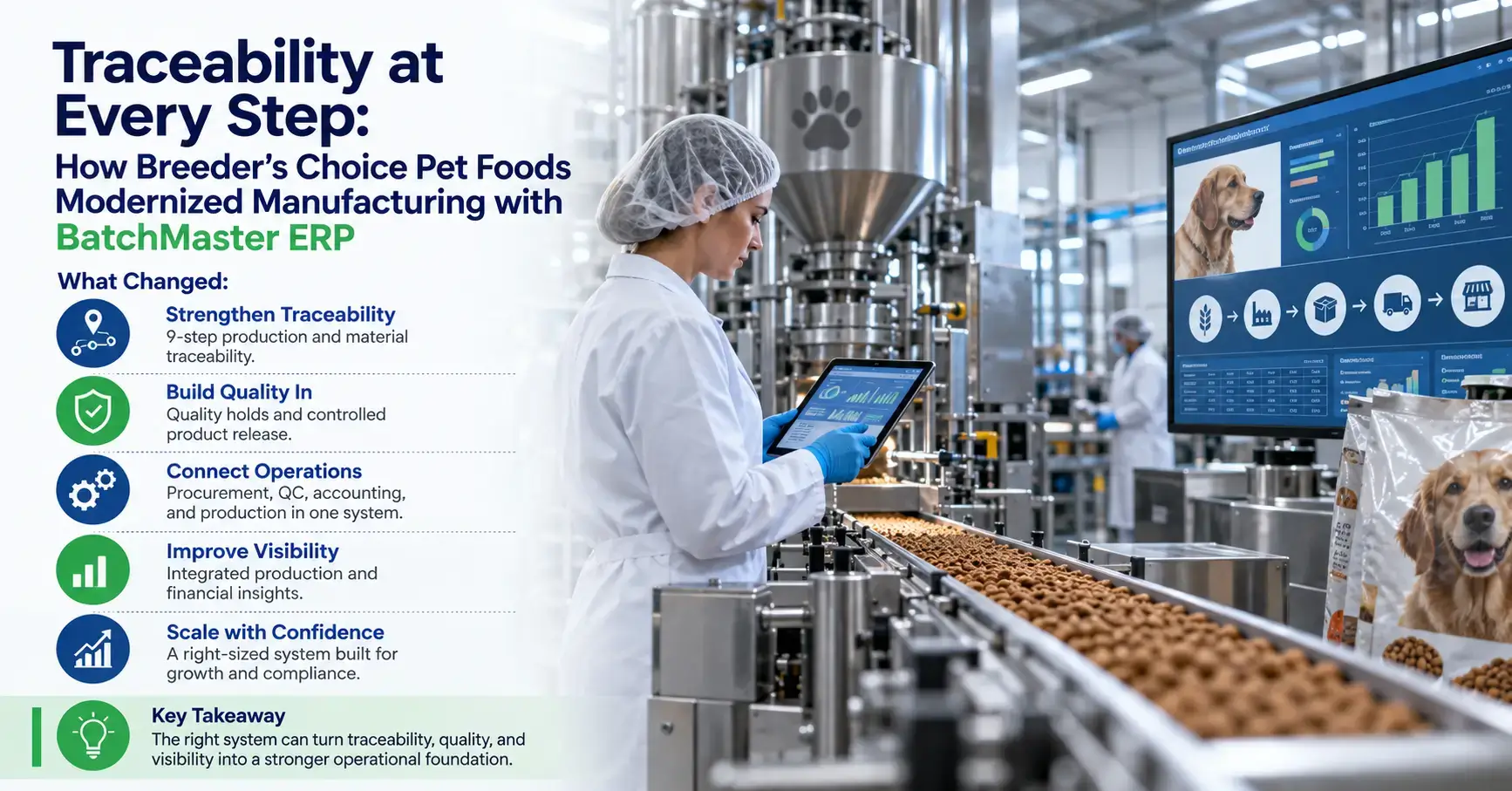
2. Powering Growth: How Sunbelt Custom Mineral Scaled with BatchMaster ERP
3. Batch Production Best Practices for Process Manufacturers
Industry Trends, Compliance Shifts, and Investment Activity Shaping Mid-Market Process Manufacturers
The Brief
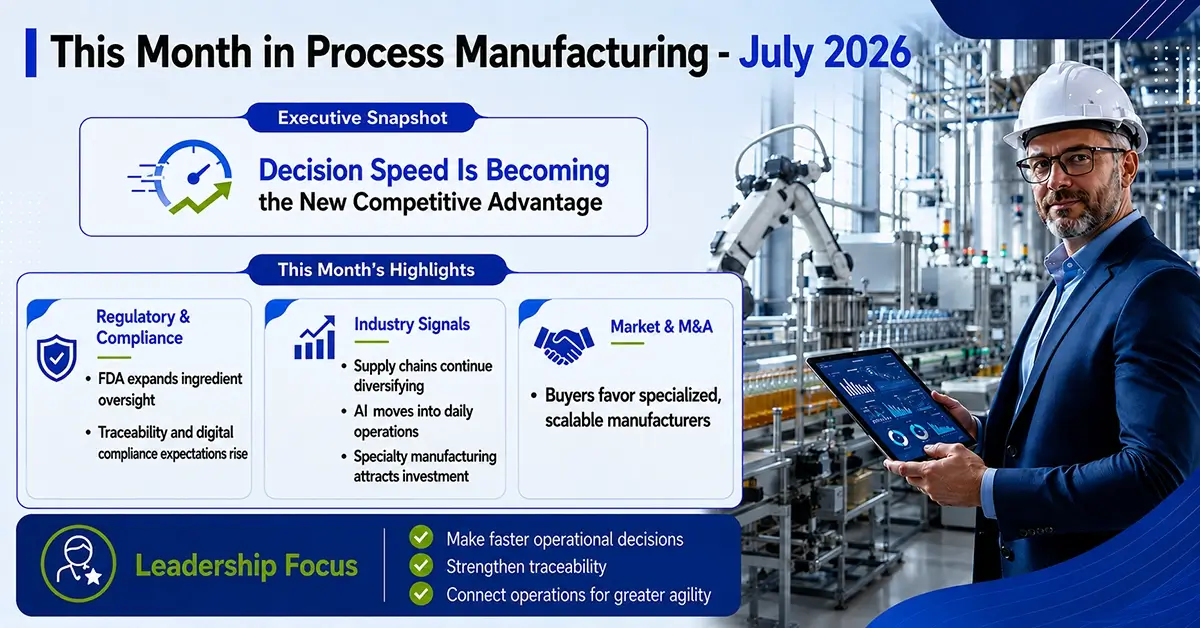
July reinforced a clear shift across process manufacturing: competitive advantage is increasingly determined by the speed of operational decision-making. As regulatory oversight expands, supply chains remain unpredictable, and investment continues favoring specialized manufacturers; leaders can no longer rely on operational resilience alone. For mid-market manufacturers, the ability to respond quickly to changing compliance requirements, input costs, and production challenges is becoming just as important as efficiency, protecting both margins and long-term growth.
Compliance & Regulatory Watch
MAHA & FDA Update: Ingredient Oversight Continues to Expand
The FDA continued advancing its Human Foods Program during July, reinforcing its transition toward continuous post-market ingredient oversight rather than periodic regulatory reviews.
FDA Activity
Recent agency updates continued expanding work around:
- Post-market food chemical assessments
- Review of synthetic preservatives and additives
- Modernization of GRAS oversight
- Greater transparency around ingredient safety evaluations
The agency has also continued reviewing stakeholder responses regarding BHT and Azodicarbonamide while developing its long-term chemical review framework.
Ingredients Under Increased Review
Manufacturers should continue monitoring:
- BHA
- BHT
- Azodicarbonamide (ADA)
- Synthetic food dyes
- Phthalates
- GRAS self-affirmed ingredients
For many manufacturers, the operational challenge is no longer simply reformulation. It now includes supplier validation, documentation updates, and maintaining consistent formulations across changing regulatory expectations.
→ Operational Impact
Ingredient governance is becoming increasingly cross-functional.
Successful manufacturers are connecting:
- R&D
- Procurement
- Quality
- Regulatory
- Production
to shorten reformulation cycles and improve decision speed.
Compliance Watch
FSMA 204: Readiness Is Becoming a Competitive Advantage
Although compliance remains scheduled for July 2028, retailers and customers continue increasing traceability expectations well before regulatory enforcement.
Manufacturers are increasingly expected to demonstrate:
- Event-level lot traceability
- Faster recall readiness
- Connected production records
- Complete digital documentation
→ Operational Implication:
Companies waiting until regulatory deadlines may find themselves behind customer expectations.
GMP Enforcement Continues Focusing on Documentation
FDA inspections continue emphasizing:
- Batch record completeness
- Investigation documentation
- Process deviations
- Electronic record integrity
Inspection activity increasingly focuses on proving that documented procedures match actual manufacturing practices.
21 CFR Part 11: Data Integrity Expectations Continue Rising
Digital transformation continues through process manufacturing, but regulators are placing greater emphasis on validating electronic systems.
Manufacturers should ensure:
- Secure audit trails
- Validated electronic records
- Controlled electronic signatures
- Consistent data across production, quality, and compliance
→ Operational Implication:
Digital systems create value only when data remains accurate, synchronized, and audit ready.
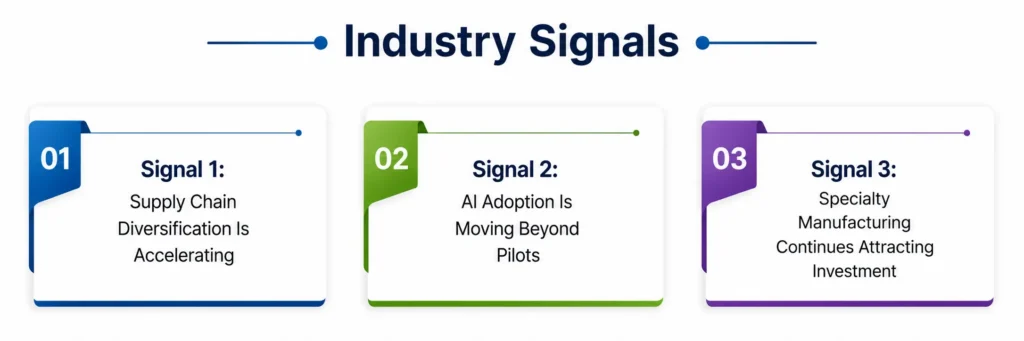
Signal 1: Supply Chain Diversification Is Accelerating
What Happened
Recent manufacturing surveys indicate companies continue reshoring production while expanding domestic supplier networks to reduce geopolitical risk and improve supply chain resilience.
Manufacturing Implication
Supplier diversification is becoming part of operational strategy rather than emergency planning.
Organizations are evaluating:
- Secondary suppliers
- Domestic ingredient sourcing
- Regional manufacturing capacity
- Inventory strategies
Before your next leadership meeting, ask: If one critical supplier becomes unavailable tomorrow, how quickly can production continue?
Signal 2: AI Adoption Is Moving Beyond Pilots
What Happened
Manufacturing organizations continue investing in AI, but the most successful deployments are focused on improving operational decisions rather than replacing employees.
Companies are increasingly applying AI to:
- Production scheduling
- Demand forecasting
- Quality monitoring
- Predictive maintenance
- Inventory optimization
Manufacturing Implication
The gap is widening between manufacturers experimenting with AI and those embedding it into daily operations.
Before your next leadership meeting, ask: Are we measuring AI success by the number of projects launched or by operational decisions improved?
Signal 3: Specialty Manufacturing Continues Attracting Investment
What Happened
Private equity and strategic buyers remain focused on specialty manufacturers with differentiated formulations, regulated production environments, and technical expertise.
Investment activity continues favoring businesses that demonstrate:
- Proprietary formulations
- Technical manufacturing capabilities
- Strong quality systems
- Long-term customer relationships
Manufacturing Implication
Specialized manufacturing capability is increasingly becoming a valuation driver.
Before your next leadership meeting, ask: What capabilities would make our manufacturing operation difficult for competitors to replicate?
M&A Intelligence
$125M Acquisition: SK Capital Acquired J&K Ingredients (Food Ingredients)
SK Capital completed the acquisition of J&K Ingredients, a manufacturer of specialty bakery ingredients and clean-label solutions serving commercial food manufacturers.
Signal: Buyers continue investing in manufacturers with formulation expertise and clean-label innovation that support evolving consumer and regulatory demands.
Approximately $80M Acquisition: Azelis Acquired Solchem Nature S.L. (Personal Care & Specialty Ingredients)
Azelis expanded its specialty ingredient portfolio through the acquisition of Solchem Nature, strengthening its presence in natural cosmetic ingredients and formulation support.
Signal: Ingredient suppliers with technical application expertise continue commanding strong strategic interest as manufacturers pursue differentiated formulations.
Strategic Acquisition: Azurity Pharmaceuticals Acquired Covis Group (Specialty Pharmaceuticals)
Azurity Pharmaceuticals expanded its specialty pharmaceutical portfolio through the acquisition of Covis Group, adding complex branded medicines and expanding manufacturing capabilities.
Signal: Pharmaceutical investment activity continues prioritizing specialized manufacturing, regulatory expertise, and established product portfolios over simple production capacity.
Valuation Signal
July’s investment activity continued reinforcing a consistent market message: buyers are paying premiums for specialized manufacturing capabilities, regulatory maturity, and operational visibility.
Manufacturers with differentiated formulations, validated quality systems, and integrated operations continue attracting stronger strategic interest than businesses competing primarily on production capacity alone.
The valuation gap between capability-driven manufacturers and commodity producers continues to widen.
Final Takeaway
July reinforced that operational speed is becoming just as important as operational efficiency. Manufacturers are navigating an environment where regulatory expectations, supply chain strategies, and investment priorities continue evolving simultaneously. Organizations that can quickly adapt formulations, validate suppliers, maintain traceability, and make informed operational decisions will be better positioned to protect margins and sustain growth.
In today’s process manufacturing environment, operational control is evolving beyond an efficiency initiative. It is becoming a defining characteristic of long-term competitiveness and enterprise value.
Resources & Sources
MAHA & FDA
FDA Human Foods Program
FDA Systematic Process for Post-Market Assessment of Chemicals in Food
FDA Human Foods Program Updates & News
FoodNavigator-USA
Food Dive
Reuters Business News
Compliance & Regulatory
FDA Food Safety Modernization Act (FSMA)
FSMA 204 Food Traceability Rule
FDA 21 CFR Part 11 Guidance
Food Safety Magazine
Industry Signals
Institute for Supply Management (ISM) Manufacturing Report
Manufacturing Dive
Reuters Manufacturing & Supply Chain News
Deloitte 2026 Manufacturing Industry Outlook
McKinsey Manufacturing Insights
M&A Intelligence
SK Capital acquired J&K Ingredients
Official Announcement
J&K Ingredients
Azelis acquired Solchem Nature
Official Azelis Newsroom
Solchem Nature
Azurity Pharmaceuticals acquired Covis Group
Official Press Release
Covis Group
Market & Valuation References
PitchBook
Capstone Partners
Kroll Food & Beverage Industry Insights
PwC Chemicals Deals Outlook