Industry Trends, Compliance Shifts, and Investment Activity Shaping Mid-Market Process Manufacturers
The Brief
Rising input costs are making margin protection a more immediate leadership priority across process manufacturing. September data released in October showed U.S. manufacturing activity continuing to expand, but the cost picture became more challenging. The Institute for Supply Management’s Manufacturing PMI registered 54.5, while its Prices Index climbed to 77.9, signaling another month of rising raw material prices.
For food, beverage, nutraceutical, pharmaceutical, chemical, cosmetics, coatings, and specialty ingredient manufacturers, the challenge extends beyond procurement. Changes in material costs can affect formulation economics, production schedules, inventory decisions, pricing, and working capital.
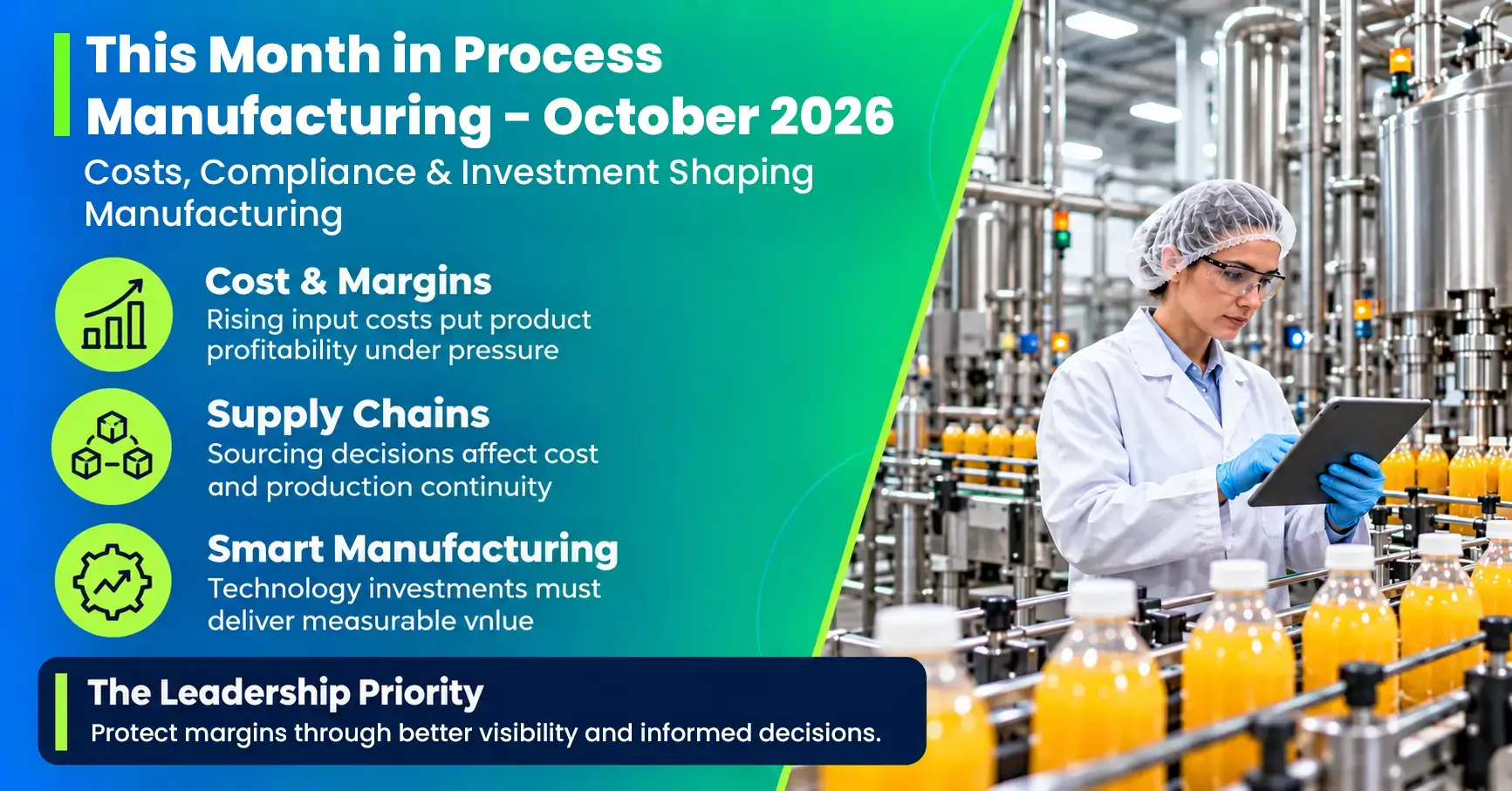
This month, three developments stand out: mounting pressure on product margins, the growing financial importance of sourcing decisions, and the need to make technology investments deliver measurable operating value. Regulatory changes and acquisition activity add another dimension to how manufacturers protect profitability while preparing for growth.
Compliance & Regulatory Watch
FDA Opens New Formulation Possibilities for Standardized Foods
On October 9, the U.S. Food and Drug Administration issued a final rule permitting salt substitutes in standardized foods where salt is specified as a required or optional ingredient. Previously, 139 standards of identity permitted or required salt without allowing substitutes.
The change gives affected food manufacturers more flexibility to develop lower-sodium products without departing from applicable standards of identity. It may also create opportunities to reassess formulations, ingredient sourcing, and product development priorities.
Leadership implication: Formulation changes need to be evaluated beyond their nutritional objectives. Manufacturers should assess ingredient availability, taste and texture, production performance, quality specifications, labeling, and unit economics before making changes at scale.
Food Safety Oversight Continues to Evolve
The FDA released its CORE+EP 2025 Annual Report on October 6, covering investigations of foodborne outbreaks and adverse events involving FDA-regulated foods. On October 2, the agency also announced further actions following Cyclospora outbreaks during summer 2026.
These developments reinforce the importance of preventive controls, supplier oversight, effective investigations, and reliable records. For manufacturers, the ability to connect ingredient lots, production records, quality results, and distribution of information can be critical when investigating a potential food safety issue.
Leadership implication: Review whether food safety and quality teams can access consistent, accurate records quickly. Strong documentation and traceability support investigations and help organizations understand the scope of a potential issue.
GRAS Oversight and Ingredient Review Remain in Focus
The FDA’s proposed rule on substances claimed to be Generally Recognized as Safe (GRAS), announced in August, remains relevant to food and ingredient manufacturers. The agency scheduled a webinar about the proposal for October 15, with public comments open through December 9, 2026.
The proposal could affect how companies document and communicate the basis for GRAS conclusions. It is a proposed rule, not a finalized requirement, so manufacturers should monitor its progress rather than assume the proposed changes are already in effect.
For companies developing or sourcing functional ingredients, flavors, preservatives, and specialty food ingredients, ingredient documentation and regulatory review remain important parts of formulation planning.
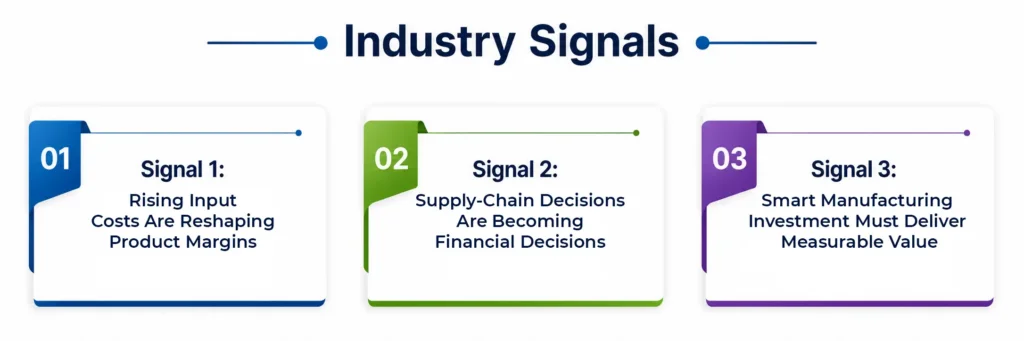
1. Rising Input Costs Are Reshaping Product Margins
The September ISM Manufacturing Purchasing Managers’ Index (PMI) report delivered a clear warning for cost-conscious manufacturers. The Prices Index rose 6.8 percentage points to 77.9, marking the 24th consecutive month of increasing raw material prices. The report identified increases in materials including aluminum, steel, resins, plastics, fuel, freight, and packaging. Food, beverage, and tobacco products, as well as chemical products, reported higher raw material prices.
The challenge is not simply that individual materials cost more. A change in one ingredient can flow through a formulation, alter a batch’s total cost, affect finished-product profitability, and eventually influence customer pricing.
When cost information is delayed or disconnected across procurement, production, inventory, and finance, leaders may not see the full impact until margins have already weakened.
What leadership should consider: Product-level costing needs to reflect current material prices, actual consumption, production variances, and overhead assumptions. Reviewing profitability by product and customer can help identify where pricing changes, formulation reviews, or sourcing adjustments deserve attention.
2. Supply-Chain Decisions Are Becoming Financial Decisions
Manufacturing activity remained in expansion territory in September, with the PMI at 54.5 and new orders at 55.3. At the same time, supplier deliveries remained slow; the Inventories index moved into contraction, and the Prices Index accelerated. These indicators point to a business environment in which demand, supply availability, and cost pressures need to be considered together.
For process manufacturers, the lowest quoted purchase price does not always translate into the lowest total cost. Longer lead times may require additional safety stock. A less reliable supplier may increase the risk of production interruptions. Switching materials or suppliers can also introduce qualification, testing, documentation, and quality control costs.
This makes sourcing a cross-functional decision rather than a procurement-only exercise.
What leadership should consider: Compare suppliers using total landed cost, lead-time reliability, minimum order quantities, quality consistency, inventory requirements, and the operational consequences of a disruption. Finance, procurement, production, and quality teams should work from a common view of the trade-offs.
The objective is not to select the most expensive or the cheapest supplier. It is to understand which sourcing option best protects product economics and production continuity.
3. Smart Manufacturing Investment Must Deliver Measurable Value
Technology remains an important part of manufacturing competitiveness, but investment alone does not guarantee better performance. Deloitte’s 2026 Manufacturing Industry Outlook identifies smart manufacturing, digital supply-chain tools, and AI-enabled operations as areas with potential to improve productivity, agility, and decision-making.
For process manufacturers, the most useful applications are those tied to specific operating needs. Better production data can help teams identify yield losses. More accurate planning can improve material availability. Timely analysis of quality deviations can help prevent repeat issues. Connected cost and production information can give finance and operations a clearer view of profitability.
The business case should begin with the problem, not technology. A system or AI initiative is more valuable when its intended results are defined in operational and financial terms.
What leadership should consider: Establish measurable objectives before approving major investments. These might include reducing material waste, improving schedule adherence, shortening quality investigations, increasing inventory accuracy, or improving visibility into product margins. Assess data readiness, integration requirements, employee adoption, and ongoing costs alongside expected benefits.
M&A Intelligence
Capsoil Technologies Acquires Red Mesa Science & Refining
Announced October 6, the acquisition adds a 55,000-square-foot U.S. manufacturing facility to Capsoil’s operations. Red Mesa brings extraction, distillation, crystallization, and chromatography capabilities, along with experience serving nutraceutical, cosmetic, and food-related markets. The facility operates under relevant food and dietary supplement manufacturing requirements, including cGMP and applicable FDA regulations.
The deal combines specialized ingredient processing with a proprietary delivery technology platform. Financial terms were not disclosed.
Strategic signal: Specialized processing expertise and the ability to scale differentiated ingredients can be valuable growth assets for manufacturers serving multiple end markets.
Penta Fine Ingredients Completes Acquisition of Synerzine
On October 9, Penta Fine Ingredients announced the completion of its acquisition of Synerzine, a supplier of aroma ingredients for the flavor and fragrance industries. Synerzine offers more than 1,200 aroma ingredients, including a specialized pyrazine portfolio and natural, kosher, and halal materials.
The acquisition expands Penta’s product portfolio and manufacturing capabilities in flavors and fragrances. Financial terms were not disclosed.
Strategic signal: Expanding specialized ingredient portfolios can strengthen a manufacturer’s ability to serve customers with diverse formulation and sourcing requirements.
GE HealthCare Agrees to Acquire SOFIE Biosciences
On October 5, GE HealthCare announced a definitive agreement to acquire SOFIE Biosciences for $945 million in cash. SOFIE operates as a U.S.-based contract manufacturer of PET radiopharmaceuticals. The transaction would expand GE HealthCare’s U.S. radiopharmaceutical manufacturing and distribution footprint, including a network of 15 contract manufacturing sites operating 21 cyclotrons.
The acquisition remains subject to closing conditions, including regulatory approvals, and was expected to close in the first half of 2027.
Strategic signal: In specialized pharmaceutical manufacturing, technical expertise, geographically distributed infrastructure, and reliable time-sensitive supply can be central to strategic value.
Valuation Signal
Specialized Capabilities Can Strengthen Strategic Value
October’s transactions illustrate different ways manufacturers can build strategic value: proprietary ingredient technology, broader specialty ingredient portfolios, and specialized pharmaceutical manufacturing infrastructure.
These deals do not establish a universal valuation premium, but they highlight capabilities that buyers may find strategically attractive. Technical expertise, specialized formulations, reliable production, quality systems, and the ability to serve demanding markets can differentiate a business beyond its installed capacity.
For mid-market manufacturers, the question is whether these strengths are repeatable, documented, scalable, and commercially relevant. Operational visibility also matters because buyers need confidence in the performance and risks of the business they are evaluating.
The leadership question: Which capabilities make your business difficult to replicate, and can you demonstrate their contribution to performance and growth?
Final Takeaway
October reinforces a critical point for process manufacturing leaders: rising costs are not just a procurement issue. They affect formulation economics, production decisions, sourcing strategy, customer pricing, and profitability.
The strongest response begins with visibility. Leaders need to understand where costs are changing, how those changes affect individual products, and which decisions can protect margins without compromising quality, compliance, or customer commitments.
Technology and investment can support that effort, but the objective remains practical: make better-informed decisions, understand the trade-offs, and protect the economics of the business.
In a higher-cost environment, margin protection starts with knowing where the business stands and acting before the impact spreads.
Resources & Sources
- ISM: September 2026 Manufacturing PMI
- Explore the FDA’s October updates
- Review the FDA’s proposed GRAS rule webinar and comment information
- Source: ISM September Manufacturing PMI
- 2026 Manufacturing Industry Outlook | Deloitte Insights
- Source: Capsoil Technologies acquisition announcement
- Source: Penta Fine Ingredients
- Source: GE HealthCare
- FDA: Final Rule on Salt Substitutes in Standardized Foods
- FDA: Human Foods Program Updates
- FDA: Proposed GRAS Rule Webinar
- Deloitte: 2026 Manufacturing Industry Outlook
- Capsoil Technologies: Red Mesa Acquisition
- Penta Fine Ingredients: Synerzine Acquisition
- GE HealthCare: SOFIE Biosciences Acquisition Agreement