📚 New Blog Posts
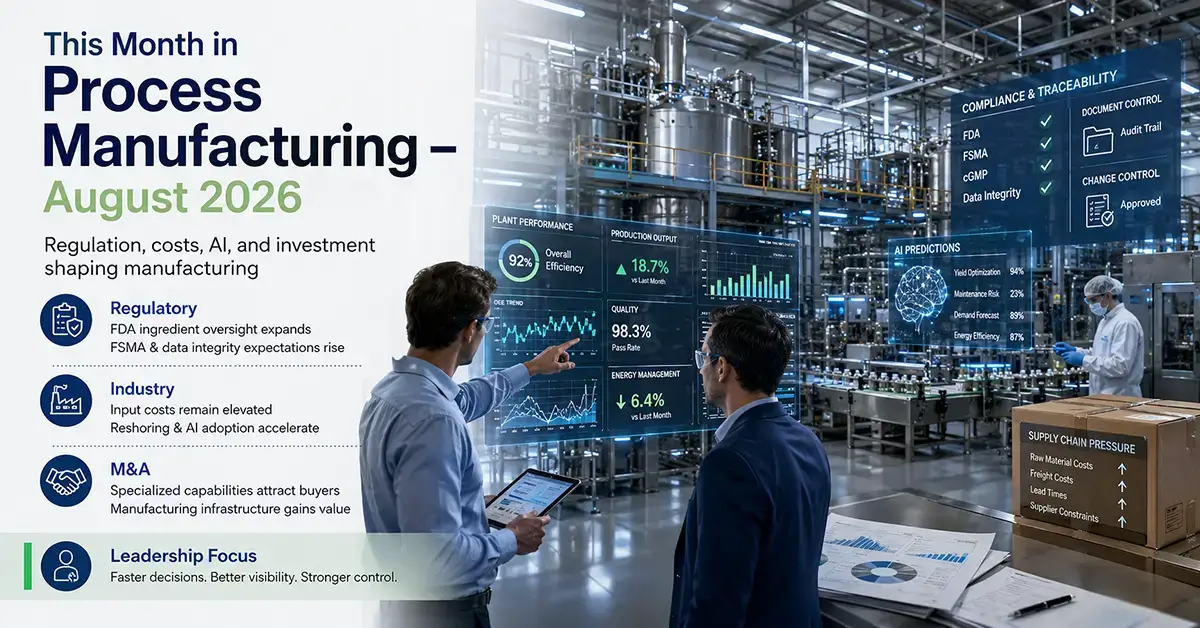
1. This Month in Process Manufacturing – June 2026
2. The Real Reasons ERP Projects Succeed or Fail
3. Why Formula Management Is Critical for Process Manufacturers?
Most production managers in process manufacturing know their operations have gaps. What fewer of them have calculated is what those gaps are costing. A batch that gets resized by hand takes time. A quality issue caught after a batch completes triggers rework. A compliance audit answered from paper logs turns into a multi-day fire drill. Individually, each of these feels manageable. Cumulatively, they define how production floor runs: either in control or perpetually catch up.
The good news is that the practices that separate high-performing process manufacturing operations from reactive ones are well understood. They do not require complexity. They require consistency.
In our recent webinar on batch production for process manufacturers, we walked through how production teams are moving away from paper logs and disconnected systems to manage batch execution in real time. What came through clearly is that the challenge is rarely about effort. Production managers are working hard, but the tools they are relying on were never built for the complexity of formula-based manufacturing.
Watch the short preview below and access the full webinar recording here.
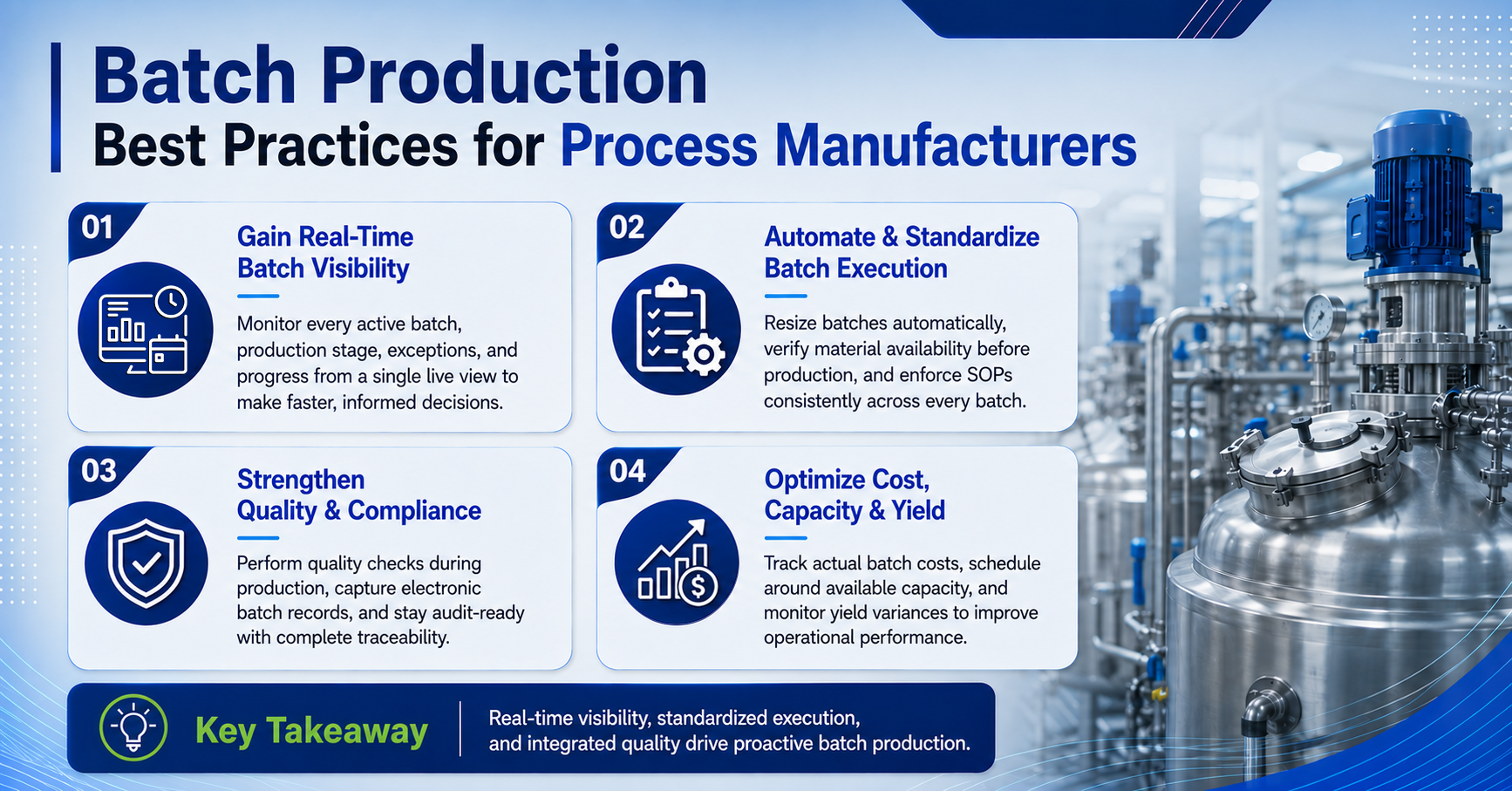
This article covers the core practices that separate high-performing batch production operations from reactive ones, and what it means for the business when those practices are actually in place.
Best Practice #1: Maintain a Real-Time View of All Running Batches
In many process manufacturing operations, the production manager’s first hour every day is spent gathering status. A call to the floor supervisor. A check of the paper log. A walk to the line. By the time the picture is assembled, decisions are already late.
The foundational shift is moving from reactive status gathering to real-time visibility. When a production manager can see all active batches in a single live view, including stage, quantity, lot, and any flagged exceptions, decisions happen in real time rather than in reaction to events that already passed.
The business outcome is not just speed. It is the character of the floor itself. Operations that run on real-time visibility plan ahead. Operations that run on status calls always react.
Best Practice #2: Build Batch Resizing into Your Process, Not Around It
Batch resizing is not the exception in process manufacturing. It is a regular operational event. Ingredient shortages, yield variability, last-minute order changes, partial bags on hand, or a shift in customer order quantity: any of these can require adjusting a planned batch before or during production.
When resizing happens manually, in a spreadsheet or on paper, it takes time and introduces error risk. The production manager or supervisor must recalculate every ingredient quantity proportionally, often under time pressure. One missed conversion can produce a batch that is out of spec before it starts.
The better practice is to treat batch resizing as a defined, reliable operation. This means systems that back-compute all ingredient quantities automatically when a batch size or a constraint changes. It also means being able to size based on what you have, not just what you planned. If a critical raw material is short, the system should tell you exactly how much finished good can be made from the available quantity, and scale everything else accordingly.
The business outcome: Recovered production time, fewer formula errors, and a faster, more confident response when supply constraints hit mid-day.
Best Practice #3: Confirm Material Availability Before the Batch Starts
One of the more avoidable sources of production stoppage is discovering a material shortage after a batch has been released to the floor. The mix is in progress; the equipment is committed, and now someone is calling the warehouse looking for inventory that was not there.
Proactive lot allocation before a batch is released prevents this. Every raw material gets confirmed for availability, correct lot status, and right priority rule: whether that is first expiry, first in/first out, or a property specific to the formula.
It also means flagging shortages in advance so that substitutions can be evaluated, or production can be rescheduled, rather than discovered on the line.
The business outcome: Fewer mid-batch stoppages, better lot traceability from the start, and production runs that begin with confidence rather than assumption.
Best Practice #4: Enforce SOPs Inside the Batch Workflow, Not Beside It
Standard operating procedures exist in nearly every process manufacturing operation. What varies is how reliably they are followed. When SOPs live in a binder on the wall, or in a production manager’s head, or in a shared folder that may or may not be current, operators can skip steps. Not always intentionally. The pressure of running a batch on schedule creates shortcuts.
The practice that eliminates this gap is embedding SOPs directly into the batch execution workflow, so operators are prompted step by step as they work. Each step is signed off before the next is accessible. The system enforces sequences. Version control ensures that the instructions on the line are always current, not the version printed six months ago.
This matters more than compliance. Batch failures caused by process deviations are largely preventable if the process is executed the same way every time. Embedding SOPs is how you make that consistency structural rather than cultural.
The business outcome: Fewer batch failures from process deviations, a clear digital audit trail for every step, and a compliance posture that does not depend on operators doing the right thing without being prompted.
Best Practice #5: Catch Quality Issues During the Batch, Not After It
Quality control in process manufacturing is often positioned as a final check. The batch completes, samples go to the lab, results come back, and then the decision is made. The problem with this sequence is that by the time a failure is discovered, the cost has already been paid: raw materials consumed, labor hours spent, equipment time used.
The better practice is building QC checkpoints into each stage of production with defined specification limits, so an out-of-spec result triggers an immediate response. If moisture content deviates at a midpoint, or a pH reading falls outside tolerance during mixing, the batch can be corrected in the moment. The cost of a mid-batch correction is almost always lower than the cost of rework or discard at the end.
This requires that QC is integrated with production execution, not separate from it. Results feed back into the batch record in real time. Holds are triggered automatically. The quality team is notified without waiting for someone to walk a sample to the lab and call back.
The business outcome: Less rework and waste, a measurably lower cost of quality failures, and no end-of-batch surprises.
Best Practice #6: Treat Every Batch Record as a Real-Time Document
The test of a batch record is what it looks like when someone asks for it on short notice, not when you file it.
In operations that rely on paper logs, assembling a complete batch record after the fact requires pulling records from multiple sources, tracking down operators who worked a shift weeks ago, and hoping that nothing was missed or illegible. For an FDA audit or a customer recall request, this process can take days.
The Electronic Batch Record (EBR) changes the premise. Rather than reconstructing what happened after the batch closes, the EBR captures everything as it happens: lot numbers, actual quantities, SOP sign-offs, QC results, in-process adjustments, labor, equipment. When the batch is done, the record is done.
In regulated industries including pharmaceuticals, nutraceuticals, food, and personal care, the ability to respond to an audit request in minutes rather than days reflects directly on the operation’s credibility and risk profile. That makes the EBR a compliance posture, not just an efficiency gain.
The business outcome: Audit readiness at all times, records that can be pulled and presented in a single session, and the elimination of the batch record reconstruction problem entirely.
Best Practice #7: Track Batch Costs in Real Time
Most process manufacturers know their standard cost but far fewer know what a batch actually cost to produce at the batch level: actual raw materials consumed, actual labor hours worked, actual yield achieved versus what was planned. The gap between standard and actual is quietly where margin disappears.
Real-time batch costing means that as materials are consumed and labor is recorded during production, the cost of the batch builds in the system. By the time the batch closes, the actual cost is already calculated. Variances from standard are visible immediately, not discovered at month-end during a financial review.
This has direct value for production managers as it shows exactly where yield losses are occurring and at which stage costs are running above plan. It has equal value for finance: it produces accurate cost-of-goods data without requiring manual post-production reconciliation.
The business outcome: Better margin visibility, faster identification of cost overruns, and actual production data that informs pricing decisions rather than estimated assumptions.
Best Practice #8: Schedule Production Around Capacity, Not Just Demand
A production schedule built from sales orders alone will almost always overcommit. What matters is not just what needs to be made, but what the floor can actually produce given current equipment availability, changeover time, and labor.
The practice that makes schedules reliable is factoring in capacity constraints before batches are released. This means knowing which equipment is available on which shift, what the realistic throughput of each line is, and how multiple batches compete for shared resources. When a mixer breaks down or a stage runs long, the rest of the schedule should adjust, not require a manual rebuild.
Linked batch scheduling, where multi-stage production is coordinated so that each stage starts based on when the prior stage can realistically complete, is particularly important for complex products. If the base for a sauce takes longer than planned, the filling stage should not be released at the original time.
The business outcome: Fewer scheduling conflicts, better equipment utilization, and production plans that the floor can actually execute.
Best Practice #9: Make Yield Variance Visible and Actionable
Process manufacturing is inherently imprecise. Evaporation, line flushes, density variation, partial bags: losses occur at every stage, and the question is whether those losses are measured or absorbed invisibly into cost of goods. Many operations track planned yield. Fewer track actual yield at each batch stage and compare it to the standard.
The practice here is reconciling actual versus theoretical yield at the batch level and making variance visible in a way that drives action. If yield on a particular product is consistently running three percent below standard, that points to something: a formula that needs adjustment, a loss that is not being accounted for, or a process step that is consistently underperforming.
Without this visibility, formulas are never corrected, and losses are never explained. With it, the data from production becomes an input into continuous improvement.
The business outcome: Reduced waste, better formula accuracy over time, and a clear understanding of where margin is being lost in the production process.
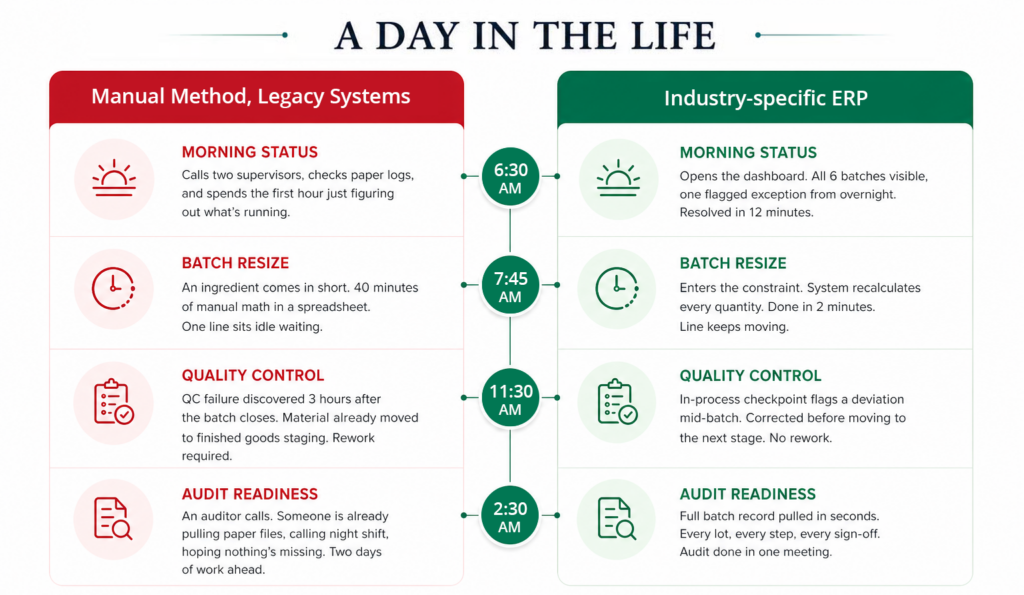
A Day in the Life: Before and After
The best practices above don’t exist in isolation. On a real production floor, they show up moment by moment throughout the day. Here’s what that looks like for a production manager running three lines and six to eight batches daily, before and after a connected batch production system is in place.
Closing: The Difference Between Catching Up and Being in Control
A production floor that is always catching up and one that is always in control do not always look different from the outside. The real difference shows up in the moments that matter: when a compliance auditor walks in, when an ingredient shortage hits at 9 AM, when a customer calls asking about a lot.
The practices above are operational standards, not technology requirements. What a purpose-built system does is make those standards enforceable and consistent, so they hold regardless of who is on shift or how busy the floor gets.
If you are evaluating how your batch production operation measures against these practices, or want to see how BatchMaster supports each of them in a live environment, we would welcome the conversation.