



📚 New Blog Posts
1. Powering Growth: How Sunbelt Custom Mineral Scaled with BatchMaster ERP
2. Batch Production Best Practices for Process Manufacturers
3. This Month in Process Manufacturing – June 2026
Ask any food and beverage manufacturer whether they’re FSMA compliant, and the answer is almost always yes. And in most cases, that answer is honest. Teams are working hard, records are being kept, and audits have gone well enough. On paper, everything looks fine.
But there’s another question manufacturers should be asking themselves : If the FDA showed up tomorrow, or a retailer asked for a full trace of a specific lot by the end of the day, how quickly could your team actually deliver complete, accurate records? For many organizations, the answer is often “we could figure it out” or “it would take a few people and most of a day.”
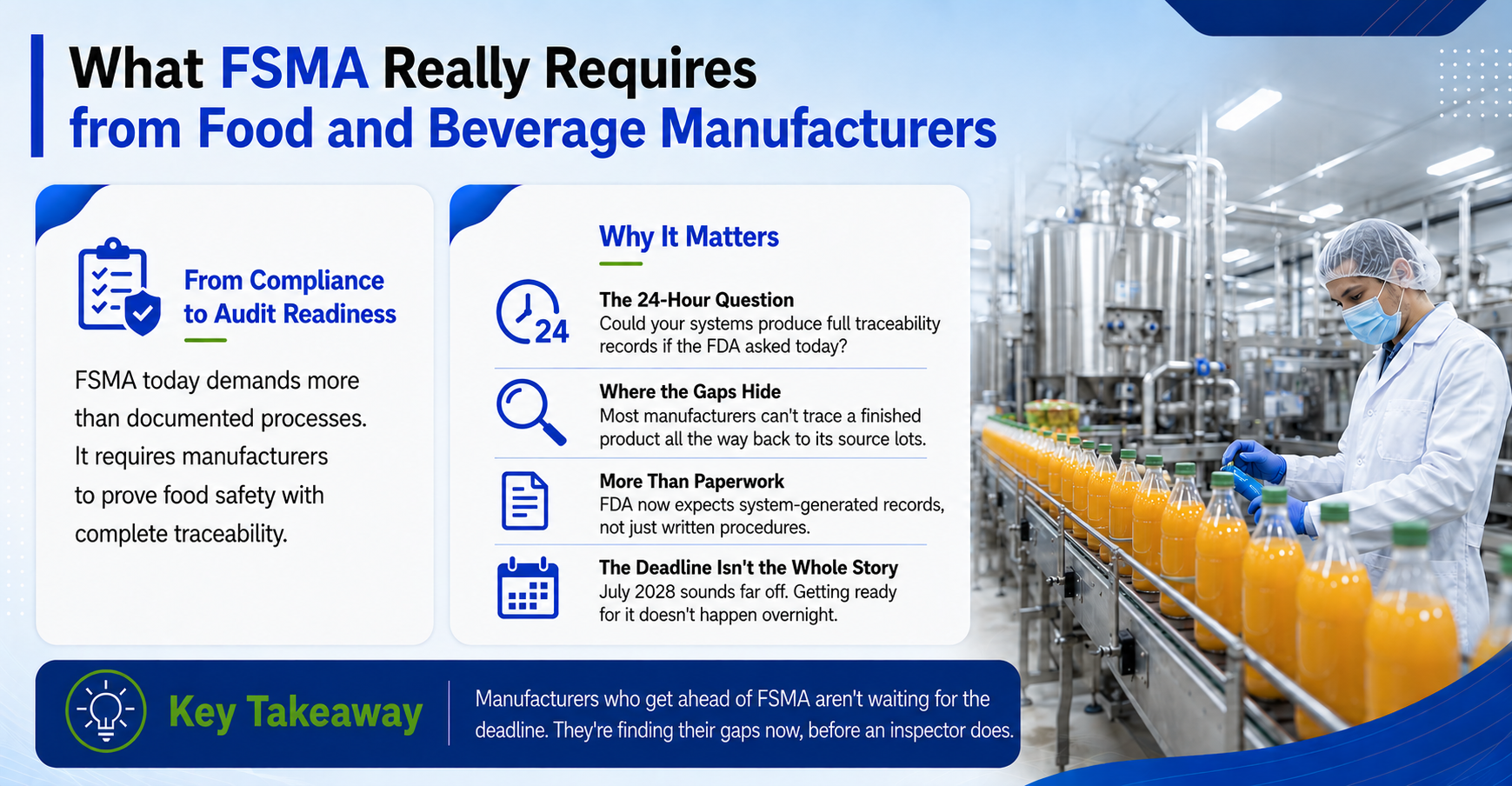
That’s the difference between being compliant on paper and being truly audit-ready. FSMA has shifted beyond maintaining records to proving compliance with complete, system-generated traceability. As FDA expectations continue to evolve, manufacturers are expected to retrieve accurate records quickly, demonstrate end-to-end traceability, and show that food safety controls are consistently followed and not just documented. This shift is especially important as manufacturers prepare for the July 2028 enforcement deadline for FSMA 204’s Food Traceability Rule, while continuing to comply with the preventive controls requirements already in effect under 21 CFR Part 117.
If you’re evaluating whether your current processes are truly audit-ready, we’ll explore these requirements in more detail during our live session on July 22. We’ll break down what FSMA expects from manufacturers, where companies commonly fall short, and what it takes to build compliance into day-to-day operations instead of scrambling when an audit or recall occurs.
What FSMA Actually Covers for Food & Beverage Manufacturers
The Food Safety Modernization Act (FSMA) is the biggest overhaul of U.S food safety law in more than 70 years. While the law covers many areas of food safety, two regulations have the greatest day-to-day impact on most food and beverage manufacturers.
21 CFR Part 117 (Preventive Controls for Human Food) requires a written food safety plan, a hazard analysis, and preventive controls, along with documented monitoring, verification, and corrective actions. It also establishes Current Good Manufacturing Practices (cGMPs), supplier verification requirements, and recall procedures, making food safety an integral part of day-to-day manufacturing operations rather than a separate compliance activity.
FSMA 204, the Food Traceability Rule, is currently one of the most significant areas of focus for manufacturers. It applies to foods on the FDA’s Food Traceability List (FTL), including products such as leafy greens, cheeses, seafood, and other designated high-risk foods. If your operation manufactures, processes, packs, or holds foods on the FTL, FSMA 204 requires you to capture specific data called Key Data Elements (KDE) at Critical Tracking Events (CTEs), such as receiving, transformation, and shipping. Manufacturers must also be able to produce these records in a sortable electronic format within 24 hours of an FDA request. The enforcement deadline is July 2028, giving manufacturers time to prepare but not much time to delay.
How the FSMA Deadline Impacts F&B Manufacturers
The rule matters, but compliance is no longer just about having documented processes. It’s about being able to demonstrate, with system-generated records, that your processes are working when regulators, customers, or retailers ask for proof. FDA enforcement under FSMA is active, and warning letters are public. When one lands, it’s visible to your customers, your retailers, and anyone doing due diligence on your brand. Beyond regulatory action, the reputational impact can affect customer confidence, retailer relationships, and future business opportunities.
Recalls carry even greater consequences. Industry estimates put the cost of a significant food recall at more than $10 million once you account for lost inventory, product retrieval, disposal, litigation, business interruption, and brand recovery. The financial impact is significant, but the long-term cost of losing customer trust or retailer confidence can be even greater. That’s before the deals that quietly slip away because a retailer no longer wants the exposure.
The industry doesn’t need to look far for reminders:
- The 2022 Abbott Nutrition infant formula recall triggered a national supply crisis and became the subject of extensive regulatory and Congressional scrutiny.
- The 2024 Boar’s Head listeria outbreak led to fatalities, a plant closure, and ongoing.
While these incidents had different root causes, they highlighted the same operational reality: when traceability and recall processes are slow or incomplete, the damage compounds rapidly, increasing financial, operational, and reputational risk.
FSMA 204 establishes clear expectations for traceability by requiring manufacturers to capture critical tracking information throughout the supply chain and produce complete records within 24 hours of an FDA request. Organizations with built-in traceability capabilities can respond confidently with system-generated records, while those relying on disconnected spreadsheets, paper logs, or multiple systems often face a time-consuming and resource-intensive effort to assemble the same information.
What FSMA Readiness Actually Involves
Genuine FSMA readiness requires three broad areas, and most teams that feel uneasy about their current state typically have gaps in one or more of these areas.
Knowing what applies to your business
Do the products you manufacture, or the ingredients you source, fall on the FDA’s Food Traceability List? Does your 21 CFR Part 117 food safety plan reflect how your operation runs today, or has it become outdated as your products, processes, or suppliers have evolved? Understanding which regulations apply is the first step toward building an effective compliance strategy.
Capturing complete and accurate records
FSMA 204 requires manufacturers to capture Key Data Elements (KDEs) at Critical Tracking Events (CTEs), creating complete lot genealogy from incoming raw materials through production to finished goods and outbound shipments. Records spread across paper tickets, spreadsheets, and disconnected legacy systems often make it difficult to maintain the completeness, consistency, and traceability the regulation expects.
Producing evidence when it’s needed
Twenty-four hours isn’t long to reconstruct a supply chain story. If responding to an FDA request today requires phone calls, warehouse walks, and someone piecing information together across multiple systems, your organization may not be as audit-ready as it believes. The goal is to retrieve complete, system-generated evidence quickly and confidently.
During our live session on July 22, we’ll discuss each of these areas in detail and demonstrate how BatchMaster ERP helps manufacturers capture traceability data, maintain complete lot genealogy, and retrieve audit-ready records through forward and backward lot traceability.
The Manufacturers Who Get Ahead of This
As the July 2028 FSMA 204 enforcement deadline approaches, manufacturers are taking different paths toward compliance.
Some organizations are confident their existing processes will be enough because they’ve passed audits, avoided recalls, and haven’t faced significant traceability requests. For many, FSMA 204 remains something to address closer to the deadline.
Others are taking a more proactive approach. They are actively mapping their products against the FDA’s Food Traceability List (FTL), testing their systems through mock recalls, identifying compliance gaps before they become business risks, and evaluating whether their current processes and technology can consistently produce the records FSMA requires. Their goal is to be audit-ready well before it arrives. What sets these manufacturers apart is that they’re building compliance into everyday operations rather than treating it as a last-minute project. When an FDA inspection, customer request, or product recall occurs, they can respond with complete, system-generated records instead of assembling information from multiple disconnected sources.
If you’re evaluating your own FSMA readiness, our live webinar on July 22 will help you understand what the regulations require, where manufacturers commonly fall short, and how purpose-built ERP technology can simplify compliance. We’ll also demonstrate how BatchMaster ERP captures traceability data, maintains complete lot genealogy, and generates the audit-ready records needed to support FSMA compliance.