Food and Beverage ERP Software Built for How Food Is Actually Made
Formulas instead of BOMs. Lots instead of part numbers. Shelf life instead of infinite storage. BatchMaster Food and Beverage ERP Software runs formulation, batch production, quality, compliance, traceability, costing and financials on one system built for process manufacturers, not a discrete ERP with food features bolted on.

- Automatically adjust ingredient levels that affect nutritional property values
- Comply with food safety, labeling, traceability and recall regulations
- Manage recalls with complete bi-directional batch and lot traceability
- Minimize waste with inventory control based on shelf life and potency
- Digitally monitor every stage of production and costing
What Is Food and Beverage ERP Software?

Food and beverage ERP software is an enterprise system built around recipes, lots and expiration dates rather than part numbers and assemblies. It covers the same ground as any ERP (purchasing, production, inventory, sales, finance) and adds what Food and Beverage manufacturers are actually held to: formula management, bidirectional lot traceability, allergen and nutritional labeling, shelf-life and FEFO control, quality checks tied to production, and costing that accounts for yield and loss.
The distinction matters because process manufacturing is irreversible. You can disassemble a car and get the original parts back. You cannot disassemble a smoothie. Once ingredients are blended, roasted, fermented or filled, the system has to understand what came out, what it cost, which lots went into it, and where every case of it shipped. Most ERP systems were built for assembling parts, not blending formulas, which is why Food and Beverage manufacturers who buy a general-purpose ERP end up funding a customization project to add the functions that should have been there on day one.
BatchMaster has built only process manufacturing ERP for 40+ years, delivered today as modern cloud software with AI capabilities including natural-language formula generation, an in-product AI assistant, and AI-driven sales forecasting. Food and beverage is our largest industry, spanning bakery and snacks, confectionery, dairy, dressings and sauces, flavors and additives, frozen and packaged food, spices and seasonings, and beverages.
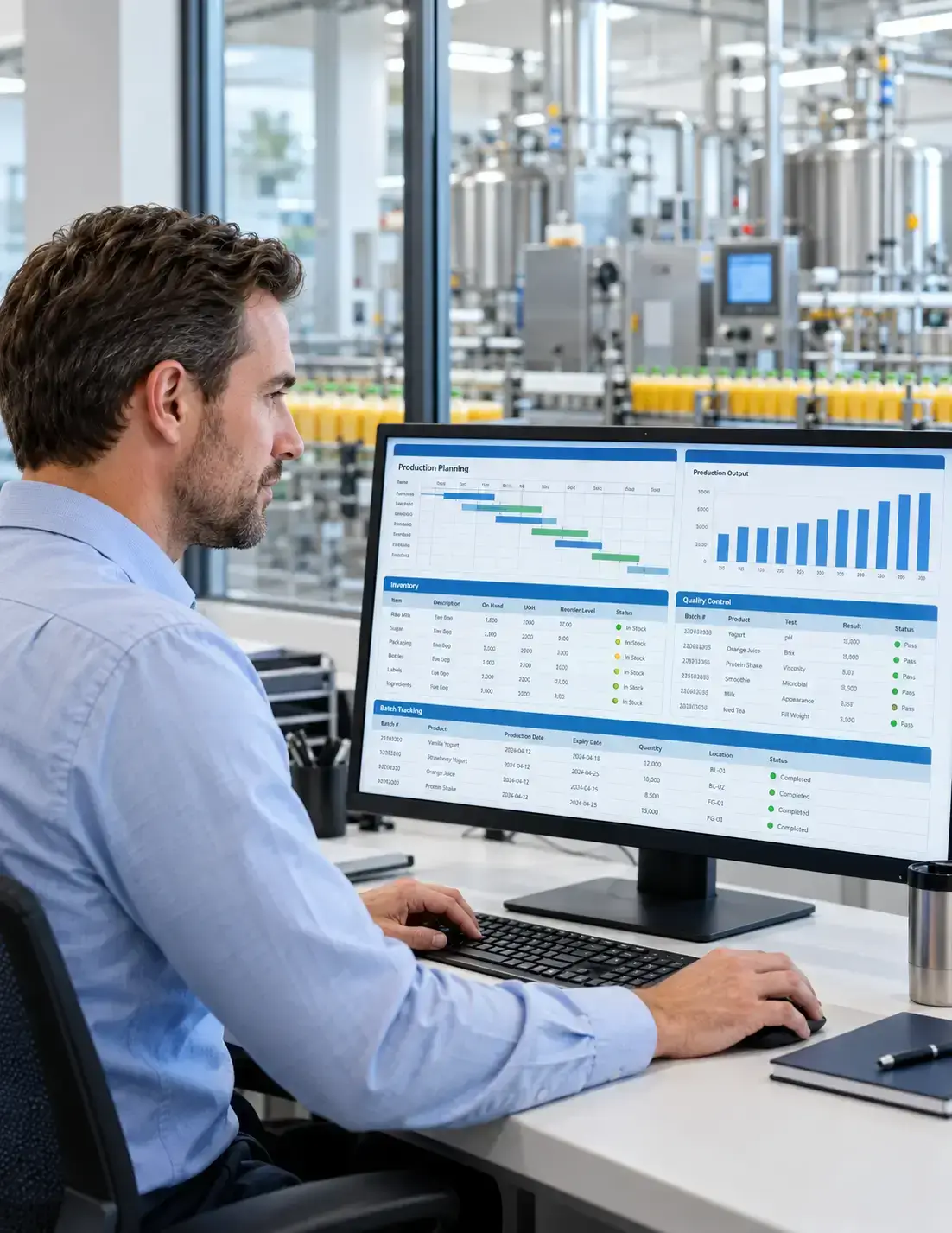
A Formula Is Not a Bill of Materials
The gaps below are the ones food and beverage manufacturers discover after go-live, when the workarounds start.
Generic or discrete ERP
- Fixed BOMs that can't scale by batch size, yield target or available inventory
- No native understanding of density, so weight-to-volume conversions live in spreadsheets
- Loss and shrink handled as a month-end variance, not modeled per line and per batch
- Lot tracking as an inventory field, not full forward-and-backward genealogy
- Allergens, nutritional panels and label claims managed outside the system
- Shelf life and FEFO added through customization or a bolt-on module
- Quality checks in a separate system that can't stop a batch from moving
BatchMaster Food and Beverage ERP
- Formulas with version control, approval workflows and dynamic scaling by weight, volume or yield
- Density understood natively: weight and volume calculated for every formula automatically
- Loss modeled at line level, batch level, and as constant losses from activities like line flushing
- Bidirectional lot genealogy from ingredient receipt to customer shipment
- Allergen tracking, FDA nutritional panels and label claims generated from formula data
- Shelf life, expiry, potency and FEFO built into inventory allocation
- QC tests, checklists and holds embedded in the production workflow itself
Specialized Capabilities for Food & Beverage Operations
Eight areas where food-specific depth decides whether an ERP works on your floor or fights you.
Recipe and formula management
Formulas are managed as living documents, not static parts lists. Each specification carries status, approval history and a complete audit trail, so R&D iterations move into production without re-entry and without losing the record of who changed what. Multiple developers can work on separate recipe and packaging specs in parallel, then run a side-by-side comparison of ingredient, labor, consumable, shipping and miscellaneous costs before anyone commits to a version.
Formulas scale dynamically by batch size, available inventory or target yield. When a formulator sets a nutritional or physical target (sugar, sodium, fat, viscosity, pH), the system flags specifications that exceed it and can adjust the contributing ingredient levels automatically. USDA and Genesis nutritional data feed directly into product development.
- Version control and approvals with full audit history on every specification
- Dynamic scaling by weight, volume, batch size or available inventory
- Automatic density handling: weight-to-volume relationships calculated, not hand-converted
- Target-value alerts for nutritional and physical properties
- Side-by-side spec comparison across ingredient, labor and consumable cost
- Packaging BOMs managed alongside the formula for multi-pack and private-label SKUs
Lot traceability, recall readiness and FSMA
Every receipt, transfer, production step and shipment is written against a lot. That makes a trace a query rather than a project: forward from a suspect ingredient lot to every batch, finished SKU and customer it reached, or backward from a finished case to every input, supplier and receiving date behind it. Real recalls and mock recalls run the same logic, which is what auditors look for. And the recall workflow runs on a phone: when a hold comes down, the person walking the racks can identify affected lots, see where they went and act on them from a handheld, instead of relaying lot numbers back to whoever is sitting at a desk running the trace.
The lot record carries the attributes food manufacturers are asked to produce under FDA, FSMA, HACCP and GFSI schemes including SQF and BRC (lot codes, quantities, dates, locations and reference documents), captured as part of normal transactions rather than assembled after the fact. Bar Bakers responds to bidirectional traceability requests in under 15 minutes, including exactly where finished goods were used and shipped.
- Bidirectional genealogy across the full supply chain
- Mock recall workflow that runs the same path as a real recall
- Graphical traceability reporting built to exceed BRC and SQF recall codes
- Mobile recall execution — run the recall workflow from a phone or handheld on the floor, where the product actually is
- Lot attributes including supplier, origin, certification status, expiry and potency
- Automatic lot assignment at receiving and production
- Audit-ready documentation: batch records, QC results, COAs and lot history
Allergen control, nutritional labeling and claims
Allergen data belongs in the system that makes the product, not in a spreadsheet next to it. Physical properties and allergens (nuts, dairy, soy, wheat and the rest) are tracked from raw material through intermediates to finished goods, so the label reflects what actually went into the batch. That supports label compliance with regulations including the Food Allergen Labeling and Consumer Protection Act.
Nutritional panels are generated from formula composition rather than typed in: serving sizes, calorie content and daily values update when the formula changes. Formulas can be adjusted dynamically to hold a label claim, which matters when an ingredient substitution would otherwise quietly break a "no added sugar" or clean-label statement.
- Allergen tracking inherited from raw material through WIP to finished goods
- FDA nutritional and ingredient labels generated from formula data
- Label claim protection: recipes adjusted dynamically to hold the claim
- Certification status tracked at lot level for organic, kosher, halal and non-GMO
- Multi-pack and private-label label configurations from a single formula
Quality control and food safety
Quality is embedded directly in the production workflow. QC and QA inspection libraries, checklists and special instructions are defined once, then enforced at the points that matter: incoming material, in-process and finished goods. Tests are specific (moisture content, pH, weight, visual and physical checks), with results recorded against the lot and travelling with it downstream.
Digital checklists can mandate critical readings and environmental conditions before production is allowed to start. Substandard inventory is auto-dispositioned, deviations and non-conformances are managed with an audit trail, and certificates of analysis are generated per lot. Tea Aroma uses the quality module to track third-party lab results for every import and export: "If there's a problem, we can trace it immediately. There's no guessing."
- QC/QA libraries for inspections, checklists and special instructions
- Enforced checkpoints at receiving, in-process and pre-shipment with hold and release
- Automatic disposition of substandard inventory
- Deviation and non-conformance management with full history
- Customized COA reports generated per lot
- Quality connected to cost: holds, rejections and rework land in batch cost, not just in the QA file
Shelf life, FEFO and variable-weight inventory
Perishability changes how inventory has to behave. Ingredients and finished goods are tracked by expiration date, age, status and location, and batch jobs allocate material by expiry and rotation method rather than by whatever the warehouse picks first. FEFO, FIFO and LIFO issue methods are all supported, so short-dated material gets used, reworked or discounted before it becomes a write-off.
Variable-weight products are handled with simultaneous dual units of measure, so a case can be received, produced, picked and costed while the actual weight travels with it. Inventory can also be selected by certification status and potency, not just quantity: the difference between an ERP that knows your product and one that knows your part numbers.
- Expiry, aging and status tracked at lot level across warehouses
- FEFO, FIFO and LIFO allocation applied automatically to batch jobs
- Dual units of measure for catch-weight and variable-weight items
- Selection by certification and potency, not quantity alone
- Reservation of inventory for customer orders and scheduled batch jobs
Batch production, yield and loss
To protect margin you need to know exactly how much raw material it takes to hit a target yield. BatchMaster models loss at the line level, at the batch level, and as constant losses from activities like line flushing, so whether you are producing a hundred gallons or ten thousand, material lost to evaporation, cleaning and changeover is factored into the plan and the cost.
Batch jobs can be sized to available raw material, linked and scheduled together, and revised mid-stream when a substitution is required. Co-products, by-products, rework and private-label runs are handled natively. On the floor, master batch records and electronic batch records replace paper: SOPs, batch weights, scale readings and operator activity are captured directly, with tasks executed on mobile devices and inventory backflushed automatically.
- Loss and yield modeling at line level, batch level and constant losses
- MBR and EBR with automated documentation for faster approvals and audits
- Shop-floor execution with weigh sheets, scale integration and real-time logging
- Co-products, by-products and rework tracked with their own lots and costs
- Flexible batch sizing against available inventory, with substitution support
- Mobile warehousing for receiving, putaway, WIP moves and pick/pack/ship
Planning, scheduling and demand forecasting
Food demand is seasonal, promotional and perishable all at once. MPS and MRP plan against sales forecasts, seasonal parameters, vendor delivery performance and planned production, then generate synchronized batch jobs and purchase orders. Demand can be consolidated across products to earn volume pricing on shared ingredients, and planning horizons and calendars are set to match how your plant actually runs.
AI-driven sales forecasting applies statistical models (exponential smoothing, Holt-Winters, moving average) to historical sales and feeds the result into planning, so seasonal peaks and demand swings are anticipated rather than absorbed. Ask BME, the in-product AI assistant, answers how-do-I questions without a support ticket, which matters most in the first ninety days when new plant and office staff are still learning the system. Formulators can generate a first-pass formula from a plain-language description.
- MPS and MRP tuned to seasonality, shelf life and raw material availability
- AI-driven sales forecasting using exponential smoothing, Holt-Winters and moving average
- Natural-language formula generation with labeling and manufacturing instructions
- Demand consolidation for discount bulk purchasing across product lines
- Linked batch scheduling with equipment, resource and capacity constraints
Costing, margin and financials
Ingredient prices move weekly and food margins are thin, so costing has to be granular and current. Costs are tracked at formula, batch and product level, with fixed, tiered and variable labor costs defined inside the specification and consumables costed explicitly. Estimated finished-goods cost uses the item's inventory valuation method, so current and average cost movements show up where they matter.
What-if analysis lets you test an ingredient substitution or a price increase before it reaches the P&L. Tea Aroma's accounting lead put it directly: "In food production, every ounce of weight loss during roasting affects the final product's cost. Now, we can track it all down to the smallest detail."
- Costing at formula, batch and SKU level with expected-versus-actual analysis
- Cost explosion across every production step, including loss and yield
- What-if cost analysis for substitutions, price moves and target-cost formulation
- Labor and consumable costs defined within the specification
- Role-based dashboards and ad-hoc reporting on real-time data
Beverage Production Is Formula Work With a Packaging Problem Attached
Beverage manufacturers blend by formula, sell by volume, buy ingredients by weight, and run a packaging line that is a second scheduling problem with its own bottles, caps, labels and cartons. Generic ERP handles neither half well.
BatchMaster understands the relationship between weight and volume natively, so recipes scale across tank sizes and fill volumes without manual conversion. Quality parameters such as pH and moisture content are defined as tests against the batch. Packaging BOMs plan containers and components alongside the liquid. And because loss is modeled per line and per batch, material lost to line flushing between flavor runs is in the cost, not in the variance.



FSMA-Ready Software, FSMA-Literate Implementation, Validation Services When You Need Them
Compliance breaks in three places: the software, the implementation, and the validation. Most vendors sell you the first, subcontract the second, and leave you to source the third.
FSMA ready out of the box
Every receipt, production step, transfer and shipment is recorded against a lot, carrying the data the FDA Food Traceability Rule asks for, traceability lot codes, quantities, dates, locations and reference documents as a by-product of normal transactions rather than a separate reporting exercise.
- Bidirectional trace and mock recall on demand, so you rehearse the trace on a normal Tuesday instead of discovering the gaps during an audit
- Quality checkpoints that map to HACCP critical control points and hold a batch until they pass
- A recall workflow that runs on mobile devices, so the trace and the hold happen where the product is
- Electronic, time-stamped audit trail behind formulas, batch records, QC results and dispositions
Configured by people who know food
A compliant system is a configuration decision long before it is a software feature. BatchMaster implements, supports and trains entirely in-house, so the people making those decisions have made them for food and beverage plants before, not for whatever industry the partner worked in last.
- Consultants who have configured bakeries, dairies, flavor houses, seasoning blenders and beverage producers before yours
- Process and compliance best practices built into the configuration, what an SQF or BRC auditor will ask for, and where the records need to live
- The same team from discovery through go-live and every release after
- Hands-on training for production, quality and office users, delivered in-house
FDA and FSMA validation services
Manufacturers under FDA oversight are often required to validate the software itself, not simply use it. BatchMaster delivers GMP Validation as a Service, so validation is not a separate project you have to scope, source and manage alongside the implementation.
- Validation protocols, execution and the documented evidence package auditors expect
- Delivered by the same organization that built and implemented the system
- Available across food, beverage, nutraceutical and life sciences operations
- Electronic signatures and approvals aligned with 21 CFR Part 11
That industry knowledge shows up in configuration decisions, not just in the sales conversation. How allergen segregation should be enforced on a shared line. Which quality checkpoints an auditor will want evidence for. Where FSMA traceability records have to sit so they can be produced on request rather than reconstructed. Those are process and compliance judgments before they are software settings, and they are the difference between an ERP that passes an audit and one that creates work during it.
Driving Success Across All Food & Beverage Segments
Each segment brings its own formulation, compliance and scheduling realities. These are the ones BatchMaster supports out of the box.

Dairy
Raw milk variability, co-products and by-products from a single run, aggressive shelf-life windows and FEFO discipline across cold storage.
Learn More →
Dressings and Sauces
Emulsions and viscosity targets, acidification and pH control, flavor-run changeovers and private-label runs under multiple brand specs.
Learn More →
Flavors and Additives
Concentrated formulas where small deviations carry, potency-based inventory, heavy compliance documentation and customer-specific specs.

Frozen and Packaged Food
Multi-component assembly from produced intermediates, cold-chain lot integrity, USDA and SQF requirements, and export documentation.

Bakery and Snacks
Multi-stage doughs and pre-ferments, daily runs against standing orders, oven and line scheduling, and shelf life measured in days rather than months.
Learn More →
Beverages
Blending and filling, weight-to-volume conversion, packaging BOMs, changeover loss and seasonal demand across pack sizes.
Learn More →
Confectionery and Chocolate
Tempering and cooking steps with tight process parameters, seasonal demand spikes, allergen segregation and ingredient price volatility.

Spices and Seasoning
Natural ingredient variability, blend consistency across lots, country-of-origin tracking and shelf-life-driven potency management.
Learn More →Three Ways to Run BatchMaster. Start Where You Are.
The manufacturing capability is the same in all three. What changes is how much of your business runs inside BatchMaster, and that depends on whether your financial system is staying, going, or growing into something bigger.
BatchMaster Manufacturing add-on
Your accounting team is not changing systems, and shouldn't have to. Keep QuickBooks and add real process manufacturing alongside the financials you already run.
- Integrates with QuickBooks Online and Desktop, Sage 100/300, Dynamics 365 Business Central
- Full formulation, traceability, quality, inventory and warehousing
- Fastest path to compliance and traceability without a finance project
BatchMaster ERP
One system for manufacturing and financials. BatchMaster ERP covers process manufacturing plus accounting, sales, purchasing, distribution and CRM in a single cloud platform.
- From formula to financials in one system, no integration to maintain
- Common replacement for Sage 50, Sage 100 and spreadsheet-plus-QuickBooks setups
- AI assistant, natural-language formulas and AI forecasting included
BatchMaster ERP with SAP Business One
For multi-site, multi-entity or international operations that need enterprise financial control alongside process manufacturing depth.
- Natively embedded in SAP Business One using SAP's own development framework
- Multi-currency, intercompany consolidation and branch accounting
- Enterprise reporting that only exists when operations and financials share one system
Hear It From Food & Beverage Manufacturers Who Run BatchMaster
Bidirectional lot trace response
Bar BakersSaved every month in data entry
Michou DeliAutomated lot tracking end to end
Breeder's ChoiceCustomer inquiry response, down from 1–2 days
Tea AromaThe ability to integrate BatchMaster with QuickBooks was essential for us. We didn't want to lose familiarity with QuickBooks, but we needed the advanced manufacturing capabilities. BatchMaster gave us the best of both worlds.
We can respond to bidirectional lot traceability requirements in under 15 minutes, including exactly where finished goods were used and shipped.
BatchMaster allows us to plan and produce and track full traceability through all nine steps. Our quality assurance depends on BatchMaster to maintain complete control of manufacturing.
I would spend hours online just going through every system out there, and everything kept going back to BatchMaster.
Customer Story
Seamless Integration With Leading Financial Systems
Switch to BatchMaster without replacing your current financial system. Integrates with QuickBooks, SAP Business One, Microsoft Dynamics 365 Business Central, Microsoft Dynamics GP and Sage 100 & 300, so you can scale operations while keeping your trusted accounting platform. Available in the cloud and on-premise.





What Sets BatchMaster Apart for Food & Beverage Manufacturers


Purpose-built for food & beverage

Formula-centric
by design

Compliance, end to end

40+ years of focus. Cloud and AI today.
Experience the ERP Built for Food & Beverage Manufacturing
A working demo on your products, your compliance requirements and your segment, not a slide deck. Buyers don’t want to buy ERP twice.
Food & Beverage Manufacturing ERP Resources
BatchMaster Food & Beverage ERP: FAQs