📚 New Blog Posts
1. Inside a BatchMaster Implementation: 5 Lessons Learned
2. FSMA Compliance for Food & Beverage Manufacturers: Requirements, Risks and What to Do Now
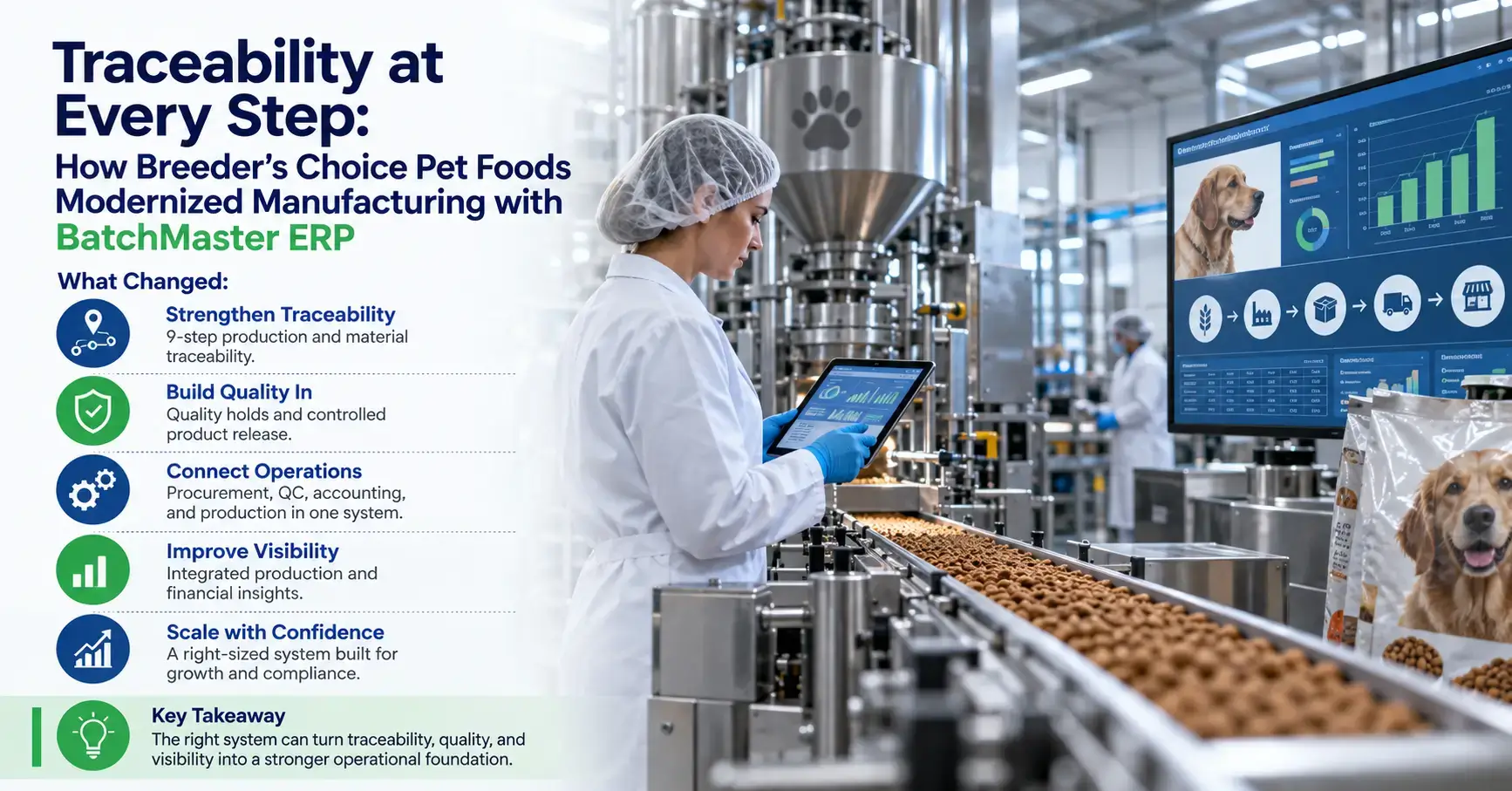
3. Scaling for Growth: How Next Drinks Built a Foundation for Expansion with BatchMaster ERP
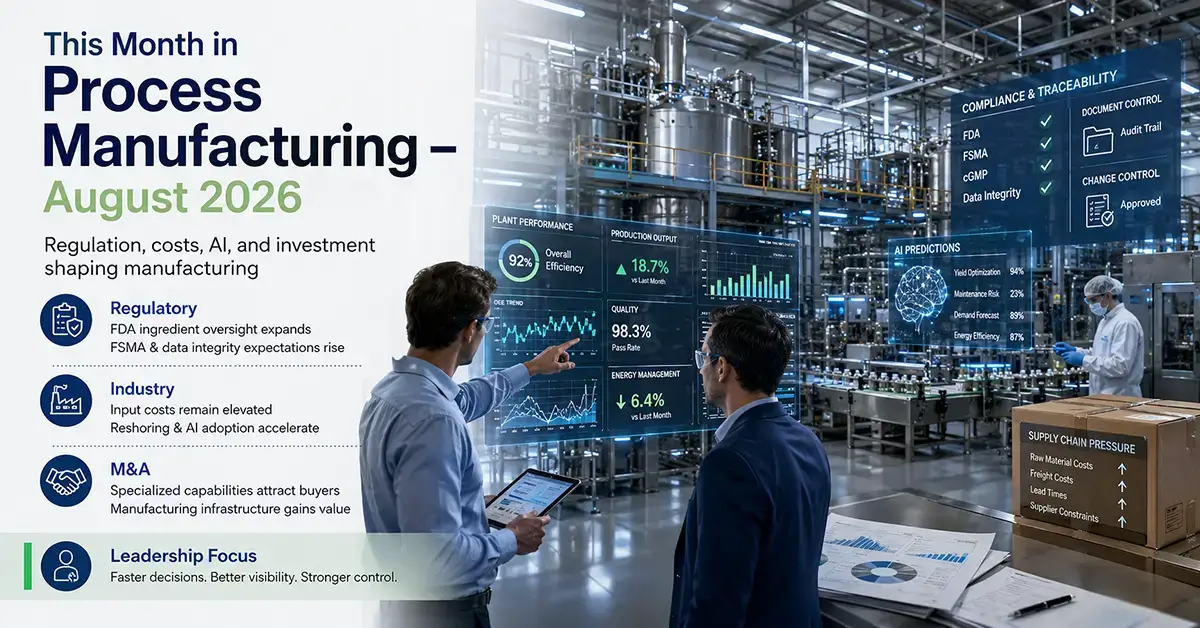
Regulatory shifts, supply chain pressure, AI adoption, and investment activity shaping mid-market process manufacturers
The Brief
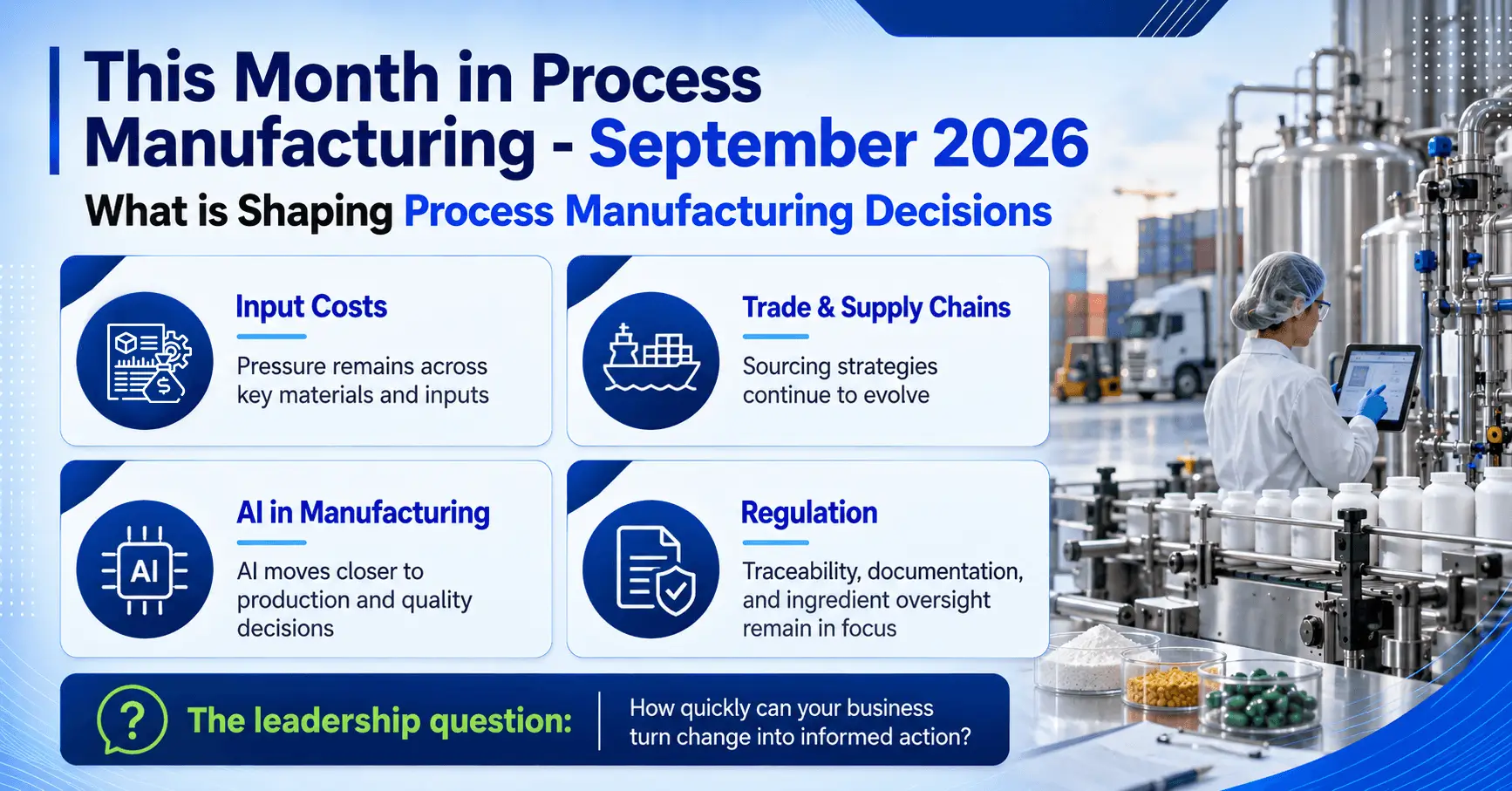
August reinforced a more demanding operating environment for process manufacturers. Manufacturing activity strengthened, but input prices remained elevated, trade policies continued shifting, and regulatory oversight expanded.
For food, beverage, nutraceutical, pharmaceutical, chemical, personal care, paints and coatings, and specialty ingredient manufacturers, the leadership challenge is increasingly about making faster decisions while maintaining control over cost, compliance, sourcing, and production.
Compliance & Regulatory Watch
MAHA & FDA: Ingredient Oversight Is Moving Toward Formalized Control
The FDA moved another step forward in August with a proposed rule to strengthen oversight of substances claimed to be Generally Recognized as Safe, or GRAS. The proposal is intended to increase transparency around GRAS determinations and would change how companies support these claims.
This follows the FDA’s broader systematic approach to post-market chemical assessments.
The agency also continued its review of food chemicals, with BHT remaining a specific focus. In July, FDA reopened the BHT comment period, extending the deadline to August 31, 2026.
What this means for manufacturers
Ingredient oversight is becoming a recurring operational requirement rather than a one-time regulatory exercise.
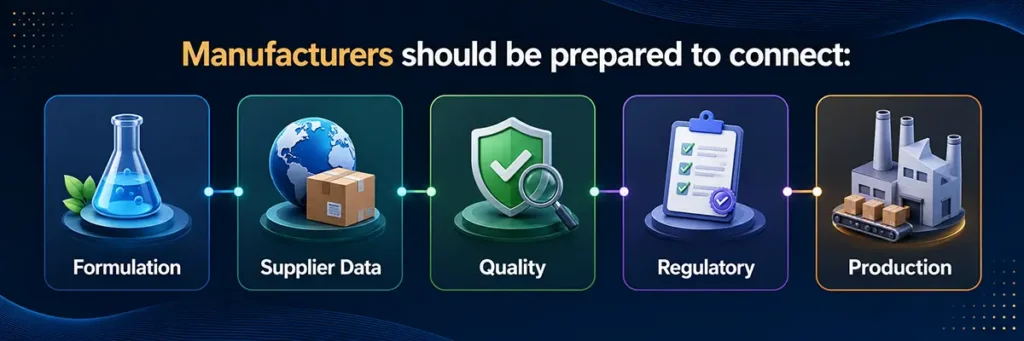
The ability to identify affected SKUs, evaluate alternative ingredients, validate suppliers, and update documentation quickly will become increasingly important.
Compliance Watch: FDA Focus Extends Beyond Records
The FDA finalized guidance in August for ready-to-eat fresh-cut produce operations under the FSMA Preventive Controls for Human Food rule, reinforcing expectations around hazard prevention and implementation.
The agency also continued strengthening import enforcement. August updates included detention without physical examination for products involving undeclared colors; foreign establishments refusing FDA inspection, FSVP noncompliance, pesticides, and other food safety issues.
For process manufacturers, the broader message is important:
Compliance increasingly depends on what manufacturers can demonstrate about their processes, suppliers, records, and controls, not simply whether documentation exists.
For pharmaceutical and other regulated manufacturers, the same principle applies to electronic records, validation, audit trails, and data integrity.
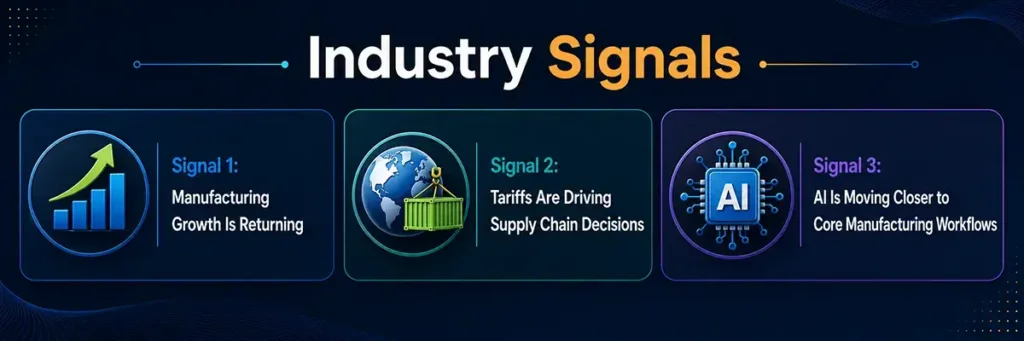
Signal 1: Manufacturing Growth Is Returning, but Cost Pressure Has Not Disappeared
The latest ISM Manufacturing PMI showed U.S. manufacturing activity reaching 55.6 in July, its highest level since May 2022. New orders, production, employment, backlogs, and exports are all strengthened.
But the improvement came with continued cost pressure.
The ISM Prices Index remained elevated at 71.1, with manufacturers reporting increases across steel, aluminum, petroleum-based products, resins, plastics, fuel, freight, and other inputs. Chemical and food, beverage and tobacco manufacturers were among industries reporting higher raw-material prices.
Manufacturing implication
Growth is improving, but margin management remains difficult.
For leadership teams, the question is shifting from:
Are we growing?
to:
Are we growing profitably as input economics continues changing?
Signal 2: Tariffs Are Driving Supply Chain Decisions, Not Just Pricing Decisions
Trade policy remained a major operating variable in August.
KPMG’s latest tariff research found that 26% of organizations were already planning or actively executing reshoring, up from 10% six months earlier. However, 60% said fully reshoring operations would take one to three years.
The pressure became more visible in August as the U.S. and Canada moved into another round of tariff escalation, affecting deeply integrated North American supply chains.
Manufacturing implication
Reshoring is not simply a procurement decision.
It affects:
- Supplier qualification
- Production economics
- Inventory strategy
- Capacity planning
- Working capital
- Customer pricing
For process manufacturers, changing sourcing without understanding its impact on formulation costs and production economics can simply move risk from one part of the business to another.
Leadership question:
Do we know the operational and margin impact of moving a critical input to a different supplier or region?
Signal 3: AI Is Moving Closer to Core Manufacturing Workflows
AI adoption is moving beyond isolated experimentation, but infrastructure and organizational readiness remain important constraints.
A recent manufacturing connectivity study found that 33% of manufacturing leaders were prioritizing AI investment, while only 17% ranked network architecture as a top investment priority.
At the same time, NTT DATA’s 2026 manufacturing research found that leading AI adopters are embedding AI directly into production, planning, and enterprise workflows rather than treating it as a standalone technology project.
Manufacturing implication
AI is becoming less about adding another tool and more about improving how decisions are made.
For process manufacturers, the opportunity is increasingly tied to:
Planning → Production → Quality → Inventory → Cost → Decision
The organizations most likely to capture value will be those with the data foundation and workflows required to act on AI-generated insights.
Leadership question:
Is our operational data structured well enough for AI to improve decisions, or are we simply adding intelligence on top of fragmented information?
M&A Intelligence
$13.4M Facility Acquisition: SANY Nutrition Group Acquired Former Butterball Facility
SANY Nutrition Group acquired the former Butterball facility in Jonesboro, Arkansas for $13.4 million and announced plans to invest more than $30 million in the site. The protein snack manufacturer expects to create more than 150 jobs and has already begun operations.
Signal: Existing manufacturing infrastructure is becoming a strategic advantage for fast-growing food and nutraceutical-adjacent businesses. Reusing established facilities can accelerate capacity expansion while reducing the time and capital required to build from scratch.
Strategic Acquisition: MFG Chemical Acquired AP Tech
MFG Chemical acquired AP Tech, a manufacturer of solid chemistry solutions for industrial water treatment. Financial terms were not disclosed.
The acquisition adds proprietary solid chemistry capabilities to MFG’s existing liquid water-treatment portfolio and follows its earlier acquisitions of Radical Polymers and Masters Chemical.
Signal: Specialty chemical buyers continue using M&A to build technical breadth and proprietary formulation capabilities rather than simply adding production volume.
Strategic Acquisition: Griffith Foods Acquired Plant-Tec Factory
U.S. based ingredients manufacturer Griffith Foods agreed to acquire the Plant-Tec factory in Poland from LipCo Foods Group. The facility adds regional manufacturing capacity for dry seasonings and coatings and expands Griffith’s Eastern European footprint.
Signal: Strategic buyers continue using manufacturing acquisitions to add regional capacity, flexibility, and proximity to customers.
Valuation Signal
August’s transactions reinforced a pattern emerging across process manufacturing.
Buyers continue to place greater strategic value on specialized capabilities, proprietary formulations, established manufacturing infrastructure, and technical expertise.
Capacity remains important.
But capacity that is difficult to replicate, supported by strong quality systems and specialized know-how, is becoming more valuable.
The distinction is increasingly between:
Capacity that can be purchased
and
Capability that takes years to build.
Final Takeaway
August showed that process manufacturers are operating in an environment where growth, regulation, sourcing, technology, and investment decisions are increasingly interconnected.
The strongest operators will not simply react faster to individual changes. They will have the visibility to understand how one change affects the rest of the business.
For leadership teams, that means strengthening the connection between cost, formulation, sourcing, production, quality, and financial performance.
Operational control is becoming more than an efficiency objective.
It is becoming the foundation for faster decisions, stronger margins, and long-term enterprise value.
Resources & Sources
MAHA & FDA
- FDA Human Foods Program Constituent Updates
- FDA Proposed GRAS Rule
- FDA Chemicals Under Review
- FDA Food Chemical Safety Post-Market Assessment Program
Compliance & Regulatory
- FDA FSMA
- FDA FSMA Traceability Rule
- FDA Part 11 Guidance
- FDA Import Alerts
Industry Signals
- ISM July 2026 Manufacturing PMI
- Reuters: U.S. Manufacturing Activity and Input Prices
- KPMG 2026 Tariff Survey
- NTT DATA 2026 Global AI Report: Manufacturing
- Manufacturing Institute: Frontline Leadership in Manufacturing AI Adoption
M&A
- SANY Nutrition Group / Arkansas Economic Development Commission
- MFG Chemical / AP Tech Acquisition
- Griffith Foods / Plant-Tec Acquisition Coverage
Market Context
- Reuters Manufacturing & Supply Chain Coverage
- Manufacturing Dive
- Food Processing M&A Coverage