We Weren’t Implementing Software. We Were Defining How We Operate.
What a specialty chemical manufacturer learned putting in its first ERP.


Most implementation stories get told after the scar tissue fades — once the numbers look good and everyone’s forgotten how it actually felt. We wanted the other version.
Brilliant Group, a specialty fluorescent pigment manufacturer in Richmond, California, went live on BatchMaster ERP about three months ago. What makes their story worth telling isn’t that it went well — it’s that this was the company’s first integrated ERP system. Seventeen years of formulas, costing, and hard-won institutional knowledge had lived in their accounting software, spreadsheets, and people’s heads. There was no one system to rip out and replace. They were building it from longstanding internal processes and disconnected systems.
So we asked Julia Folk, Brilliant Group’s General Manager and the person who led the project, for an honest look under the hood — the parts of a first ERP implementation nobody puts in the brochure. Her opening answer reframed the whole thing.
Customer Conversation
A conversation with Julia Folk, General Manager, Brilliant Group and Sudi Gummi, Chief Marketing Officer, BatchMaster Software.


An ERP project isn’t a software project
Ask most people what implementing an ERP involves and they’ll describe installing something. Julia describes something else.
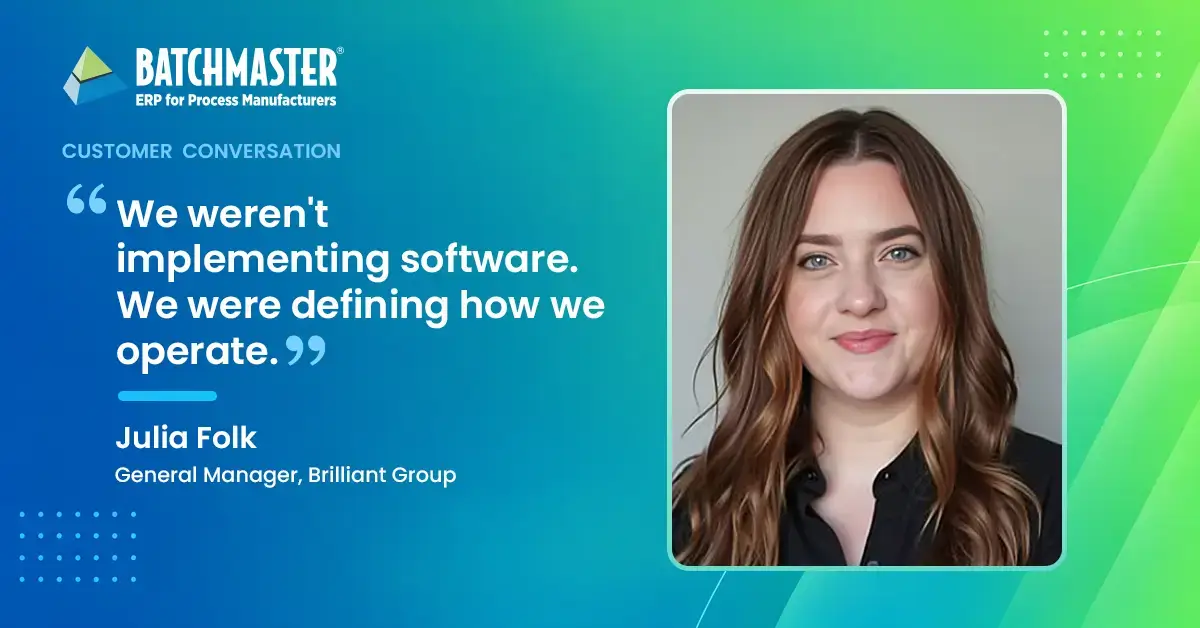
“We weren’t just implementing software. We were defining how our future operations are going to actually work.”
For a first-timer, that distinction is everything. A company switching from one ERP to another has decisions already baked in — naming conventions, workflows, who owns what data. For the Brilliant Group, many of those definitions and decisions had never needed to be formally codified in a single system. Every one of those choices was live. The early discovery calls, she said, kept pushing the team on the unglamorous questions: how does work actually get from A to B, and “how master data is owned — who owns that information, is it clean, is it consistent?”
The upside of a blank slate was that nothing was inherited by default. “Nothing was set in stone,” Julia said. “We could say, this is how we do it now — but is that really the best choice for us?” She called it a healthy exercise: “That’s always good for a company to have that moment.”
Making those calls without an ERP to lean on took a mix of what they knew and what they were willing to test. “We had the bones,” she said — item categories, classifications, the structure of the business. What they didn’t have yet was a system that removed the guesswork. In the old world, “we have a process, and then we have the intuition of the process” — people who could read a spreadsheet and know what it really meant. The whole point of the new system was to need less of that. “As long as our data is strong, the results should be strong.” So they ran scenarios with the implementation team — if we set it up this way, here’s what that means downstream; which one do we feel good about? — and, in Julia’s words, started “asking questions of our data that we hadn’t deep-dived in a while.”
The hardest part wasn’t the data. It was the discomfort.
Going in, Julia expected the data migration to be the mountain. It wasn’t — the implementation built it up in pieces rather than dropping it all at once, and their one real hiccup was a delay in moving from desktop to online QuickBooks, but the team worked around it. The genuinely hard part came from somewhere less technical.
“Our company had been doing similar day-to-day activities for about fifteen years,” she said. “Every single day you log in, you see the same screen, you push the same buttons, you get the same result — and then all of that changes. That’s a really hard thing to do.” The old habits were second nature; the new ones weren’t, yet.
She’s candid about the low point. About a month after go-live: “I just wished it was July. I knew it would be fine — but that day, it felt really hard.”
We spoke to her in July. “Our day-to-day now, we don’t even think about it,” she said. “That pit of anxiety — do I know how to do this next thing — it’s gone.”
What carried them across wasn’t a clever trick. It was patience, plus a kind of permission. Her phrase for it stuck with us: “Sitting in our discomfort was pretty big — and that’s okay.” She stopped treating every rough day as a problem to solve on the spot. “It’s okay to have a hard day with a new system. We’re not meant to be perfect right away.” Sometimes, she said, leading the team meant simply letting people learn — herself included, since she was learning it at the same time.
And the discomfort turned out to be the payoff. Because the whole team went through it, Julia says they now bring sharper questions to the table. “My team gives better suggestions and deeper insights into how we handle our data. We’re identifying things we could do differently operationally — and we wouldn’t be able to do that if they hadn’t gone through the hard part.”
What she’d do differently
Ask Julia what she’d change, and she doesn’t reach for a feature. She reaches for something that happens before you ever pick a vendor.
“We would really think about business process mapping,” she said, “maybe even before the selection process.” Because Brilliant Group had never run an ERP, some discovery questions caught the team flat — and decisions got made in the moment that, with more time to think, they might have made differently. It’s the rare piece of implementation advice that’s actually about the pre-implementation.
The preparation that did pay off was blunt about cost. They’d told themselves upfront it would take “about 40% of my time, and 20 to 30% of the team’s” — and it did, in two- and three-hour working sessions. They also turned the implementation into documentation as they went, practicing each step and writing their own SOPs, so that a month or two after go-live Julia was training the rest of the team from notes that already existed. For a company whose entire reason for buying an ERP was to get institutional knowledge out of individual heads, that was the goal showing up early.
Go-live isn’t the finish line
Three months in, Julia is careful not to oversell. It’s too early for clean before-and-after percentages, and she’d rather be honest than impressive — “stay posted,” she says on the hard numbers. What she’ll claim now is much better visibility into costing, inventory, and operating data, and continuing to build out the planning and costing capabilities. They’re moving into MPS and MRP for production and material planning and into the costing capabilities they laid the groundwork for. “We’re living in the system,” she said. “We’re not in two systems. We’re not doing double work.”
She’s also quick to credit the support — responsive to the point that “it blows my mind every time,” and rare enough now that the system “feels like a part of us.” The implementation team, she said, “felt like they were on our team. It didn’t feel disconnected from our day-to-day.”
But the line every manufacturer weighing a first ERP should hear is her closing one:
“Go-live isn’t the finish line. You go live, and then the real work for your team begins. So allow space for that part after go-live.”
What to carry forward
- Treat it as a business project, not a software one. You’re deciding how you’ll operate, not just what you’ll install.
- Map your processes before you shortlist vendors. It’s the step Julia would add.
- Treat it as a business project, not a software one. — plan for something like 40%, and protect it.
- Plan for the discomfort, and let the team sit in it. A hard month is normal, not a warning sign.
- Build your SOPs during implementation, so training the rest of the team is a copy-paste, not a project.
- Treat go-live as the starting line. The visibility and the wins show up in the months after.
Brilliant Group is exactly the kind of chemical manufacturer we built for — formula-driven, multi-site, growing, and ready to move beyond disconnected systems and spreadsheets. If you’re somewhere near where they were a year ago, the honest version above is worth more than any highlight reel — and a truer guide to why ERP projects succeed or fail than most.