The Brief
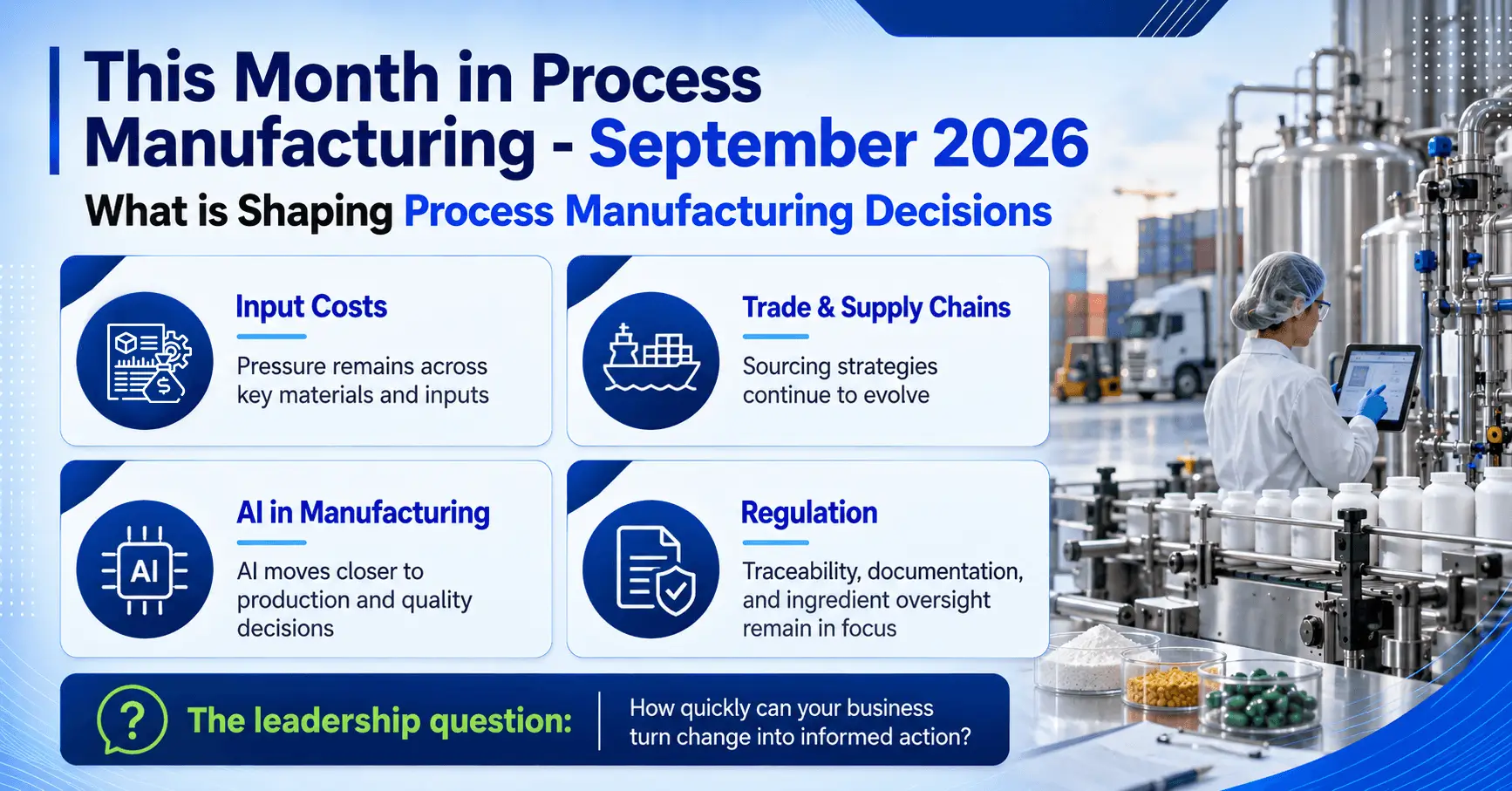
September highlights a broader shift in process manufacturing: the ability to adapt quickly is becoming increasingly important to maintaining operational and financial control. Changing costs, evolving trade conditions, advancing technology, and regulatory expectations are creating more interconnected decisions across sourcing, production, quality, compliance, and customer demand.
For mid-market manufacturers, this makes visibility and decision-making increasingly important. Leadership teams need to understand how changes in one area can affect the wider business and respond without compromising margins, quality, or compliance. As these pressures continue to evolve, operational agility is becoming an increasingly important part of long-term manufacturing competitiveness.
Compliance & Regulatory Watch
FDA Continues Expanding Food Chemical Oversight
The FDA’s Human Foods Program has made food chemical safety a major 2026 priority. Its agenda includes stronger oversight of GRAS substances, post-market assessments of food chemicals, continued work on contaminants such as PFAS, and the review of ingredients including BHA and BHT.
In August, the FDA also proposed a rule that would strengthen oversight of substances claimed to be GRAS and increase transparency around those uses.
For food, beverage, nutraceutical, and ingredient manufacturers, this creates a more dynamic formulation environment. Ingredient decisions increasingly need to be supported by accessible documentation, supplier information, specifications, and a clear understanding of where each ingredient is used.
Leadership focus: Treat formulation and ingredient data as an operational asset. When regulatory expectations change, the ability to quickly identify affected formulas, suppliers, products, and documentation can reduce the time and cost of responding.
2026 FDA Food Code Brings New Food Safety Updates
On September 17, the FDA released the 2026 Food Code, updating provisions covering areas including allergen cross-contact, food establishment operations, employee illness policies, inspection reporting, specialty mushrooms, dehydration and freeze-drying, and other food safety practices. The Food Code is a model used by state, local, tribal, and territorial regulators rather than a federal regulation imposed directly on every food manufacturer.
For manufacturers serving retail and foodservice channels, the development reinforces a broader direction in food safety: documentation, preventive controls, and consistent execution remain central to maintaining product safety and customer confidence.
Leadership focus: Review whether quality and food safety information can move consistently from incoming materials through production and finished-goods release, especially when customers or regulators request supporting records.
FSMA Traceability Remains a Readiness Issue
The FDA continues to work with the industry on implementation of the Food Traceability Rule. The agency has released additional FAQs, a discussion paper on possible flexibility for lot-level tracking, and findings from traceability of readiness tabletop exercises. The compliance date has been pushed to July 20, 2028, with the FDA directed not to enforce the rule before that date.
The additional time does not eliminate the operational challenge. Companies subject to the rule will need to maintain Key Data Elements associated with Critical Tracking Events and be able to provide information to the FDA within 24 hours when required.
Leadership focus: Use the additional runway to test traceability at the operational level. The question is not simply whether records exist. It is whether the organization can retrieve the right information quickly and confidently.
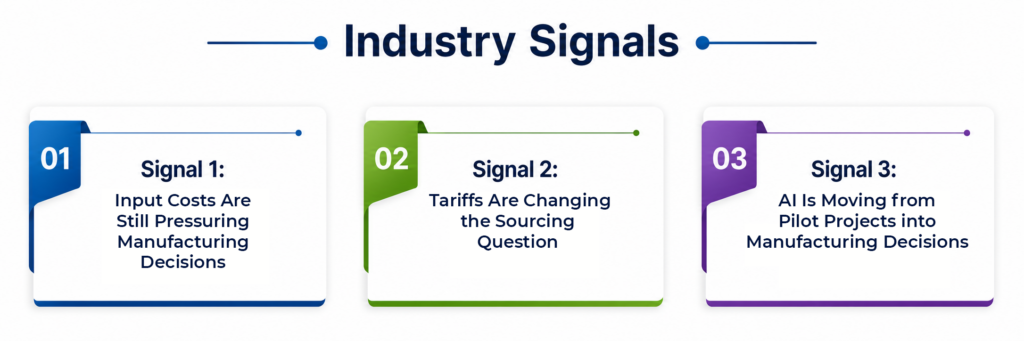
1. Input Costs Are Still Pressuring Manufacturing Decisions
The cost environment has not normalized.
ISM’s August Manufacturing PMI showed the Prices Index at 71.1, marking the 23rd consecutive month of rising raw material prices. Steel, aluminum, petroleum-based products, resins, plastics, chemicals, freight, and electrical components were among the inputs reported as experiencing price increases. Food, beverage, and tobacco products and chemical products were also among the industries reporting higher raw material prices.
The latest National Association of Manufacturers survey adds another layer. Manufacturers surveyed in August expect raw material and other input costs to increase 5.0% over the next year. Freight and fuel costs were also cited as significant challenges.
For process manufacturers, the impact goes beyond procurement.
Higher material costs can change the economics of a formula, alter product margins, influence purchasing decisions, and affect pricing conversations with customers. When materials represent a significant share of product cost, even relatively small changes can materially affect profitability.
What leadership should be thinking about: Can the organization see how changes in individual material costs affect product-level margins? Can procurement, finance, production, and sales work from the same cost information when pricing or sourcing decisions need to be made?
The objective is not simply to predict the next cost increase. It is to shorten the time between a cost change and a management decision.
2. Tariffs Are Changing the Sourcing Question
Trade uncertainty continues to influence manufacturing and supply-chain decisions, but September developments reinforce an important distinction: tariffs do not automatically make reshoring the right answer.
ISM’s August reporting showed tariffs continuing to appear among manufacturers’ concerns, alongside pricing volatility and longer lead times. Its supply management analysis has also highlighted the risks of reacting to tariff changes through inventory front-loading or immediate relocation without evaluating the broader economics.
What leadership should be thinking about: Instead of asking only, “Should we reshore?”, evaluate which materials, products, or production activities actually benefit from regionalization.
The strategic advantage may come from a more diversified supply network rather than a simple move from global sourcing to domestic production.
3. AI Is Moving from Pilot Projects into Manufacturing Decisions
AI adoption in manufacturing is entering a different phase.
Deloitte’s 2026 AI in Manufacturing survey of more than 140 manufacturers found that 84% reported measurable value from AI, but only about 20% of use cases had been scaled consistently across sites or across the enterprise. Quality, production, and logistics and supply chain were among the areas with the highest levels of adoption.
The finding is particularly relevant to process manufacturing. Deloitte identified chemical and physical transformation, packaging and quality control, and formulation and finishing as areas with significant improvement potential.
The question is no longer simply whether a manufacturer should experiment with AI. The more important question is where AI can improve a measurable operational outcome and whether the organization has the data, governance, workflows, and people required to scale it.
For a process manufacturer, potential applications can include identifying patterns affecting quality, improving material planning, supporting production decisions, identifying process variation, and making operational knowledge easier to access.
What leadership should be thinking about: Start with decisions, not technology.
Identify the manufacturing decisions where better prediction, faster analysis, or easier access to operational knowledge could affect yield, quality, material costs, throughput, or equipment availability. Then determine whether the underlying data is reliable enough to support that use case.
AI may create value, but scaling that value requires operational discipline.
M&A Intelligence
Specialty Ingredients Remain Attractive to Focused Buyers
Mutares acquires AmeriTerpenes from Symrise
Mutares acquired AmeriTerpenes, the U.S. terpene ingredients business of Symrise, on September 1. The business generates approximately $200 million in revenue and produces natural terpene-based ingredients used across fragrance, personal care, food and beverage, and industrial chemicals. Financial terms were not disclosed. Symrise described the transaction as part of its portfolio management strategy and said long-term supply and commercial arrangements would continue.
Signal: Specialized ingredient capabilities can remain strategically valuable even when larger companies are simplifying their portfolios. For mid-market manufacturers, differentiated formulations, technical know-how, and established customer relationships can create strategic relevance beyond production capacity alone.
Contract Manufacturing Continues to Attract Capital
Blue Sea Capital acquires CompletePet
Blue Sea Capital announced the acquisition of CompletePet on September 1. The company develops, formulates, and manufactures pet wellness products for brands across formats including soft chews, liquids, sprays, dental products, oils, and powders. Management is remaining in place and reinvesting alongside the new owner. Financial terms were not disclosed.
Signal: Outsourced formulation and manufacturing capabilities continue to attract investor interest where technical expertise, product development, quality, and manufacturing execution come together. For contract manufacturers, the ability to support customers across formulation, development, production, and multiple dosage formats can create a broader strategic proposition.
Specialty Chemicals See Continued Platform Building
Glen Oaks Capital and Tecum Capital acquire StanChem Resins and Dux Coatings
On September 9, Glen Oaks Capital and Tecum Capital announced the acquisition of StanChem Resins and Dux Coatings, creating a specialty chemicals platform focused on water-based emulsion polymers and solvent-based protective coatings. The companies will continue operating under existing senior management, with additional capital supporting expansion. Financial terms were not disclosed.
Signal: Buyers continue to look for specialized manufacturing platforms where technical capabilities, differentiated products, and expansion potential can support a broader growth strategy.
Valuation Signal
Capital continues to favor specialized capabilities over undifferentiated capacity.
Kroll’s latest food and beverage M&A analysis found that strategic buyers and financial sponsors are increasingly focused on high-quality businesses with differentiated capabilities, resilient operating profiles, and strong market positions.
For process manufacturers, this points to a practical valuation question.
Final Takeaway
September reinforces a broader shift in process manufacturing.
Costs remain difficult to predict. Trade conditions continue to influence sourcing. Regulatory expectations are becoming more data intensive. AI is moving closer to production and quality decisions. Investors continue to examine specialized manufacturing capabilities for strategic value.
For leadership teams, the common thread is decision quality.
The ability to understand what is changing, connect that change to operations and financial outcomes, and respond without losing control is becoming increasingly important.
The next competitive advantage may not come from simply producing more.
It may come from knowing sooner, deciding faster, and executing with greater control.
Resources & Sources
Regulatory
- FDA Human Foods Program 2026 Priority Deliverables
- FDA 2026 Food Code
- FDA Generally Recognized as Safe (GRAS)
- FDA Food Chemical Safety Post-Market Assessment Program
- FDA Food Traceability Rule
Industry Signals
- ISM August 2026 Manufacturing PMI
- National Association of Manufacturers Q3 2026 Manufacturers’ Outlook Survey
- ISM: Front-Loading Inventory Isn’t Always About Tariffs
- Deloitte AI in Manufacturing 2026
- Reuters: EnerVenue manufacturing decision and supply-chain considerations
M&A and Market Signals
- Mutares: AmeriTerpenes acquisition
- Symrise: AmeriTerpenes divestment
- Blue Sea Capital: CompletePet acquisition
- Glen Oaks Capital and Tecum Capital: StanChem acquisition
- Kroll Food and Beverage Industry Insights, Summer 2026
- PwC Industrial Manufacturing Deals Outlook 2026