
📚 New Blog Posts
1. FSMA Compliance for Food & Beverage Manufacturers: Requirements, Risks and What to Do Now
2. Scaling for Growth: How Next Drinks Built a Foundation for Expansion with BatchMaster ERP
3. Inventory Valuation in Process Manufacturing: Methods, Costing, and Best Practices
A conversation with Austin Ercanbrack , VP of Operations, Nutra Connection and Anuj Saxena, Delivery Manager and Solution Architect, BatchMaster Software


In my recent conversation with Austin Ercanbrack, VP of Operations at Nutra Connection and a BatchMaster customer who recently went live with BatchMaster ERP, we discussed what contributed to a successful implementation, what helped the team prepare for go-live, and what has changed in the months since.
Nutra Connection is a dietary supplement contract manufacturer specializing in powder blending and filling into capsules, stick packs, and bulk bags. Like many growing contract manufacturers, the company wanted greater visibility across its operations. Batch records, inventory tracking, and traceability were among the areas it wanted to improve, along with bringing operations, warehouse, and finance teams onto the same information.
Our conversation highlighted five practical lessons that can help manufacturers prepare for an ERP implementation, navigate go-live, and continue building value after the system is in place.
1. Start Preparing Before the ERP Goes Live
Go-live should be the point where employees begin productive work in the new ERP, not the point where they first encounter it.
Early system access gives users time to understand processes, become comfortable with the system, and identify questions before the pressure of live operations begins.
At Nutra Connection, the internal team received access to BatchMaster ERP before go-live. Employees began entering purchase orders, sales orders, and production batches while becoming familiar with how those activities would work in the new system.
We also conducted conference room pilots, giving employees opportunities to work through processes, ask questions, and understand how information would flow before the system became fully operational.
This approach helped the team arrive at go-live with both familiarity and information already in place.
As Ercanbrack noted, early access allowed the team to become familiar with “the process and the system” before going live. It also meant employees could begin working immediately rather than waiting for information to be entered.
A practical ERP readiness sequence
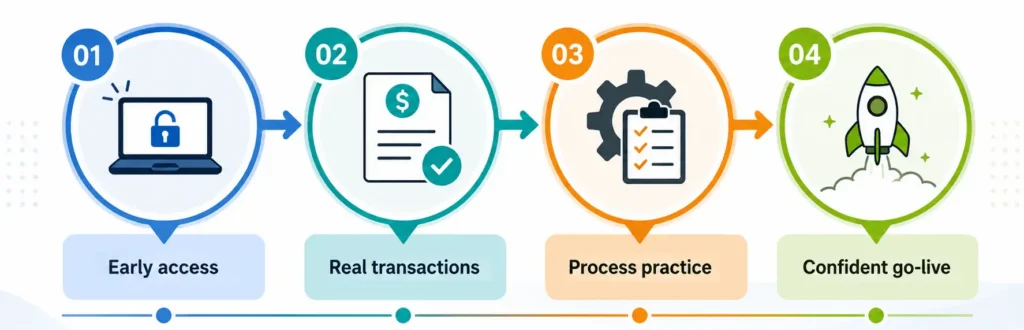
The benefit goes beyond training. When users practice with the processes they will actually perform, the transition becomes part of their working routine rather than a completely new experience on go-live day.
2. Make Employees and Leadership Part of the Implementation
ERP systems affect almost every part of an organization. That makes implementation a business-wide change, not a project that can be handled by an IT or implementation team alone.
The people who work with a process every day often understand its practical requirements better than anyone else. Their involvement can help identify what needs to change, clarify how processes should work in the new system, and create greater ownership of the implementation.
This was a key part of Nutra Connection’s approach.
The company’s internal stakeholders were involved from the beginning, including Ercanbrack, the owner and president, and other executives. At the operational level, employees who understood individual processes were also encouraged to participate.
That involvement matters because adoption is easier when employees understand not only how a new system works, but also why the organization is changing the way it works.
The people side of ERP readiness
| Implementation factor | Why it matters |
| Employees involved early | Builds familiarity and ownership |
| Process owners engaged | Brings practical process knowledge into implementation |
| Leadership involved | Creates organizational alignment |
| Data cleaned beforehand | Provides a stronger foundation for the new system |
Data preparation is another important part of this process. Moving inaccurate or outdated information into a new ERP does not solve the underlying problem.
The familiar principle of “garbage in, garbage out” remains relevant during implementation. Reliable data gives employees a better foundation for working in the new system and reduces the risk of carrying legacy data problems forward.
3. Plan for Support When Real Operations Begin
Even the best preparation cannot eliminate every question or adjustment once employees begin using an ERP in a live manufacturing environment.
The first days after go-live can reveal small issues that were difficult to identify during testing. A form may need an adjustment. A label may need to display information differently. An employee may encounter a workflow they need help understanding.
The ability to resolve these issues quickly can prevent small problems from becoming operational disruptions.
Nutra Connection experienced this firsthand through on-site support during its go-live. Having implementation support available in person allowed employees to raise questions and work through them immediately rather than relying entirely on email or chat.
The implementation team was also able to make small changes to items such as packing slips and labels during the first few days.
For a manufacturing operation, that responsiveness can be particularly valuable. Production continues while employees are learning a new system, so implementation support needs to work within the realities of the production environment.
The goal is not to eliminate every adjustment. It is to create an environment where necessary adjustments can be identified and addressed without unnecessarily slowing operations.
4. Measure Success Through Adoption and Operational Visibility
An ERP implementation is not successful simply because the system is live.
A more meaningful question is whether employees are actually using it and whether that usage is improving how information moves across the organization.
For Nutra Connection, adoption became one of the clearest changes after implementation. More team members were actively using BatchMaster than had been using the previous system.
That increased adoption meant employees across the organization were looking at the same information, improving visibility between teams.
The operational impact extended to material management as well. Nutra Connection saw more accurate material consumption and improved visibility of materials in WIP locations, both of which were important from an operations and inventory perspective.
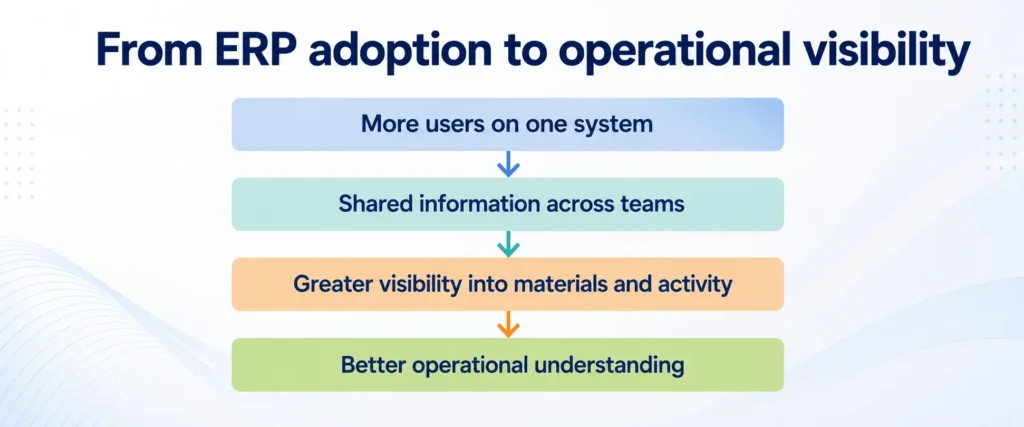
This distinction is important.
ERP visibility is not created simply by installing software. It develops when employees consistently use the same system and the organization can rely on the information within it.
The connection with financial processes adds another dimension.
BatchMaster’s real-time integration with QuickBooks Online allows transactions entered in BatchMaster to flow into the financial system. For Nutra Connection, the ability to perform a three-way match has helped improve visibility into cash flow and future spending decisions.
The result is a more connected flow of information between operational activity and financial visibility.
| Operational activity | Visibility gained |
| Purchase transactions | Connected financial information |
| Production activity | Better view of material usage |
| Inventory activity | Improved WIP visibility |
| Connected transactions | Greater cash-flow visibility |
5. Treat Go-Live as the Beginning of Continuous Improvement
One of the biggest mistakes organizations can make is treating ERP implementation as complete once the system goes live.
The first day of live operation is the beginning of a longer learning process.
Employees continue to become more familiar with the system. Processes can be refined. Teams discover opportunities to use capabilities they did not fully understand during implementation. Additional enhancements can also be built on the initial implementation.
Nutra Connection’s experience reflects this ongoing approach. The team continues to build on what has already been implemented, including work around traceability reporting that is expected to support the organization during important audits.
This ongoing development also requires a willingness to change.
An ERP implementation should not simply recreate every process exactly as it existed in the legacy system. Some existing workflows may have developed around limitations of the previous system rather than because they represent the most effective way to work.
Ercanbrack’s advice is particularly relevant here:
“Don’t go into an ERP implementation expecting the new system to work exactly like the old system. That mindset creates room for organizations to evaluate existing processes and evolve them where appropriate. Continuous learning is therefore part of ERP success, not something that happens separately from it. The implementation is just the start.”
What Manufacturers Should Carry Forward
- Prepare early – Give employees opportunities to work with the system before go-live.
- Involve the right people – Bring process owners and leadership into the implementation from the beginning.
- Prepare the data – Clean information before it becomes part of the new system.
- Support users during go-live – Address questions and adjustments while keeping daily operations moving.
- Be willing to adapt – Use the new system as an opportunity to improve processes rather than simply recreate legacy workflows.
- Keep learning – Continue refining processes and building on the implementation after go-live.
Building a Stronger ERP Foundation
A successful ERP implementation is built long before the system goes live and continues to develop long after it does.
My conversation with Nutra Connection reinforced why preparation, employee involvement, data quality, implementation support, adoption, and continuous improvement all matter. These factors influence how effectively an ERP becomes part of everyday operations.
The technology provides the platform, but the implementation process determines how well the organization can use it.
For manufacturers preparing for an ERP transition, the most important question may therefore not be, “Are we ready to go live?”
It may be:
“Are our people, processes, data, and operations ready to make the new system work for us?”
That is where a successful ERP implementation begins.