



📚 New Blog Posts
1. From Operational Silos to a Unified Platform: How Florida Nutrition Scaled with BatchMaster ERP
2. This Month in Process Manufacturing | April 2026
3. Cloud-Powered Growth: How Cosmetix West Modernized for Global Scale
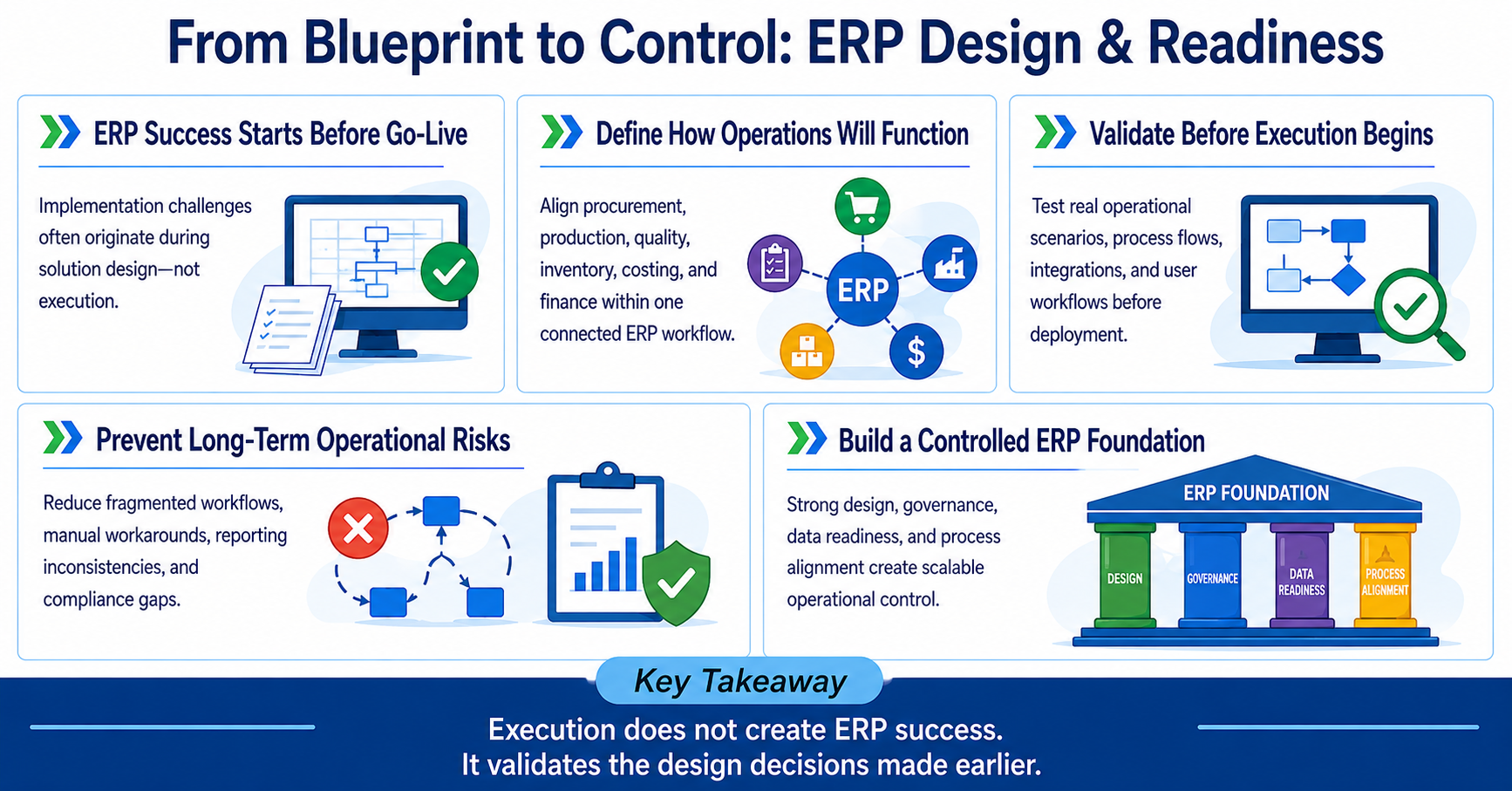
ERP implementation does not fail during execution.
It fails much earlier—at the point where business requirements are translated into system design without sufficient clarity, validation, and governance.
For process manufacturing organizations, where operations are defined by formulation accuracy, batch consistency, regulatory compliance, and cost precision, this stage becomes even more critical. A minor gap in design can cascade into production inefficiencies, inventory mismatches, compliance risks, and financial misreporting once the system goes live. At this stage of the ERP journey, leadership focus naturally shifts from “choosing the right system” to a more fundamental question:
How exactly will our business operate once everything is inside the system?
In earlier phases of this series, we explored ERP selection, internal discovery and process mapping, and project planning and kickoff. Each of these phases contributes essential clarity to the transformation journey.
This phase, Solution Design & Execution Readiness (Business Blueprint + Validation) is where that clarity is operationalized.
It defines how the organization will function within the ERP environment and ensures that execution is driven by validated business logic rather than assumptions or theoretical workflows. Because once this stage is approved, it becomes the structural backbone of the entire implementation.
Why Solution Design Determines ERP Outcomes
ERP transformation is often misunderstood as a system deployment initiative. In reality, it is a business operating model to redesign exercises.
At the solution design stage, organizations define how core business functions will operate in a controlled and integrated environment:
- How procurement will respond to production demand in real time
- How batch manufacturing will be planned, executed, and tracked
- How quality control will be embedded into every production cycle
- How inventory will move across locations with full traceability
- How financial impact will be captured at every operational touchpoint
- How leadership will access accurate, real-time business visibility
What makes this phase critical is not documentation; it is the decision-making embedded within it.
Industry experience consistently shows that ERP challenges rarely originate from system limitations. Instead, they emerge from misaligned expectations between business processes and system design decisions made during this phase.
In most cases, by the time execution issues surface, they are already a reflection of design decisions taken earlier.
This implication is clear: Execution does not create success; it only validates the design decisions already made.
Solution Design (Business Blueprint)
Solution Design, also referred to as the Business Blueprint, is the structured definition of how enterprise processes will be executed within the ERP system.
It serves as the bridge between business requirements and system configuration, ensuring that every operational activity is mapped, validated, and controlled within a unified system architecture.
The outcome of this phase is a comprehensive blueprint document, which becomes the authoritative reference for configuration, development, testing, and deployment.
This blueprint is not static documentation. It is a governance framework for implementation decisions.
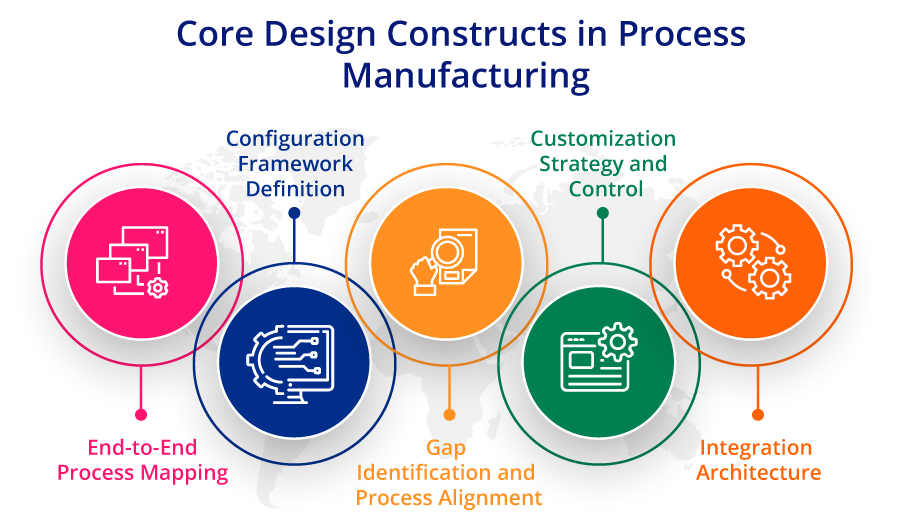
1. End-to-End Process Mapping
This step focuses on designing how business processes flow across departments in a fully integrated manner. In process manufacturing environments, operations are inherently interconnected. Procurement decisions directly impact production schedules, production impacts inventory levels, and inventory availability influences sales execution.
Process mapping ensures that:
- Procurement is aligned with production planning requirements
- Formulation and recipe management are system-controlled and standardized
- Batch production flows are structured with defined inputs, outputs, and validations
- Quality control checkpoints are embedded within operational stages
- Inventory movements are tracked at batch and lot level in real time
- Financial transactions are automatically linked to operational events
The objective is to eliminate siloed operations and ensure that every business function operates as part of a continuous, system-driven workflow.
2. Configuration Framework Definition
Configuration defines how the ERP system will behave under different business conditions without requiring code-level changes.
It includes structured definition of:
- Workflow hierarchies and approval mechanisms
- Role-based access control and segregation of duties
- Batch tracking rules, traceability parameters, and genealogy tracking
- Shelf-life, expiry, and compliance enforcement rules
- Costing models at batch, material, and production level
- Quality control workflows including inspection and release conditions
This layer ensures that business policies are enforced consistently through the system, reducing dependency on manual interpretation or individual decision-making.
A well-defined configuration framework directly influences:
- Operational consistency
- Governance enforcement
- Audit readiness
- System usability and adoption
3. Gap Identification and Process Alignment
This stage evaluates the difference between current operational practices and system-aligned workflows.
Most organizations discover that existing processes contain:
- Manual interventions that introduce variability
- Informal approvals that are not system-driven
- Data inconsistencies across departments
- Process dependencies that are not documented
- Inefficient or redundant operational steps
The purpose of gap analysis is not just identification—it is decision classification:
- What processes must be redesigned
- What can be standardized within ERP
- What requires controlled system customization
- What should be eliminated entirely
This is often one of the most sensitive stages, as it challenges long-standing operational habits within the organization.
4. Customization Strategy and Control
Customization defines how the system will be extended beyond standard capabilities to meet specific business requirements.
However, in mature ERP environments, customization is treated as a controlled exception—not a default approach.
A structured customization strategy ensures:
- Only business-critical requirements are approved
- Functional gaps are validated against business value
- Standard ERP capabilities are prioritized wherever possible
- Custom development is governed through formal approval cycles
- Long-term system maintainability is not compromised
Over-customization is one of the most common reasons ERP systems have become difficult to upgrade, maintain, and scale. Therefore, this stage requires strict governance and business justification.
5. Integration Architecture
Modern enterprises operate within a multi-system environment, and ERP must function as the central operational backbone.
Integration architecture defines how ERP will interact with:
- Production or shop floor systems
- Warehouse management systems
- Customer order and distribution platforms
- Financial and reporting systems
- External compliance or regulatory systems
A well-designed integration framework ensures:
- Real-time data synchronization across systems
- Elimination of duplicate data entry
- Consistent reporting across platforms
- Unified decision-making based on a single source of truth
Without proper integration design, organizations risk fragmented systems that operate independently rather than as a connected enterprise ecosystem.
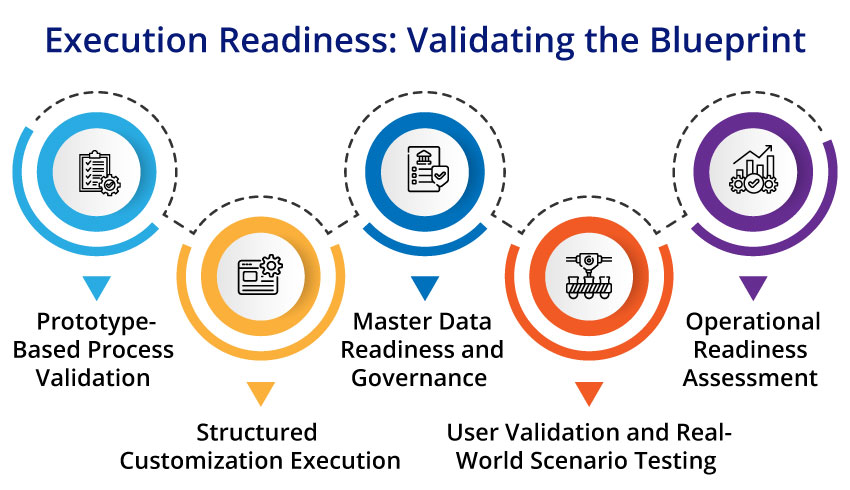
Once solution design is finalized, execution readiness ensures that the blueprint performs under real operational conditions.
This phase reduces implementation risk by validating assumptions before full-scale deployment.
1. Prototype-Based Process Validation
Prototype validation involves simulating real business operations in a controlled ERP environment.
It allows stakeholders to test end-to-end workflows such as:
- Batch creation and production execution
- Material consumption and inventory updates
- Quality inspection and approval cycles
- Cost tracking and financial posting
This stage ensures that theoretical process design translates effectively into practical system behavior.
It also helps identify functional gaps, usability issues, and process inefficiencies before system rollout.
2. Structured Customization Execution
Once requirements are validated, approved customizations move into execution through a controlled lifecycle:
- Development of required enhancements
- Functional and technical testing
- Business review and validation
- Formal approval and deployment
This structured approach ensures that system changes are not only technically sound but also aligned with business expectations and operational requirements.
It also minimizes risks associated with uncontrolled or unverified system modifications.
3. Master Data Readiness and Governance
Master data serves as the foundation of ERP system accuracy.
This includes core business data such as materials, formulations, vendors, customers, and production parameters.
Data readiness ensures:
- Accurate and standardized data structures
- Removal of duplicates and inconsistencies
- Alignment across departments before system usage
- Continuous validation during implementation
Without strong data governance, even a well-designed ERP system will produce unreliable outputs.
4. User Validation and Real-World Scenario Testing
This step ensures that end users validate the system using real operational scenarios instead of theoretical test cases.
It confirms whether the system supports actual business activities such as production planning, batch execution, quality control, and reporting.
This phase is critical for:
- Building user confidence
- Reducing resistance to change
- Ensuring operational familiarity before go-live
5. Operational Readiness Assessment
Operational readiness evaluates whether the organization is fully prepared to transition into the new system environment.
It assesses:
- Process alignment across functions
- User training and adoption readiness
- Data completeness and accuracy
- System stability and performance
The objective is to ensure that go-live is not just a technical milestone, but a controlled operational transition.
Business Impact of Effective Solution Design
When executed effectively, this phase delivers measurable business value:
1. Operational Visibility
Leadership gains real-time visibility into production, inventory, quality, and financial performance, enabling faster and more informed decision-making.
2. Process Standardization
Operations become structured, consistent, and repeatable across the organization.
3. Compliance and Traceability
Regulatory and audit requirements are embedded directly into system workflows.
4. Financial Control
Batch-level costing enables precise margin analysis and cost transparency.
5. Scalable Architecture
The system is designed to support future growth without structural redesign.
Implications of Weak Design and Execution Readiness
When this phase is not executed with discipline, organizations typically face:
- Misalignment between system workflows and real operations
- Increased reliance on manual workarounds
- Low system adoption across teams
- Inconsistent and unreliable reporting data
- Delayed decision-making cycles
- Elevated compliance and operational risks
These issues accumulate over time, significantly reducing the long-term value of ERP investment.
Conclusion: Design as the Determinant of ERP Success
Solution Design & Execution Readiness is not a preparatory step—it is the structural foundation of ERP success.
It determines whether the system becomes:
A unified, intelligent operational platform
or
A fragmented system requiring continuous correction
For leadership teams, the focus must remain on ensuring that this phase is executed with precision, governance, and business alignment.
Because once execution begins, design decisions become increasingly difficult to reverse.
In the next phase of this series, we will explore system execution, configuration, and development, where the validated blueprint is transformed into a fully operational ERP system through configuration, testing, and deployment.