📚 New Blog Posts
1. How a $20 Million Paint & Coatings Manufacturer Finally Saw Where It Was Making Money
2. This Month in Process Manufacturing – February 2026
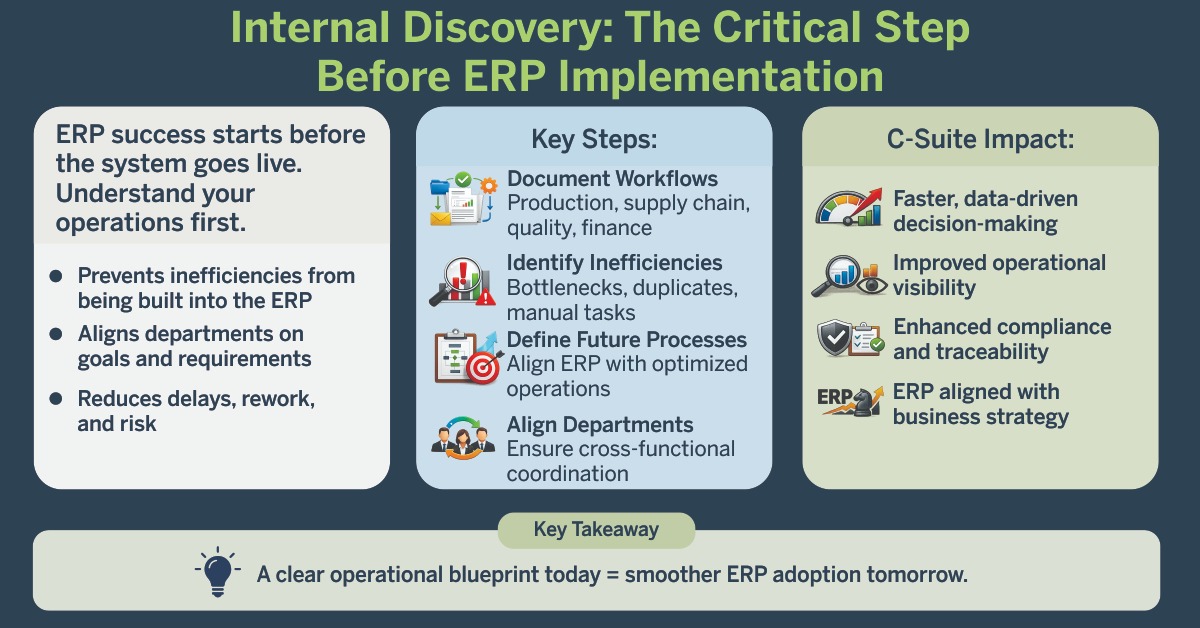
Selecting an ERP system is a significant milestone for any manufacturing organization. But while ERP selection often receives the most attention, the real determinant of success lies in what happens next; that is how the organization prepares for implementation.
As part of this series, our previous article, ERP Selection Process: How to Transition to a New ERP System, discussed how manufacturers evaluate ERP solutions and finalize the right technology partner. However, selecting the platform is only the beginning of the journey. Before implementation begins, organizations must take a crucial step that many overlook; these are internal discovery and process mapping.
Industry research consistently highlights the importance of this stage. According to Gartner, many ERP initiatives fail to achieve their original business objectives due to organizational misalignment, unclear requirements, and poorly defined processes, not because of limitations in the technology itself.
For process manufacturers, the stakes are particularly high. ERP systems for process manufacturing connect production planning, supply chain management, quality assurance, regulatory compliance, and financial operations. Without a clear understanding of how these processes function today, organizations risk implementing technology that replicates inefficiencies rather than solving them.
This is where internal discovery becomes the bridge between ERP selection and successful implementation.
By examining current operations, identifying bottlenecks, and aligning departments on future goals, organizations can create a clear blueprint that guides ERP configuration and adoption.
Companies that invest in this stage often experience smoother implementations, faster user adoption, and stronger long-term returns on their ERP investment.
What is Internal Discovery and Process Mapping?
Internal discovery is the process of analyzing how an organization currently operates before implementing new technology. It involves documenting workflows, identifying inefficiencies, and aligning departments on how the business should function moving forward.
For executives overseeing ERP initiatives, this stage provides something invaluable: visibility into operational reality.
Many process manufacturing businesses believe they understand their internal processes, but discovery often reveals unexpected complexities. Over time, departments develop their own workflows, workarounds, and data management practices. These differences may function adequately in isolation but can create significant challenges when integrated into a unified ERP environment.
With efficient process mapping, it is easier to bring these differences into focus.
Rather than relying on assumptions, organizations conduct structured workshops and interviews to understand how work flows across departments like from production and procurement to quality management and finance.
A simple review and demo might simply document high-level activities, but strategic discovery sessions go deeper by analyzing:
- How information moves between departments
- Where manual processes slow down operations
- Which tasks are duplicated across systems
- Where visibility gaps limit decision-making
For manufacturing leaders, the goal is not simply to capture current processes but to evaluate how those processes should evolve.
Strategic discovery allows organizations to move beyond existing limitations and design processes that fully leverage ERP capabilities.
The result is greater clarity, fewer implementation delays, and faster system adoption once the ERP goes live.
Key Activities in Internal Discovery
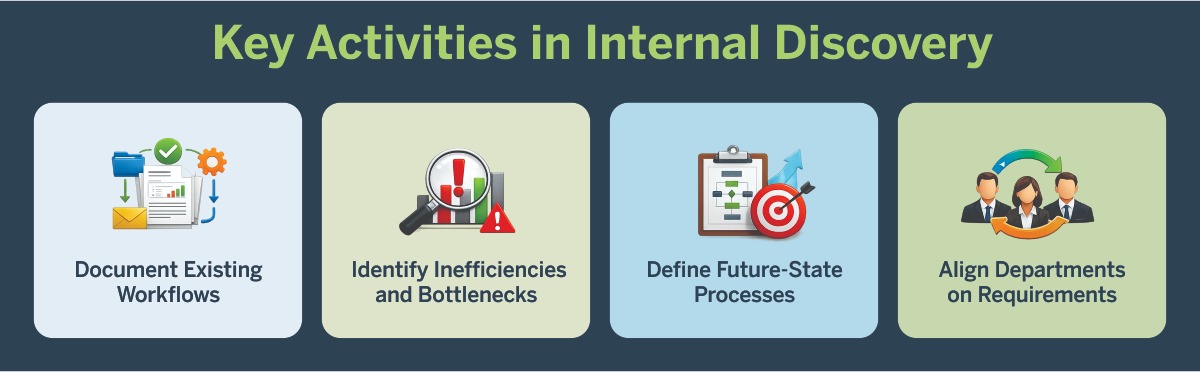
While every manufacturer approaches discovery differently, successful initiatives typically include several core activities. Together, these efforts produce a business process blueprint that becomes the foundation for ERP configuration.
1. Document Existing Workflows
The first step in discovery is understanding how work is currently performed.
For process manufacturers, this includes mapping workflows across key functions such as:
- Production planning and batch manufacturing
- Supply chain and procurement operations
- Inventory and warehouse management
- Quality assurance and regulatory compliance
- Financial management and reporting.
These workflows often span multiple departments and systems. In many cases, organizations discover that processes vary widely between teams or rely heavily on manual coordination.
Documenting workflows provides a shared understanding of how operations truly function.
2. Identify Inefficiencies and Bottlenecks
Once workflows are documented, organizations can begin identifying inefficiencies that limit performance.
Common issues discovered during ERP discovery include:
- Duplicate data entry across multiple systems
- Limited real-time visibility into production or inventory
- Delays in quality documentation or compliance reporting
- Manual reconciliation of inventory records
- Inconsistent cost tracking between operations and finance
These inefficiencies not only slow down operations but can also increase regulatory risk in highly controlled industries.
By identifying these bottlenecks early, organizations can ensure that ERP configuration addresses real operational challenges rather than simply replacing legacy software.
3. Define Future-State Processes
Discovery should not only document how operations function today; but it should also define how the business wants to operate tomorrow.
The future-state process aligns operational goals with ERP capabilities. For example, organizations may aim to achieve:
- Effective batch traceability throughout production
- Real-time inventory visibility across locations
- Integrated quality checks within manufacturing workflows
- Comprehensive financial reporting connected directly to operational data
Defining these goals early allows implementation teams to configure the ERP system to support improved workflows rather than replicating outdated processes.
4. Align Departments on Requirements
ERP systems integrate multiple business functions, making alignment essential.
Discovery sessions typically involve leaders from:
- Production and operations
- Supply chain and procurement
- Quality assurance and compliance
- Finance and accounting
- IT and technology teams
Each department brings unique priorities. Production teams may focus on efficiency, while quality teams prioritize compliance, and finance leaders emphasize reporting accuracy.
The C-Suite Impact
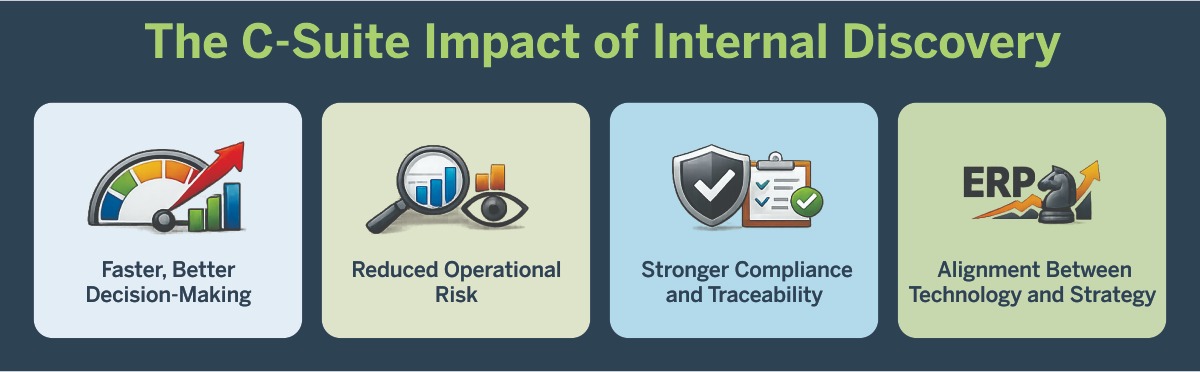
For executives, internal discovery provides far more than technical preparation; it delivers strategic insight into how the process manufacturing industry operates.
A structured discovery phase allows leadership teams to achieve several important outcomes.
1. Faster, Better Decision-Making
Process mapping reveals how information flows across the organization. With improved visibility, executives can identify operational bottlenecks and address them proactively.
2. Reduced Operational Risk
ERP implementation often touches critical manufacturing processes. By understanding workflows in advance, organizations can reduce the risk of production disruptions during the transition.
3. Stronger Compliance and Traceability
For regulated industries, discovery ensures that quality and compliance requirements are built directly into ERP processes rather than handled through manual workarounds.
4. Alignment Between Technology and Strategy
Perhaps most importantly, discovery ensures that ERP investments support business goals rather than operating independently.
For C-suite leaders, internal discovery is ultimately a risk-management strategy as much as a planning exercise.
Best Practices and Implementation Strategies
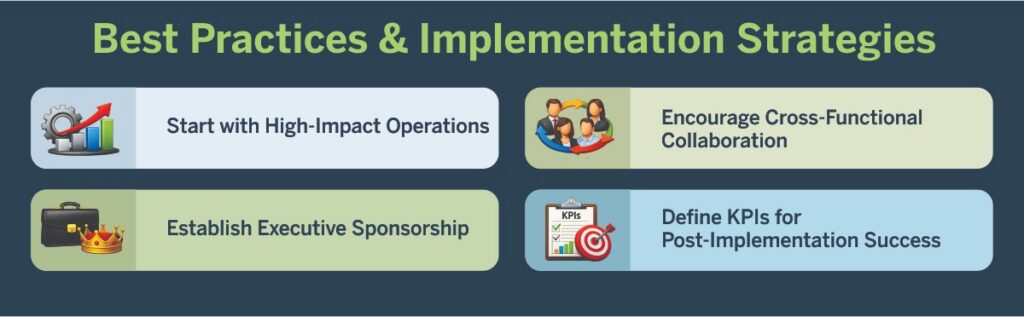
Organizations that approach discovery strategically often follow several best practices to maximize results.
1. Start with High-Impact Operations
Rather than mapping every process simultaneously, many organizations begin with functions that have the greatest operational impact, such as:
- Production planning and scheduling
- Inventory management
- Supply chain coordination
- Quality and compliance workflows
Focusing on these areas first helps identify key requirements that influence the rest of the implementation.
2. Encourage Cross-Functional Collaboration
Discovery should involve stakeholders from across the organization. Cross-functional workshops often reveal dependencies that individual teams may not recognize.
For example, production planning may depend heavily on procurement timelines, while finance requires accurate inventory data for cost management.
Collaborative discovery sessions help resolve these dependencies before ERP configuration begins.
3. Establish Executive Sponsorship
Strong executive involvement is essential to maintain momentum during discovery.
Leadership plays a key role in:
- Setting project priorities
- Allocating resources
- Resolving interdepartmental conflicts
- Reinforcing the strategic importance of the ERP initiative
Without visible executive support, discovery efforts can stall as departments focus on daily operational demands.
4. Define KPIs for Post-Implementation Success
The insights gained during discovery should feed directly into performance metrics that measure ERP success.
Common examples include:
- Improved production visibility
- Increased inventory accuracy
- Reduced manual reporting processes
- Faster financial close cycles
- Enhanced product traceability
Tracking these metrics helps leadership evaluate whether the ERP implementation is delivering measurable business value.
Lessons from the Field
ERP discovery often uncovers operational issues that would otherwise disrupt implementation.
For example, sales leaders frequently observe inconsistent inventory practices across departments, which can cause major complications during data migration if not addressed early.
Another common discovery involves misalignment between operations and finance regarding cost tracking. When these processes are standardized before ERP configuration, organizations avoid significant rework later in the project.
Implementation experts consistently emphasize the risks of skipping process mapping entirely.
Conversely, process manufacturers that invest time in discovery often see measurable improvements even before implementation begins.
Executive Takeaways
For executives leading ERP initiatives, internal discovery is one of the most valuable investments in the entire implementation process.
Before moving into system configuration, leadership teams should focus on several key priorities.
1. Establish clear process visibility
- Document workflows across production, supply chain, quality, and finance
- Identify operational bottlenecks and manual processes
2. Align departments early
- Bring stakeholders together to define shared requirements
- Resolve cross-department conflicts before implementation begins
3. Prioritize high-impact processes
- Start with operations that directly affect production, compliance, or revenue
4. Connect discovery to measurable outcomes
- Define KPIs that track operational improvements after ERP deployment
ERP implementation is not simply about deploying new technology. It is about creating a stronger operational framework for the future.
For process manufacturers navigating growth, regulatory complexity, and evolving market demands, internal discovery provides the clarity needed to turn ERP from a software investment into a strategic advantage.
Process manufacturing organizations that take the time to understand their processes today are far better positioned to build the systems that will support tomorrow’s growth.