



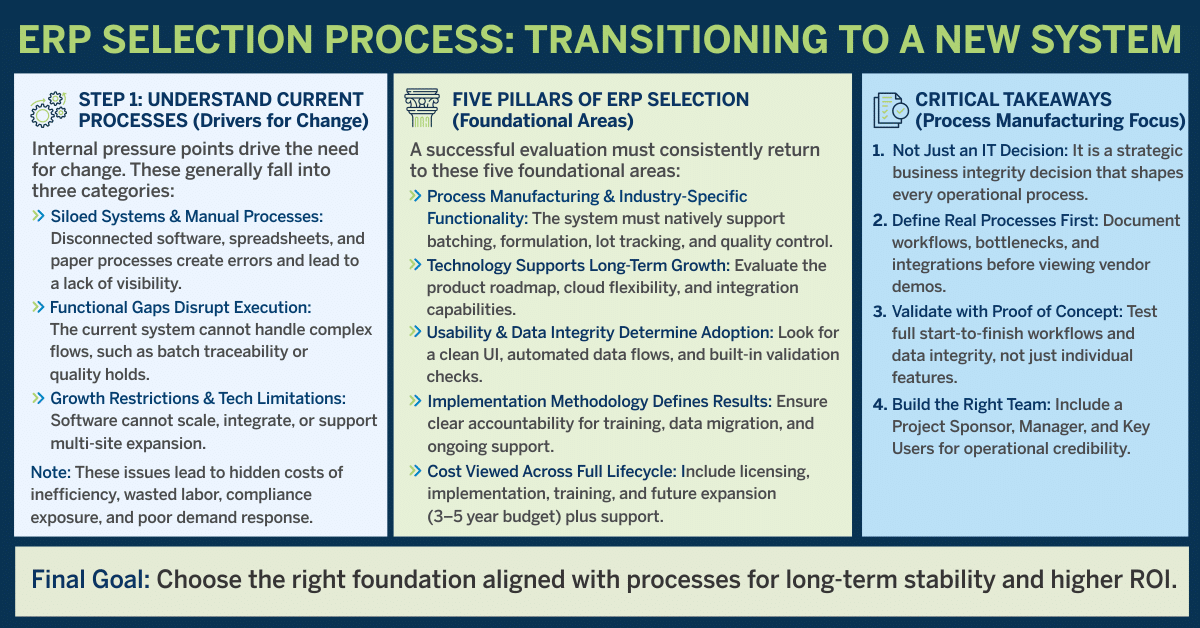
We recently held a webinar session (watch the recording here) with manufacturers to help them with their ERP selection processes. This session included manufacturers who were looking for an ERP for the first time, as well as those aiming to improve their previous ERP selection. The insights shared during this session reflect real-world challenges and proven best practices from successful and unsuccessful ERP journeys.
Deciding to adopt an ERP system or switching ERP systems is a significant investment and business decision for a small to midsize manufacturer. Yet ERP selection is too often driven by speed, when it should be grounded in structure, operational clarity, and the specialized requirements of process/batch, production/recipe, and formula-based manufacturers.
For process manufacturers operating in highly regulated, batch production environments, there are no shortcuts. ERP must become the digital backbone of the business, supporting formulation management, lot tracking, quality compliance, inventory accuracy, and financial visibility as one connected system.
This ERP selection guide is built on real-world feedback from our customers and years of hands-on industry experience defining what makes a successful and unsuccessful ERP evaluation. The foundation of any successful ERP implementation, business transformation, and long-term technology investment begins with selecting the right ERP system and the right vendor for your business.
Step 1: Understand Your Current Processes Before Searching for ERP
The most effective ERP evaluations begin long before vendors enter the conversation.
Before researching platforms, your business must define why change is necessary and why now. In process manufacturing, three internal pressure points almost always drive ERP software replacement or upgrades, these are:
1. Siloed Systems and Time-Consuming Manual Processes
Many manufacturing organizations still operate across disconnected software, shared drives, spreadsheets, paper documents, and internal knowledge.
While tools like Excel and spreadsheets will always have a place in daily operations, they were never designed to manage:
- End-to-end batch production
- Formulation
- Material Requirements Planning (MRP)
- Master Production Scheduling (MPS)
- Advanced Planning and Scheduling (APS)
- Recall management and lot traceability
- Material genealogy
- Costing
As spreadsheets and disconnected systems multiply, errors compound. Data is re-entered across departments. Version control breaks down. Validation becomes nearly impossible.
Most importantly, businesses lose real-time visibility into production, inventory, and quality; all of which are mission-critical in process manufacturing.
Hidden inside these workarounds are the true costs of inefficiency: wasted labor, delayed releases, compliance exposure, and poor demand response.
2. Functional Gaps That Disrupt Execution
Another common trigger for ERP change is when the current system simply cannot keep up with operational complexity.
For process manufacturers, these gaps most often appear in:
- Batch and lot traceability
- Quality holds and release management
- Production-to-order alignment
- Inventory accuracy across locations
- Customer-to-batch visibility
Without true system connectivity from sales, production, shipment, and invoicing, critical links break. Teams rely on manual data capture, emails, and spreadsheets to hold operations together.
Over time, these operational fractures have become business risks.
3. Growth Restrictions and Technology Limitations
Growth breaks when software cannot scale. Manufacturers often reach a point where:
- Their ERP is no longer supported
- Their vendor can no longer deliver reliable service
- Their system cannot integrate with ecommerce, equipment data, or third-party tools
- Their technology cannot support multi-site expansion
Lack of modern integration capability is one of the most common barriers to growth today. ERP should act as the data hub of the business, not a standalone system where everything works around it.
Step 2: Define and Document Manufacturing Processes
Successful ERP selection depends on process clarity.
Every department experiences operations differently, from sales and planning to production, QA, warehousing, and finance. ERP evaluation cannot rely on assumptions. It must be grounded in reality.
Best practice for process manufacturers includes:
- Documenting each major workflow from order to cash
- Identifying bottlenecks, failure points, and manual work
- Defining improvement goals for each department
- Listing every tool currently used across operations
Equally important is documenting all existing integrations, or lack thereof, between systems. These connection points will shape both ERP requirements and implementation complexity.
This step creates the blueprint against which every ERP platform will be evaluated.
Step 3: Focus on the Five Pillars of ERP Selection
Once internal alignment is established, evaluation should consistently return to five foundational areas.
1. Functionality Must Be Process-Manufacturing and Industry-Specific
Generic ERP platforms are rarely built for the realities of batch-driven production.
Process manufacturers require systems that natively support their industry:
- Batch and formulation control
- Lot tracking and full material genealogy
- Quality documentation and release workflows
- Regulatory validation readiness
- Controlled production scheduling
- R&D and lab
ERP functionality must map directly to how your manufacturing plant operates, not how a software vendor believes manufacturing should work.
2. Technology Must Support Long-Term Growth
ERP systems are long-term infrastructure investments.
Process manufacturers should evaluate:
- Product roadmaps and long-term development direction
- Cloud, on-premises, and hybrid deployment flexibility
- Native and third-party integration capabilities
- Support for mobile access and remote operations
As manufacturing ecosystems evolve, ERP platforms must allow the addition of new capabilities and functionality, and not become technical dead ends.
3. Usability and Data Integrity Determine Adoption
Even the most functionally rich ERP system will fail if users reject it.
Strong ERP systems balance:
- Clean, intuitive user interfaces
- Role-based permissions and authorizations
- Automated data flow across transactions
- Built-in checks and balances to protect data integrity
In well-designed workflows, core data moves automatically from:
- Estimate
- Sales order
- Production order
- Shipment
- Invoice
Re-keying data introduces risk, inefficiency, and compliance exposure.
4. Why Implementation Methodology Defines Your Results
ERP success depends as much on implementation of execution as on software capabilities.
Manufacturers must understand:
- Who manages the implementation
- How training and knowledge transfer are handled
- How data migration is structured
- What post-go-live support looks like
ERP projects succeed when accountability remains clear from contract to go-live and beyond.
5. Cost Must Be Viewed Across the Full Lifecycle
True ERP cost includes:
- Licensing or subscriptions
- Implementation services
- Training and support
- Future expansion phases
Manufacturers should establish a realistic low-to-high budget range spanning three to five years. This enables more transparent vendor conversations and more controlled long-term investment.
Step 4: Build the Right ERP Team
Strong projects are led by structured teams.
A typical ERP team includes:
- Project Sponsor – Executive oversight and financial authority
- Project Manager – Evaluation coordination and implementation ownership
- Key Users – Department representatives who validate real-world alignment
This structure ensures both operational credibility and executive accountability throughout the project lifecycle.
Step 5: Vendor Evaluation with Discipline
Rather than engaging dozens of vendors simultaneously, manufacturers should narrow the field to four to six candidates based on:
- Industry specialization
- Budget alignment
- Functional scope
- Implementation capabilities
Initial discovery calls should confirm strategic fit before deeper demonstrations begin. This avoids wasting time and helps both sides set realistic expectations.
Step 6: From Demos to Proof of Concept
As evaluation advances, the focus must shift from feature demonstrations to process validation.
Proof-of-concept demos should validate:
- Full start-to-finish workflows
- Cross-department data movement
- Quality and compliance processes
- Financial integration
- Reporting accuracy
At this stage, data integrity becomes the central decision factor. Visual appeal alone is never enough.
Step 7: Final Selection and Contract Readiness
Before signing, manufacturers should:
- Speak with reference customers
- Review full implementation plans
- Validate long-term support structures
- Verify pricing transparency and escalation terms
Once alignment is complete, ERP transitions from a selection project to a business transformation initiative.
Why ERP Selection Is Especially Critical for Process Manufacturers
Unlike discrete manufacturing, process manufacturing introduces:
- Regulatory compliance exposure
- Lot traceability accountability
- Formula and batch dependencies
- Quality validation requirements
ERP failures in these environments have far-reaching consequences, from rejected products to regulatory scrutiny and customer trust erosion.
ERP selection is not an IT decision. It is a business integrity decision.
Where BatchMaster Fits in the Process Manufacturing Equation
For manufacturers seeking an ERP platform purpose-built for batch-driven industries, BatchMaster provides specialized depth without sacrificing scalability.
BatchMaster supports:
- End-to-end batch and lot traceability
- Integrated quality management workflows
- Regulatory validation readiness
- Inventory, formulation, and production control
Deployment flexibility as a standalone ERP or integrated with leading accounting and ERP platforms.
BatchMaster gives process manufacturers the tools to manage complex operations with confidence, while enabling future growth through system integration and data integrity.
Conclusion
ERP selection is not about choosing the fastest solution; it’s about choosing the right foundation that aligns with your processes and long-term growth.
Process manufacturers who invest in:
- Internal process clarity
- Structured evaluation
- Disciplined vendor selection
- Realistic budgeting
Achieve higher ROI, faster user adoption, and long-term operational stability.
For process manufacturers, ERP is not just software; it is the business and digital backbone that governs every process, batch, lot, and customer promise.
If you’re interested in diving deeper into the ERP selection process and understanding how to make the right decision for your manufacturing business, check out the full webinar recording now.