📚 New Blog Posts
1. This Month in Process Manufacturing – July 2026
1. What FSMA Really Requires From Food and Beverage Manufacturers
2. Powering Growth: How Sunbelt Custom Mineral Scaled with BatchMaster ERP
Ask three finance leaders in a process manufacturing plan what a gallon of finished product costs to produce, and there is a reasonable chance of getting three different answers. Not because anyone is wrong. Because the number labeled “cost” on an inventory report is not a fact. It is the output of a method, and the method was chosen, sometimes deliberately, sometimes by default, and the moment the item was set up in the ERP.
That distinction gets lost in most costing conversations. Teams talk about cost as if it exists independently of the system that calculates it, when in reality the valuation method is the cost. Change the method, and the number moves. Change how labor is absorbed, and the number moves again. Close a batch three days early or three days late, and it moves once more.
For process manufacturers, where a single production run may consume raw materials with volatile pricing, generate co-products, absorb hours of labor across multiple work centers, and yield slightly less than the formula predicted, this is not an accounting quirk. It is a strategic control point. The decisions made at item setup ripple through every batch, every P&L close, every audit, and every margin conversation for years afterward.
Watch the Walkthrough
The Four Methods, and Why Item-Level Control is the Real Story
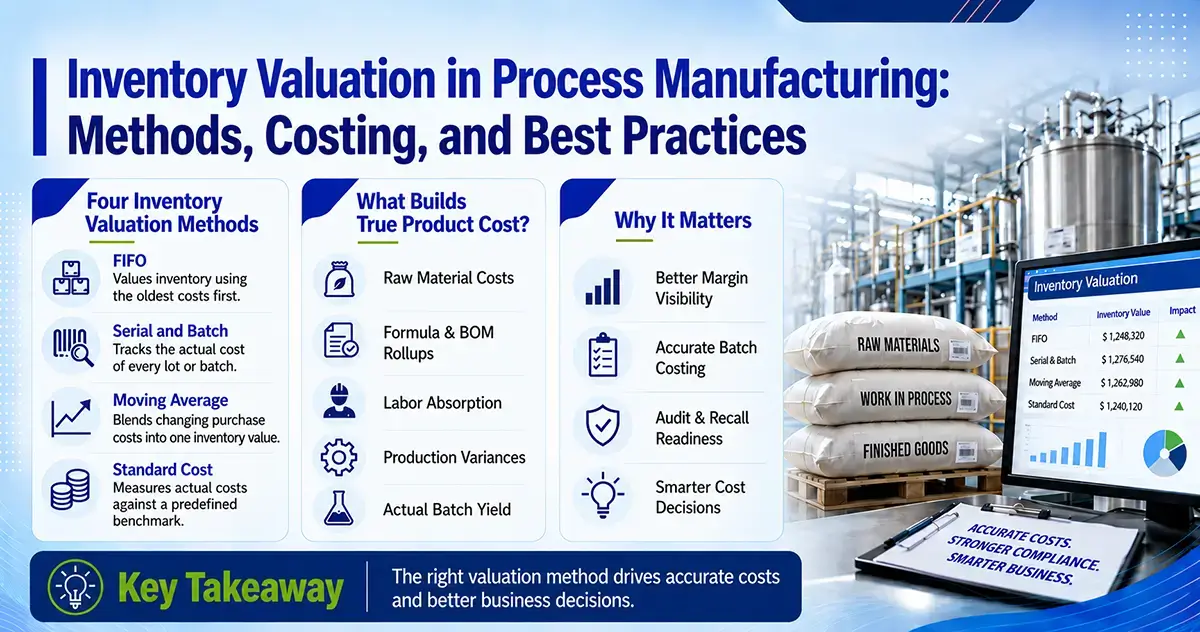
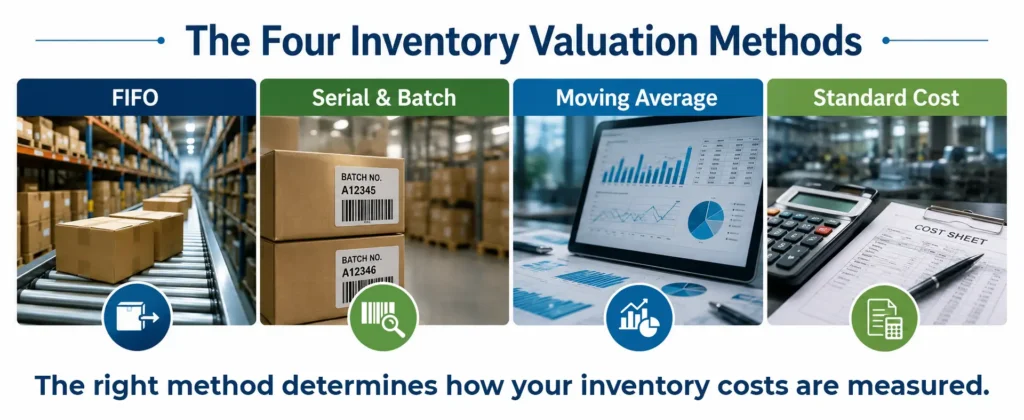
Most ERPs supporting process manufacturing offer four valuation methods: FIFO, serial and batch (also called specific identification), moving average, and standard cost. Each has a distinct behavior, and each answers a different question about the product.
FIFO answers the question, “What did the oldest inventory cost?” Serial and Batch costing answer, “What did this specific lot or serial-numbered item cost, and can that cost follow it through every transaction?” Moving Average answers, “What is the current blended cost of all inventory on hand?” Standard Cost answers, “What should this item cost, and how does the actual cost compare to that standard?” Each method answers a different business question, making the right choice dependent on the insight your organization needs rather than on which method is “best.”
The deeper insight is that these are not competing choices to make once, at the company level. In a modern process manufacturing ERP such as SAP Business One, the valuation method is set at the item level. Finished goods can run on serial and batch to preserve lot-specific costs through recalls and traceability events. Raw materials can run on moving average to smooth the pricing swings that hit specialty chemicals, botanicals, or protein inputs. Packaging, where cost variation is minimal and simplicity matters, can run on standard cost. A single company can carry all four methods at once, one item at a time.
The practical recommendation, and the one many implementation teams settle into, is to apply methods by item group rather than item by item. Grouping keeps the setup manageable while still respecting the fact that finished goods, raw materials, and packaging behave differently, cost differently, and need to be valued differently.
FIFO: Useful, and Often Misunderstood
FIFO is the default reflex for many finance teams. It matches the intuition that the oldest inventory moves first, and it produces a clear costing layer for every receipt. In a well-configured system, teams can view open FIFO layers by consumption and reconcile every issue back to the specific receipt that funded it.
Where FIFO becomes complicated is in industries where physical flow does not follow accounting flow. A dairy processor might operate strict FEFO on the shop floor, first expired, first out, while accounting values inventory FIFO. That mismatch is not a defect. It is a deliberate separation of what the plant does from what the ledger records. Understanding that separation, and being able to defend it in an audit, is part of what makes FIFO a good fit or a poor one for a given item.
Serial and Batch: The Method that Respects the Batch
For regulated process manufacturers, serial and batch costing is often the most defensible choice for finished goods. The cost associated with a specific lot follows that lot through every transaction the system posts. Sales order fulfillment, production issues, deliveries, and returns all carry the lot’s actual cost. If a batch needs revaluation, whether because a late-arriving invoice from an ingredient supplier changes the input cost or because a quality event requires reprocessing, that adjustment applies to the batch in question without disturbing the valuation of any other lot in the warehouse.
That granularity matters. Process manufacturers who have ever answered a recall inquiry, a customer margin dispute, or an audit trace know that the question is never “what did this product cost on average last quarter.” It is always “what did this batch cost, and where did it go.” Serial and batch costing is the method that answers that question natively.
Moving Average and Standard: The Quiet Workhorses
Moving average has an elegant simplicity. Every receipt triggers a recalculation, and the updated cost is stored per item per warehouse. The classic example makes the mechanic obvious: one thousand units on hand at one dollar becomes three thousand dollars total value after another thousand units arrive at two dollars, and the new moving average lands at one dollar and fifty cents. Every subsequent issue flows out at that blended rate until the next receipt shifts it again.
For raw materials with frequent, price-variable receipts, moving average produces a stable, defensible cost that reflects current buying conditions without the administrative overhead of maintaining FIFO layers. The tradeoff is that the method obscures cost spikes. A single expensive receipt gets diluted into the average rather than showing up as a discrete signal on the P&L.
Standard cost inverts the logic. Instead of letting actuals dictate the number, the team sets an expected cost, values inventory at that number and captures the difference between actual and standard as a variance. For packaging, indirect materials, and stable-priced inputs, standard cost simplifies both accounting and reporting. For volatile ingredients, it creates variance noise that must be explained at every close.
The Formula is the Cost Engine
The formulas of these valuation methods do their work in isolation. In process manufacturing, the finished production cost is built from the formula and bill of materials, and the ERP must roll those component costs into a finished item value that reflects current reality.
That rollup is where a lot of process manufacturers lose visibility. A cost roll-up report should reveal, at any moment, the difference between the currently stored product cost and what the product would cost if the ingredient tree were revalued today. Five-gallon pails that were valued at thirty dollars yesterday might roll up to twenty-two dollars and sixty cents today because base solutions moved, and cobalt inputs shifted. Some finished goods will move up. Some will move down. The ability to see the full tree, item by item, before committing a revaluation, is what turns costing from a monthly surprise into a controllable process.
Labor Absorption Belongs in Inventory, Not On the P&L
One of the most consistent gaps in process manufacturing costing is labor. Direct labor and overhead that were consumed in producing a batch should not sit as unabsorbed expenses on the profit and loss statement. They should be absorbed into the value of the inventory the batch produced and released to cost of goods sold only when that inventory is sold.
Handled properly, labor absorption uses a labor ID that carries an hourly rate and a GL account. When production consumes labor hours against a batch, the system posts the absorbed cost into inventory and offsets the expense on the P&L as a contra entry. Kept as a distinct section of the P&L expenses, labor absorption becomes visible and auditable. Buried in general labor expense, it disappears, and the true unit cost of the batch becomes impossible to reconstruct after the fact.
The Batch Close is Where the Truth Lands
Every valuation method, every price source, every labor rate, every ingredient consumption ultimately meets reality at the batch close. When a production batch is created, the system reaches into whichever price source the item is configured to use and assigns costs to the batch ticket. During the run, actual consumption diverges from formula; actual yield diverges from expected yield, and actual labor diverges from planned. At close, all of those variances land somewhere. If the system is designed well, they land in the right accounts, the right variance categories, and the right period.
The single most useful artifact of that close is the production goods transaction report. Every material issue, every backflush, every labor absorption journal entry, every finished goods receipt, and every variance posting appears in one place. The report exists to answer the only question that matters after the batch is done: what this costs, and where every dollar of that cost came from.
The Takeaway
Inventory valuation is often treated as a finance question. In process manufacturing, it is an operations question, a compliance question, and a margin question at the same time. The method chosen at item setup determines what the numbers on next quarter’s P&L are actually measuring. It determines whether a recall inquiry can be answered in minutes or hours. It determines whether a batch that yielded ninety-two percent of formula is a healthy result or a costing problem hiding on a moving average.
Manufacturers who treat valuation as a strategic setup decision, not an accounting default, tend to be the ones whose margin conversations, audit responses, and cost-reduction initiatives all pull from the same version of the truth. That alignment is not an accident with ERP software. It is a consequence of understanding, item by item, what question the number on the report is answering.