
For Quality, Compliance & Operations Managers

Trace any lot from raw material receipt to customer shipment, in minutes, not days.

Bi-directional lot genealogy across every transaction in your plant: receiving, production, WIP, co-products, by-products, and outbound shipments. When a recall happens, you know exactly which lots to pull and which ones you don’t have to.
MRP_Hero_Billiboard

A customer just reported a reaction. You have 4 hours to identify every affected shipment.

A distributor called. One of your finished goods lots triggered a customer complaint. Possible contamination in raw material from a supplier you have used for three years. Your quality manager opens the system. There is no single place to see where that vendor lot went.

Someone starts pulling paper batch records. Someone else is checking spreadsheets for which batch jobs used that ingredient lot. A third person is looking up which sales orders shipped which finished goods lots. It is Friday afternoon. Two people are already gone for the weekend.
Three hours later you have a partial list. You still do not know if Batch#4423 used the same vendor lot or a different one. To be safe, you put all inventory for that item on hold, not just the affected lots. $60,000 of finished goods that had nothing to do with the complaint, frozen because you could not trace fast enough to know better.
1

No Single Trace Path

Lot data lives across receiving records, paper batch tickets, and shipping manifests. Connecting them manually takes hours, and one missing link leaves you guessing about which customers to notify.
2

Over-Broad Holds Cost Money

Without precise lot genealogy, the only safe option is holding all inventory for an item, not just the affected lots. That is a $40,000 – $100,000 decision made under pressure with incomplete data.
3

Co-Products Fall Through the Gaps

Glycerin recovery, intermediate concentrates, generic systems do not trace these through the lot chain. If the issue touched a co-product or by-product reused downstream, you will not know until an auditor asks.

Every transaction in the plant generates a lot record. The trace runs in both directions, automatically.

KEY CAPABILITIES
Lot traceability built for the specific demands of process manufacturing.
Lot Genealogy & Bi-Directional Traceability
  • Demand-Driven Material Planning
Demand Purchase
  • Purchase orders generated from confirmed MPS orders, open production batches, sales orders, and forecasts in a single planning run.

  • Full supply netting across on-hand inventory, open purchase orders, in-transit receipts, and planned production outputs.

  • MRP run by warehouse, by item, or across a range of items and locations for targeted or enterprise-wide planning.

  • Intermediate batch scheduling integrated into material planning, with sub-assembly and WIP requirements planned alongside raw material procurement.

  • MRP processing run on a scheduled frequency or triggered on demand for consistent, up-to-date planning cycles

Lot Capture, Validation & Status Management
  • Visual Workbench & Planner Visibility
Visual Workbench & Planner Visibility
  • Visual Workbench displaying procurement orders by item, warehouse, and vendor for consolidated planner control.

  • Calendar view of planned orders with drill-down, grouping, analysis, and rescheduling capabilities.

  • Demand-to-supply and supply-to-demand pegging providing full visibility into why and when each item is required.

  • Time-phased planning view showing required production and procurement across short-, medium, and long-range horizons.

  • User-defined planning buckets configurable in days, weeks, months, or any combination to match planning cycles.
Recall Readiness & Compliance
  • Purchase Order Management & Procurement Execution
  • Automated purchase order creation directly from MRP recommendations, with no manual re-entry from planning output.

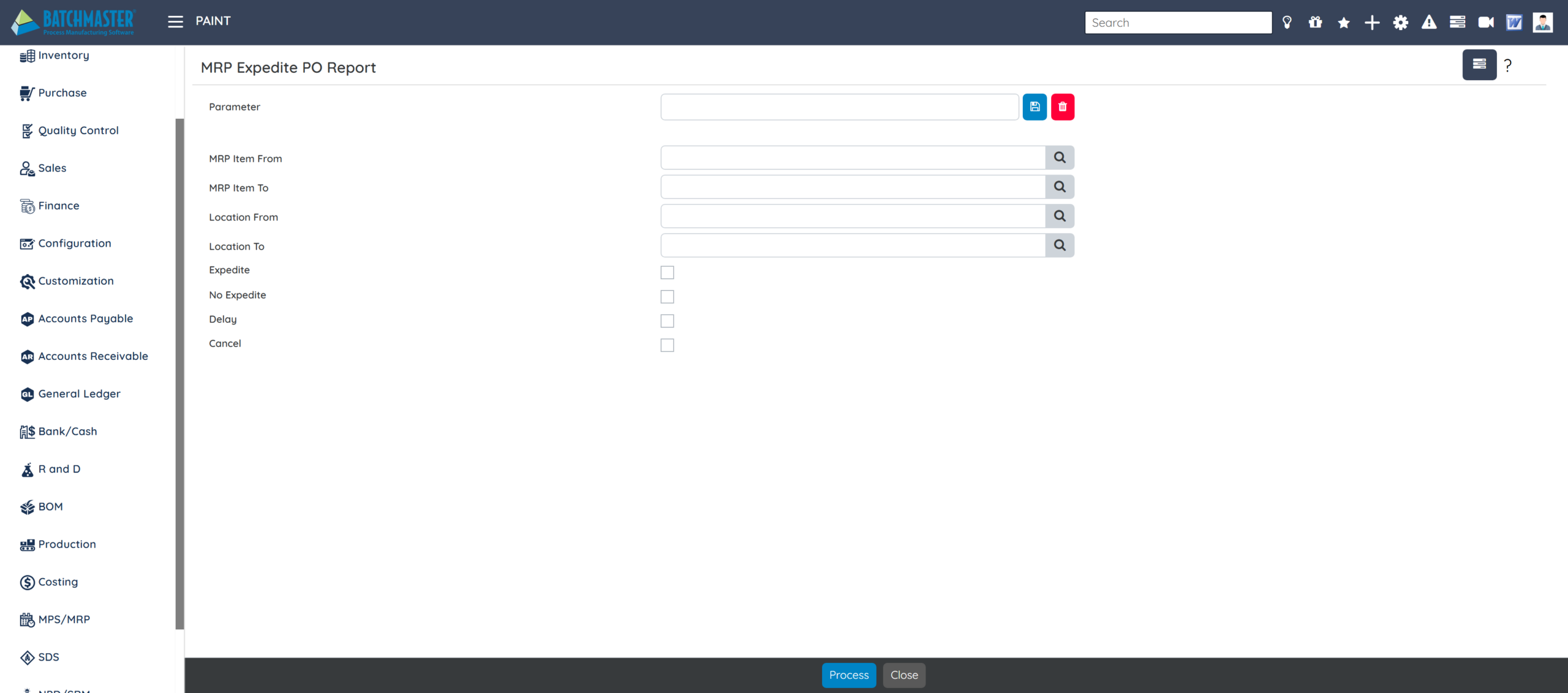
  • Expedite reporting to manage urgent procurement requirements and flag at-risk supply commitments.

  • Auto-conversion of MPS orders to purchase orders and batch production jobs reducing manual planning effort.

  • Vendor and item-level lead time management factored into planned order dates and procurement scheduling.

  • Planned order consolidation and splitting for quantity and date optimization against available capacity.

  • Demand-Driven Material Planning
Demand Purchase
  • Purchase orders generated from confirmed MPS orders, open production batches, sales orders, and forecasts in a single planning run.

  • Full supply netting across on-hand inventory, open purchase orders, in-transit receipts, and planned production outputs.

  • MRP run by warehouse, by item, or across a range of items and locations for targeted or enterprise-wide planning.

  • Intermediate batch scheduling integrated into material planning, with sub-assembly and WIP requirements planned alongside raw material procurement.

  • MRP processing run on a scheduled frequency or triggered on demand for consistent, up-to-date planning cycles

  • Visual Workbench & Planner Visibility
Visual Workbench & Planner Visibility
  • Visual Workbench displaying procurement orders by item, warehouse, and vendor for consolidated planner control.

  • Calendar view of planned orders with drill-down, grouping, analysis, and rescheduling capabilities.

  • Demand-to-supply and supply-to-demand pegging providing full visibility into why and when each item is required.

  • Time-phased planning view showing required production and procurement across short-, medium, and long-range horizons.

  • User-defined planning buckets configurable in days, weeks, months, or any combination to match planning cycles.

  • Purchase Order Management & Procurement Execution
  • Automated purchase order creation directly from MRP recommendations, with no manual re-entry from planning output.

  • Expedite reporting to manage urgent procurement requirements and flag at-risk supply commitments.

  • Auto-conversion of MPS orders to purchase orders and batch production jobs reducing manual planning effort.

  • Vendor and item-level lead time management factored into planned order dates and procurement scheduling.

  • Planned order consolidation and splitting for quantity and date optimization against available capacity.

What Generic ERP Misses in Lot Traceability

Generic ERP

  • Lot tracking covers finished goods. Raw material lot lineage is a manual spreadsheet exercise

  • Co-products and by-products have no lot inheritance and are invisible in the trace chain

  • Expiry blocking is manual or unenforced. , expired lots can be issued into production or shipped

  • Recall scope defaults to all inventory for an item. No lot-level precision means unnecessary holds

  • Trace-amount ingredients are rounded or dropped, creating compliance gaps in micro-dosed formulations

BatchMaster Lot Traceability

  • End-to-end lot genealogy from vendor receipt through customer shipment in a single trace query

  • Co-product and by-product lots inherit parent batch lineage automatically with no gaps in the trace path

  • Expired lots are automatically blocked from production and shipment; near-expiry lots flagged for QC review before they move

  • Graphical traceability tool identifies exactly which lots are affected, limiting the recall to the minimum necessary scope

  • Decimal-level quantity precision ensures even trace-level ingredients are tracked and traceable for regulatory compliance

Results from real MRP implementations.

< 15 min

Process manufacturers worldwide running active lot traceability on BatchMaster

3,000+

Process manufacturers worldwide running active lot traceability on BatchMaster

45+ yrs

Exclusively serving process manufacturing industries that require lot traceability by regulation

"The traceability from purchasing the material, receiving the material, to using the material, to testing the material, all has to be recorded and kept for a certain period of time... Because of the ability of the software and us to track all that stuff, we've been able to become certified for GMP and USD Organic."

Chris Beekman,
COO & Managing Partner, Florida Nutrition

FAQs (Frequently Asked Questions)

Can BatchMaster trace a lot across multiple plants or warehouse locations?
Yes. BatchMaster’s lot traceability operates across all warehouses, bins, tanks, and coolers under a single unified structure. Lot numbers are validated at every inventory movement including inter-warehouse transfers, so the trace chain is never broken when a material or finished good moves between locations. Enterprise-wide lot queries return results across all sites, with the ability to drill down by item, location, lot, or transaction.
How does BatchMaster handle traceability for co-products and by-products?
Co-products and by-products produced during a batch job automatically inherit the parent batch’s lot lineage. Their lot numbers are linked to the originating batch job and the raw materials that went into it. This means recovered materials, a glycerin by-product, and a concentration intermediate are inside the trace chain from the moment they are produced, not tracked separately in a spreadsheet. If that recovered material is later used in another batch job, the trace chain extends forward automatically.
How does BatchMaster support mock recalls and regulatory audit readiness?
BatchMaster’s graphical lot traceability and recall tool lets quality teams run forward and backward traces on any lot number in minutes, the same process used for a real recall is also used for mock recall exercises required by GFSI, BRC, and SQF certifications. The system generates recall letters for affected suppliers and customers directly from the trace results. Master Batch Records with full lot data are available for FDA review. Every inventory transaction maintains a complete audit trail from receipt through shipment, supporting cGMP, FSMA, and HACCP audit readiness without manual report compilation.
Our current ERP has lot tracking. What does BatchMaster do differently?

Generic ERP lot tracking typically covers finished goods and basic receiving, but leaves raw material genealogy, co-product lineage, and QC-driven lot holds as manual processes. BatchMaster is built specifically for process manufacturing, where ingredients are present in trace quantities that must be tracked to decimal precision, co-product and by-product lots inherit batch lineage automatically, and expiry blocking and FEFO enforcement are built-in. If your current system requires spreadsheets alongside it to answer the question “which customers received product made with this vendor lot,” that gap is exactly what BatchMaster’s traceability module closes.

Is mobile and barcode scanning supported for lot capture in the warehouse?
Yes. BatchMaster’s Mobile Warehousing module supports barcode-scanned receiving, put-away, picking, transfers, and adjustments, updating lot records at the moment of transaction. Lot creation, expiry capture, and quality status assignment happen at the dock, not at a desktop later. This means the lot chain is accurate from the first moment a material enters the plant, with no lag between physical movement and system record.
Process Manufacturing ERP Q&A
Batchmaster
Privacy Overview

This website uses cookies so that we can provide you with the best user experience possible. Cookie information is stored in your browser and performs functions such as recognising you when you return to our website and helping our team to understand which sections of the website you find most interesting and useful.