📚 New Blog Posts
1. The Real Reasons ERP Projects Succeed or Fail
2. Why Formula Management Is Critical for Process Manufacturers?
3. How SIPCO Innovations Cut Procurement Planning Time by 50%
The Brief
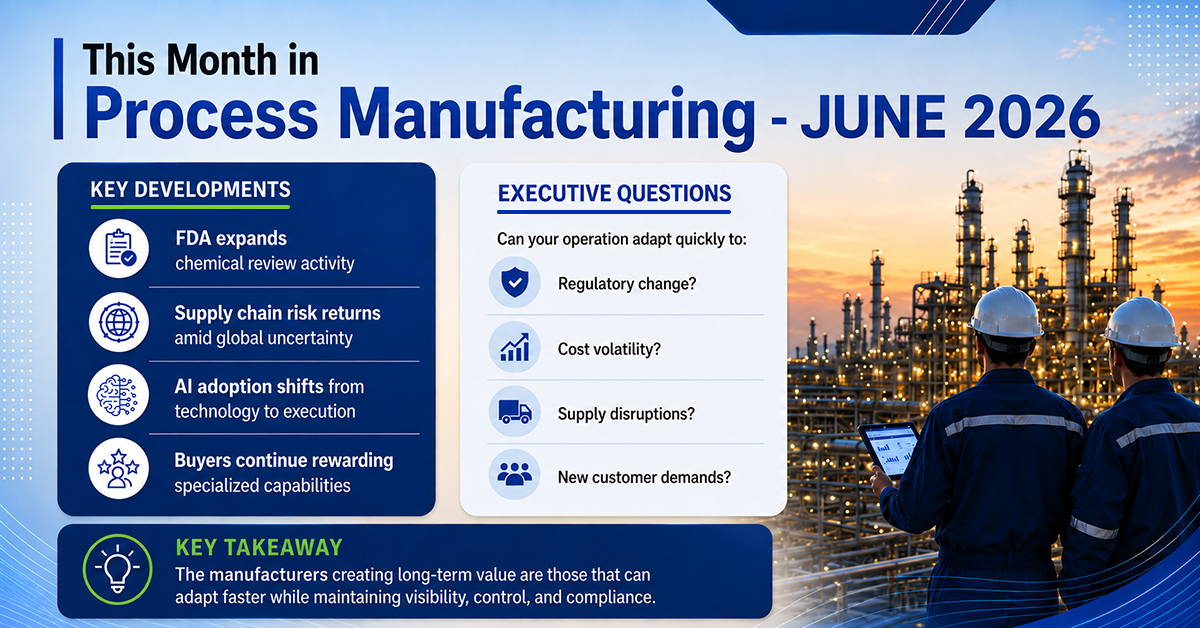
June reinforced a growing reality across process manufacturing: adaptability is becoming a competitive advantage.
FDA ingredient reviews accelerated, input cost volatility returned, and supply chain uncertainty increased as geopolitical tensions affected global trade and energy markets. At the same time, AI discussions shifted from technology adoption to operational execution.
Across food, beverage, nutraceutical, pharmaceutical, chemical, and personal care manufacturing, the companies best positioned for growth are those that can adapt faster while maintaining visibility, control, and compliance.
Compliance & Regulatory Watch
FDA Expands Chemical Review Infrastructure
June marked another step forward in the FDA’s transition from one-time ingredient reviews toward continuous chemical oversight.
Following the February reassessment of BHA and May Requests for Information on BHT and Azodicarbonamide (ADA), the FDA continued building its Enhanced Systematic Process for Post-Market Assessment of Chemicals in Food. The agency also published an updated list of chemicals currently under review, reinforcing that post-market assessment is becoming an ongoing process rather than a periodic initiative.
Ingredients Under Active Scrutiny
Current review priorities include:
- BHA
- BHT
- Azodicarbonamide (ADA)
- Phthalates used in food-contact materials
- GRAS self-affirmed ingredients lacking formal FDA review
The FDA also advanced its review of phthalates used in food-contact materials; opening another area manufacturers should monitor closely.
→ Operational impact: For food, beverage, nutraceutical, pharmaceutical, and personal care manufacturers, ingredient governance is becoming a continuous operational requirement.
Manufacturers increasingly need:
- Faster formulation visibility
- Ingredient-level traceability
- Stronger supplier documentation
- More agile change management processes
The challenge is no longer simply demonstrating compliance. It is maintaining readiness as review priorities evolve.
Compliance Watch: Traceability and Data Integrity
FSMA 204
Although the compliance deadline remains July 2028, preparation activity accelerated throughout June.
Retailers and supply chain partners continue requesting enhanced traceability visibility ahead of regulatory enforcement.
Operationally, manufacturers are discovering that traceability failures often occur at handoffs between procurement, production, quality, and distribution rather than within individual departments.
GMP and Digital Documentation
Inspection activity continues emphasizing:
- Batch record accuracy
- Deviation documentation
- Process verification
- Electronic record integrity
Manual processes remain one of the most common sources of compliance risk.
21 CFR Part 11
For pharmaceutical, nutraceutical, and regulated manufacturers, digital validation expectations continue to increase.
The focus is shifting toward:
- Secure audit trails
- Validated systems
- Data consistency
- Tamper-evident records
The underlying question regulators increasingly ask is simple:
Can manufacturers prove operational control through their records?
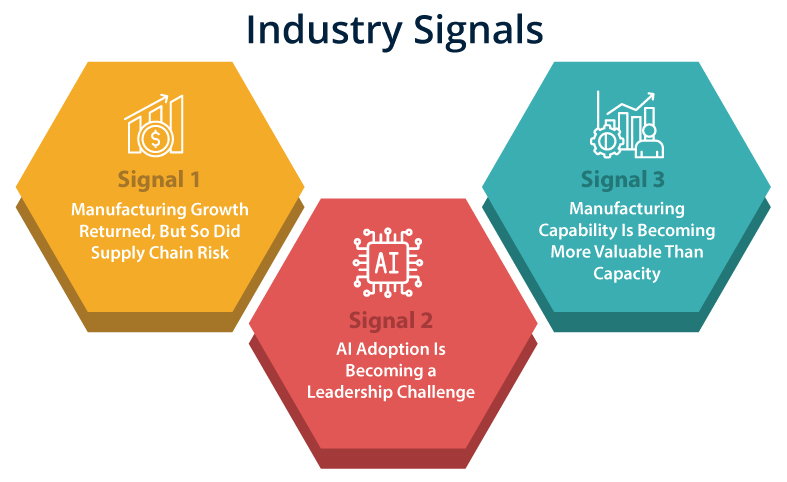
Signal 1: Manufacturing Growth Returned, But So Did Supply Chain Risk
What happened
U.S. manufacturing activity reached its highest level in four years during May, with the ISM Manufacturing PMI rising to 54.0. However, much of the growth was accompanied by inventory building and supplier concerns linked to geopolitical tensions affecting Middle East shipping routes and the Strait of Hormuz.
Manufacturing implication
Growth remains positive, but supply chain stability is becoming less predictable.
Manufacturers are once again evaluating:
- Safety stock strategies
- Supplier diversification
- Energy exposure
- Raw material sourcing flexibility
Before your next leadership meeting, ask:
How quickly can we adapt sourcing and production plans if supply disruptions intensify?
Signal 2: AI Adoption Is Becoming a Leadership Challenge
What happened
New manufacturing research continues showing that AI adoption struggles are increasingly tied to leadership readiness and frontline execution rather than technology availability. Many organizations have launched AI initiatives but struggle to integrate them into day-to-day operational decision making.
Manufacturing implication
The limiting factor is no longer access to AI tools.
The challenge is aligning:
- Workflows
- Accountability structures
- Decision-making processes
- Plant-level adoption
Before your next leadership meeting, ask:
Are we implementing AI technology, or redesigning how decisions are made?
Signal 3: Manufacturing Capability Is Becoming More Valuable Than Capacity
What happened
June deal activity continued rewarding manufacturers with specialized capabilities rather than generalized production capacity.
Strategic buyers focused on ingredient systems, specialty formulations, technical expertise, and operational integration rather than simply expanding output.
Manufacturing implication
Capabilities such as:
- Traceability
- Formulation expertise
- Regulatory readiness
- Operational integration
are becoming stronger differentiators than capacity alone.
Before your next leadership meeting, ask:
What unique operational capability would a buyer value most in our business today?
M&A Intelligence
£3.7B transaction value: Ingredion announced acquisition of Tate & Lyle (Food Ingredients)
Ingredion announced an all-cash offer to acquire Tate & Lyle, creating a larger specialty ingredient platform focused on texturants, sugar reduction, fortification, and formulation expertise.
Signal: Buyers continue investing in specialized ingredient capabilities rather than commodity ingredient scale.
Strategic ingredient platform expansion: Ingredion acquired Benicaros from Nutrileads
Ingredion acquired Benicaros, including intellectual property, clinical research, manufacturing know-how, and commercial rights related to the immune-support ingredient platform.
Signal: Proprietary ingredients supported by scientific validation continue attracting strategic interest.
Ongoing chemical manufacturing consolidation
Specialty chemical buyers continue pursuing manufacturers with differentiated formulation expertise, domestic production assets, and technical service capabilities.
Signal: Manufacturing expertise is increasingly being valued as intellectual property, not simply operational infrastructure.
Valuation Signal
June reinforced a clear trend across process manufacturing:
Buyers are paying for adaptability.
Manufacturers attracting stronger valuation interest increasingly demonstrate:
- Regulatory readiness
- Traceable operations
- Specialized capabilities
- Faster response to market changes
The valuation premium is shifting toward manufacturers that can adapt quickly without disrupting quality, compliance, or profitability.
Final Takeaway
June’s signals point to a broader shift across process manufacturing.
The strongest manufacturers are no longer distinguished solely by scale, output, or growth rates. They are increasingly differentiated by how quickly they can adapt to changing regulations, volatile costs, evolving customer expectations, and operational disruptions.
Across food, beverage, nutraceutical, pharmaceutical, chemical, and personal care manufacturing, adaptability is becoming a measurable business advantage.
The manufacturers that build flexibility into their operations today will be better positioned to protect margins, maintain compliance, and create long-term enterprise value tomorrow.
Resources & Sources
MAHA & Ingredient Policy
- FDA Finalizes Food Chemical Safety Post-Market Assessment Program, Launches Reassessment of BHT & ADA
- FDA List of Select Chemicals in the Food Supply Under Review
- FDA Launches Assessment of BHA, a Common Food Chemical Preservative
Compliance & Regulatory
- FDA Post-Market Safety of Chemicals in Food Program
- FDA Human Foods Program Updates
Industry Signals
- Manufacturing Activity & Cost Pressure
- ISM Manufacturing PMI Report – May 2026
- Reuters – U.S. Manufacturing Activity Rises to Four-Year High
- AI & Manufacturing Execution
- Manufacturing Dive – Frontline Leaders Are Crucial for Adopting AI
- 2026 Roadmap on Artificial Intelligence and Machine Learning for Smart Manufacturing
- Reuters – AI Investment Supporting Manufacturing Growth
- Manufacturing Investment & Operational Transformation
- AP News – Nvidia and AI-Driven Manufacturing Investment
- Unilever Expands AI-Powered Digital Twins Across Manufacturing Network
- Chemical & Sustainability Signals
- Reuters – Why Winning the Next Industrial Revolution Starts with Greener Chemistry