📚 New Blog Posts
1. How SIPCO Innovations Cut Procurement Planning Time by 50%
2. MPS and MRP in Process Manufacturing ERP: Differences, Planning Process, and Best Practices
3. The Complete Procure-to-Pay Process for Process Manufacturers: From Demand Planning to Final Payment
Across process manufacturing industries such as food and beverage, nutraceuticals, personal care, or specialty chemicals, the formula is the product. It defines what goes in, what comes out, what it costs to make, whether it meets quality standards, and whether it holds up under regulatory scrutiny. Every procurement decision, every production run, every compliance filing traces back to it. Get the formula right, and downstream operations become significantly more predictable and efficient. Get it wrong, and the ripple effects are costly, and often invisible until the damage is already done.
Yet despite carrying this level of operational and financial importance, formula management at many process manufacturing companies still relies on spreadsheets, disconnected systems, and tribal knowledge shared through emails and manual documentation.
In our recent webinar on Product Development with an industry-specific ERP, we explored where traditional processes begin to break down and how purpose-built process manufacturing ERP systems help address these challenges. What came through clearly is that the challenge is rarely about intent. Manufacturers want to get formulation right, but the tools that are used were never built for the complexity they are managing.
Watch the short preview below and access the full webinar recording here.
This article covers the core pain points that manufacturers face in formulation, the capabilities that directly address them, and what it means for business performance when formulation is managed efficiently.
The Problem Goes Beyond Spreadsheets and Generic ERP Systems
When most executives think about formulation challenges, they think of it as a technical or operational problem. A chemist issue. A lab issue. Something that gets sorted out before it reaches the decision-makers.
But the impact of poorly managed formula development shows up in places leadership absolutely notices: missed margins, delayed product launches, failed audits, and reactive fire-drills every time a regulatory change or ingredient substitution lands on the table.
Here is how it typically plays out at the ground level, and why it matters at the top.
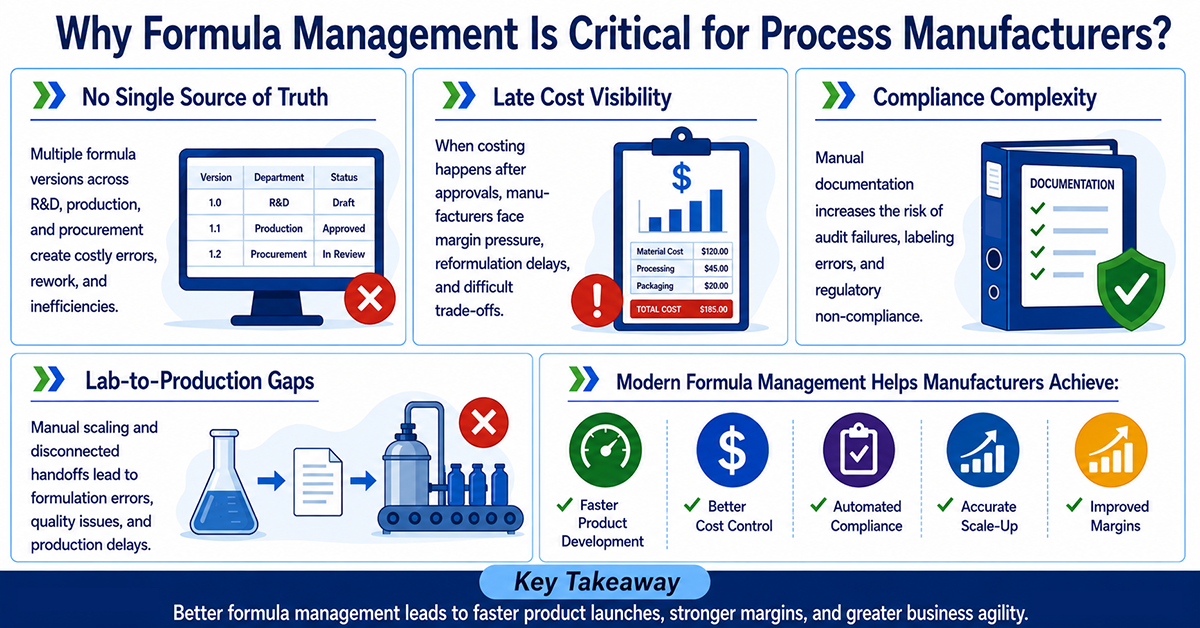
No single source of truth: R&D is working off one version of a formula. Production has a printout from last month. Procurement received something over email. Everyone assumes they have the right version. In many cases, no one does. The resulting inconsistency does not just create operational headaches; it creates financial risk. When different teams execute different data, the impact often appears as waste, rework, and production inefficiencies, and margin erosion that are difficult to trace back to their origin.
Cost visibility comes too late: The typical workflow in most manufacturing environments means a formula goes through multiple development and approval cycles before anyone runs a full cost analysis. By the time the number lands, the product may already be approved for production. If it is over budget, the options are limited and none of them are good. Cutting corners on ingredients affects quality. Absorbing the cost affects margins. Going back to square one affects time-to-market. The impact of discovering cost issues late in the development cycle is not just financial but becomes a strategic business issue.
Compliance documentation is always a last-minute scramble: Supplement fact panels, GHS safety data sheets, allergen declarations, INCI-ordered ingredient statements, Halal and Kosher certifications. For most teams, these documents are assembled manually, pulling data from different sources, reformatting it, and hoping nothing has changed since the last version. The process may appear manageable until a single missed update creates a compliance or audit issue. One ingredient change that someone forgot to cascade through the documentation is all it takes to fail an audit or hold up a product launch.
Getting from lab to production takes longer than it should: A formula that works perfectly at a five-pound lab batch does not automatically translate to a five-hundred-pound production run. Scaling requires recalculation, and when those calculations are performed manually, the likelihood of formulation and costing errors increases significantly. More critically, without a structured handoff process between R&D and production, the gap between what the lab developed and what the floor actually executes grows with every iteration.
These are not small inefficiencies. Across a product portfolio, they compound. And for a CEO evaluating product velocity or a CFO scrutinizing gross margins, they show up as underperformance that is hard to explain because the root cause is buried deep in how formulas are created and managed.
The answer is not more spreadsheets with better version control. It is a system purpose-built for the way manufacturers actually work, where formulation is not an isolated function but a connected process that flows naturally into costing, compliance, production, and sales.
Here is what that looks like in practice:
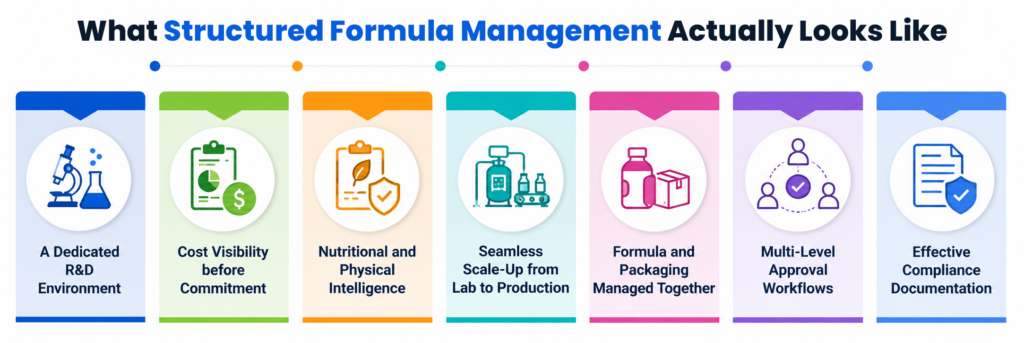
A dedicated R&D environment that is isolated from live production: The starting point is providing R&D and product development teams with a controlled environment to experiment without impacting live production data. Formula iterations, what-if scenarios, and version testing should all happen in an environment that is completely separate from anything that could influence an active production batch. Every new product request, from the moment it enters the system to the moment the formula is promoted to the production library, should be fully tracked, with every change, every version, and every approval logged in sequence.
This is not just about operational safety. It is about accountability. When a formula problem surfaces in production six months from now, the ability to trace every change and every decision back to its origin is both a compliance requirement and a business protection.
Cost visibility before commitment: One of the most significant advantages of structured formula management is the ability to shift cost analysis earlier into the product development lifecycle. Before a formula moves anywhere near production, ingredient costs can be evaluated across three valuation methods: average, standard, or last purchase price, alongside fully loaded labor costs that include setup, overhead, and variable factors by batch size, plus consumables. Two or three formula variations can be compared side by side, so the tradeoff between a cheaper ingredient and its nutritional or performance impact is visible before anyone has committed to either.
For a CFO or VP of Finance, this is the difference between having a cost management strategy and finding out you have a problem after the fact. Understanding projected margins before production is no longer optional for manufacturers operating in highly competitive markets.
Nutritional and physical intelligence built into the formula: For manufacturers in food, beverage, and nutraceuticals, nutritional data should not be a manual lookup. Integration with the USDA and Genesis databases means nutritional values flow directly into the formula, and the system flags any ingredient that exceeds target thresholds for fat, sugar, protein, or vitamins in real time. If you are trying to hit a specific nutritional profile, the system can even reverse-engineer ingredient quantities to achieve a target value, identifying which raw materials contribute a specific nutrient and auto-sizing them to meet the goal.
For manufacturers in chemicals, paints and coatings, or personal care, the equivalent capability covers VOC calculations, and regional compliance thresholds. The logic is the same: the system automates the underlying analysis so teams can focus more on product innovation and decision-making rather than manual calculations.
Seamless scale-up from lab to production: When a formula is ready to move from lab to floor, the system auto-scales batch quantities without manual recalculation. A five-pound lab batch scales correctly to a five-hundred-pound production run, with all ingredient ratios, loss factors, and labor times adjusting proportionally. This closes the most common gap in the lab-to-production handoff and removes a category of error that affects both product quality and cost accuracy.
Formula and packaging managed together, not separately: Product management requires handling both the formula and its packaging specifications, and these two elements are often managed in completely disconnected ways. A structured system links them at the top level while managing them independently. An intermediate formula carries its base ingredients, QC tests, SOPs, labor, costs, and certifications. That feeds into a finished goods formula. On the packaging side, the fill container bill of materials and the full packaging BOM are managed separately with their own specs, labeling requirements, and assembly instructions.
The operational benefit is significant: If a finished product comes in three different pack sizes, the formula does not need to be duplicated three times. The formula stays the same; only the packaging configuration changes. For operation teams managing SKU proliferation, this distinction saves significant administrative overhead.
Multi-level approval workflows with complete version history: Every formula should move through a structured approval process before it touches production. Parallel and hierarchical approval configurations mean the process does not stall when a key approver is unavailable; a secondary approver can step in without breaking the workflow. Every change is tracked with revision numbers, dates, timestamps, and user attribution. Version comparisons are available side by side, so any team member can see exactly what changed between version three and version five, why, and who approved it.
For companies operating under FDA 21, CFR Part 11, FSMA, MOCRA, or GHS requirements, these capabilities are no longer optional but a mandatory compliance foundation.
Compliance documentation that generates itself: FDA-compliant nutrition and supplement fact panels generate automatically from formula data, with no manual calculation required. GHS labels, safety data sheets, and allergen declarations are produced from the same ingredient data already in the system. Ingredient statements are automatically ordered by weight and formatted to INCI or common name standards. Halal, Kosher, and USDA Organic certifications are tied directly to ingredients and formulas, which means if an ingredient changes, the impact on certification claims surfaces immediately.
The practical implication for compliance and quality leadership is significant: teams are no longer assembling documentation from scratch before every audit. It already exists, it is accurate, and it reflects the current state of the formula.

Taken individually, each of these capabilities solves a specific operational problem. Taken together, they change how a process manufacturing business performs against the metrics that matter most to leadership.
Faster Time to Market
Faster time to market comes from fewer cycles between R&D, QA, and production. When every team is working from the same formula in the same system, time-consuming back-and-forth regarding formula versions and approvals is significantly reduced. Decisions that previously took days because information had to be collected from multiple places take minutes because everything is already in one place.
Tighter Margins
Tighter margins come from knowing costs before commitment rather than discovering problems after production has begun. The ability to compare formula scenarios side by side and run full cost analysis at the development stage turns formula approval into a genuine financial decision, rather than a purely technical approval process.
Audit Readiness
Audit readiness comes from having every change, every approval, and every document tracked automatically as a byproduct of the normal workflow. Audit preparation becomes significantly easier because documentation is generated and maintained as part of the normal operational workflow.
And the ability to respond faster to market demands, whether that means reformulating to accommodate an ingredient shortage, adjusting a nutritional profile for a new market, or adapting to a regulatory change, comes from having formulas that can be modified quickly in a controlled environment, with the cost and compliance impact visible before the change is committed.
A Platform, Not Just an add-on
One point worth emphasizing for senior leadership evaluating where formula management fits in a broader technology strategy: formulation is not an isolated capability. It is the starting point for procurement, production, quality control, and regulatory compliance. When formulation operates in isolation, the downstream effects ripple through every function. When it is integrated into a platform that connects R&D with costing, sales with production planning, and QA with compliance documentation, the business operates with a coherence that genuinely changes outcomes.
For companies already running QuickBooks, Microsoft Dynamics, Sage, or similar financial systems, this kind of manufacturing-specific capability does not require replacing existing technology. It works alongside the financial infrastructure already in place, adding the process manufacturing depth that generic platforms were never built to provide.
The Question Manufacturing Leaders Should be Asking
The right question for a CEO or CFO to ask is not “do we have a formula management problem?” Most process manufacturers do, even if the symptoms present as margin erosion, slow launches, or recurring compliance stress rather than as a formulation issue.
The right question is: how much operational efficiency, margin improvement, and product agility are we sacrificing by managing formulation processes with outdated tools and disconnected workflows?