



📚 New Blog Posts
2. How a $20 Million Paint & Coatings Manufacturer Finally Saw Where It Was Making Money
3. This Month in Process Manufacturing – February 2026
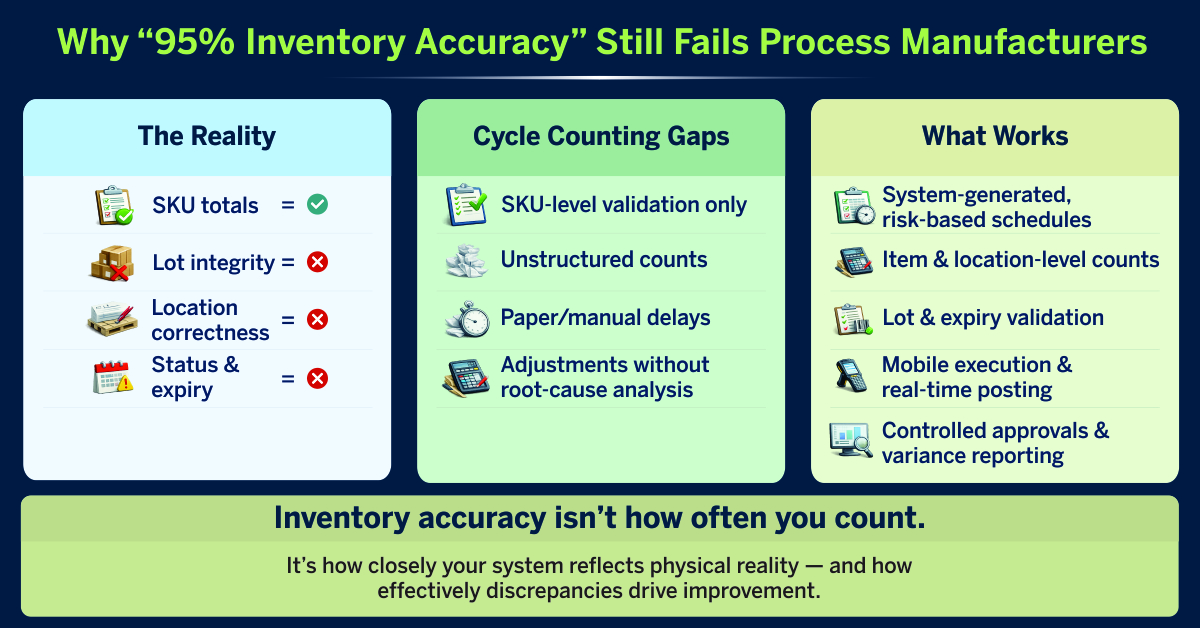
Inventory accuracy isn’t what most people think it is.
A business might report “95% accurate inventory,” but if that number reflects only SKU totals, it hides deeper complexity, especially in process manufacturing, where materials are lot-controlled, expiry-sensitive, and constantly moving.
True accuracy means more than quantity. It means the right lot, in the right location, with the right status, available at the right time.
Suppose your ERP shows 500 units of ingredient X on hand. Production begins only to discover the lot due to expire first isn’t where the system says it is. Meanwhile another lot has passed its usable date but still appears available.
The SKU total was correct but operational reality was not.
In environments with rework, quality holds, multiple storage zones, and expiry constraints, SKU-level accuracy provides false comfort. When data does not reflect physical location, lot identity, or status, leadership believes inventory is under control, until it isn’t.
The consequences extend beyond stockouts. Planning degrades. Procurement decisions distort. Expedited freight increases. Write-offs rise.
Inventory inaccuracy is not a minor operational issue but a silent performance drag.
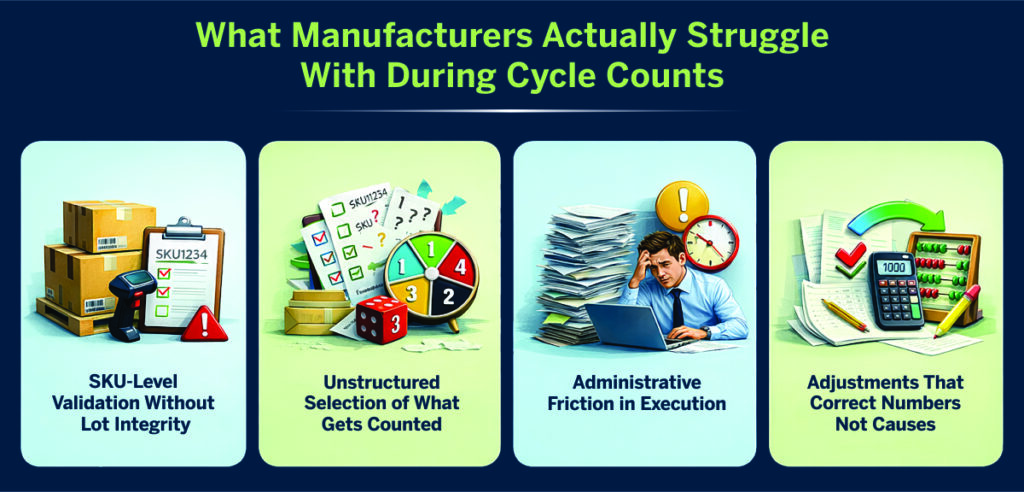
What Manufacturers Actually Struggle With During Cycle Counts
If inventory accuracy breaks down structurally, cycle counting is where the breakdown becomes visible.
Most manufacturers understand the importance of cycle counting. The difficulty lies in execution, especially in environments where materials move constantly, lots expire, and quality statuses shift in real time.
In practice, cycle counting tends to break down in the following areas:
1. SKU-Level Validation Without Lot Integrity
A count may confirm that total quantity matches the system. But in process manufacturing, accuracy is rarely about totals.
A material may exist, but in the wrong lot.
A lot may exist, but in the wrong location.
Inventory may appear available, but is actually under quality hold.
When counts validate only SKU totals, deeper discrepancies remain hidden.
2. Unstructured Selection of What Gets Counted
In many operations, count selection is manual or loosely scheduled.
High-risk materials do not always receive higher frequency validation, whereas low-impact items are sometimes counted repeatedly.
Without structured, risk-based logic, cycle counting becomes activity and not strategy.
3. Administrative Friction in Execution
Paper-based sheets. Delayed system entry. Manual reconciliations.
Each additional handoff increases the gap between physical reality and system records. In fast-moving facilities, even small delays compound into recurring inaccuracies.
4. Adjustments That Correct Numbers Not Causes
Discrepancies are found. Adjustments are posted.
But unless variance drivers are categorized, reviewed, and trended, the same patterns repeat.
Without root-cause visibility by item, location, or process, cycle counting becomes corrective rather than preventative.
The issue is not whether cycle counts are performed. It is whether the process is structured to surface systemic issues or merely reconcile quantities.
That distinction determines whether cycle counting becomes an operational control mechanism or remains an administrative task.
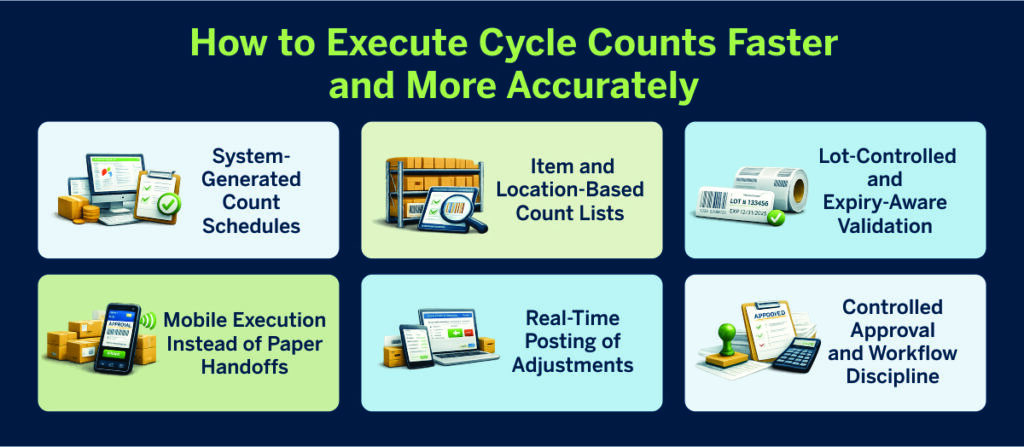
How to Execute Cycle Counts Faster and More Accurately
If execution gaps expose the problem, structured design is what prevents it.
Cycle counting becomes faster and more accurate when the process is engineered correctly, not when teams simply count more often.
The following design elements consistently separate reactive counting from disciplined execution:
1. System-Generated Count Schedules
When supervisors manually decide what to count, prioritization becomes inconsistent. Counting schedules often fail to align with actual risk and operational impact.
A disciplined approach uses system logic based on value, movement, expiry risk, or historical variance, to automatically generate count schedules. This removes subjectivity and ensures attention is directed where risk is highest.
Speed improves because time isn’t spent deciding what to count.
Accuracy improves because priority items are not overlooked.
2. Item and Location-Based Count Lists
In process environments, location integrity is just as critical as quantity.
Counts should not only confirm “how much,” but also “where.”
System-generated count lists that tie items to specific bins or storage locations eliminate guesswork. They reduce search time, prevent double-counting, and surface misplaced materials before they disrupt production.
When location logic is built into the count, execution becomes cleaner and more predictable.
3. Lot-Controlled and Expiry-Aware Validation
For process manufacturers, lot integrity is non-negotiable.
Counting by SKU without validating lot details leaves blind spots. A lot nearing expiry, sitting in the wrong location, or incorrectly marked as available can derail planning.
Cycle counting must validate:
- Lot identity
- Expiry status
- Quality or hold conditions
This level of verification protects planning accuracy and prevents downstream surprises.
4. Mobile Execution Instead of Paper Handoffs
Paper introduces delay. Delay introduces drift.
Mobile scanning tied directly to the ERP or any other system eliminates transcription errors and compresses the time between physical validation and system update.
Counts recorded at the point of activity reduce rework, minimize lag, and allow teams to operate in real time, not retrospectively.
Speed increases because there are fewer handoffs.
Accuracy increases because there are fewer manual touches.
5. Real-Time Posting of Adjustments
Inventory is dynamic. If adjustments are delayed, new transactions may occur before discrepancies are reconciled, compounding inaccuracy.
Posting adjustments in real time, with clear variance visibility, keeps system records aligned with physical reality.
For example, if a raw material is counted in the morning but a production issue or transfer occurs before the adjustment is posted, the system may reflect a corrected balance that is already outdated.
6. Controlled Approval and Workflow Discipline
Accuracy without accountability does not sustain.
Well-designed cycle count processes include:
- Defined variance thresholds
- Mandatory reason codes
- Segregation between counting and approval
- Controlled adjustment workflows
This ensures discrepancies are reviewed before being absorbed into the system, preserving audit integrity and operational trust.
When cycle counting is designed with this level of structure, it shifts from a recurring task to a controlled operational mechanism.
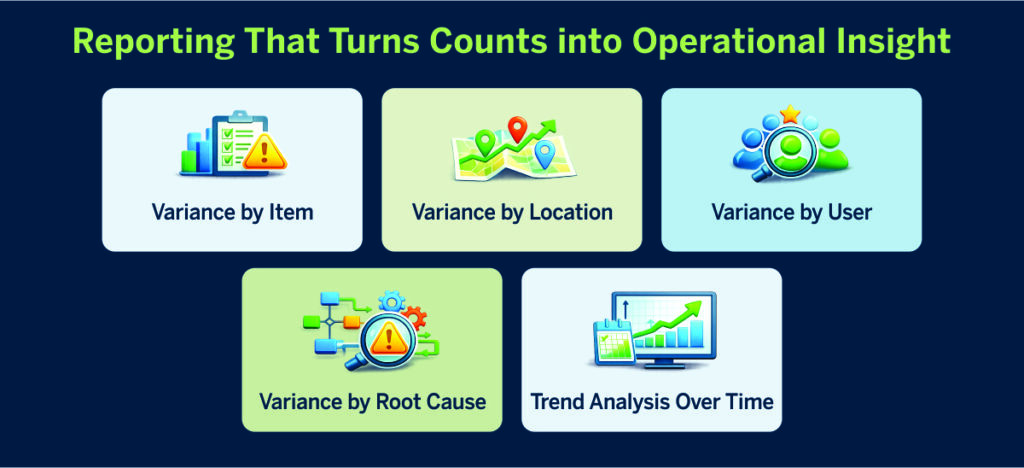
Reporting That Turns Counts into Operational Insight
Cycle counting creates data. Reporting determines whether that data becomes insight.
Without structured reporting, a cycle count ends when an adjustment is posted. With proper analysis, it becomes a feedback system.
To transform cycle counting from correction into control, reporting must be structured across several key dimensions, as mentioned below:
1. Variance by Item
Some materials repeatedly show discrepancies. Others rarely do.
Variance-by-item reporting highlights which SKUs consistently drift from system records. These patterns may indicate:
- Shrinkage
- Yield miscalculations
- Unit of measure confusion
- Transaction timing gaps
- Handling or storage errors
Without item-level variance visibility, high-risk materials remain hidden inside aggregate accuracy percentages.
2. Variance by Location
In process environments, location integrity is critical.
If one bin or warehouse zone consistently produces discrepancies, the issue is rarely random. It may point to:
- Poor put-away discipline
- Incomplete transfer transactions
- Staging area confusion
- Overlapping responsibilities
Location-based variance reporting surfaces operational friction that manual reviews often miss.
3. Variance by User
When discrepancies are tracked by user or role, organizations gain visibility into:
- Training gaps
- Process misunderstandings
- Transaction timing behaviors
- Repeated override patterns
This is not about fault-finding. It is about identifying where execution deviates from defined procedures.
4. Variance by Root Cause
Posting adjustments without categorization closes the loop numerically but not operationally.
Structured reporting requires variance to be coded:
- Transaction timing
- Damaged goods
- Expired materials
- Misplaced inventory
- Production over/under-consumption
- Data entry errors
Root-cause reporting transforms discrepancies from isolated events into actionable intelligence.
5. Trend Analysis Over Time
A single variance event is noise. Recurring patterns are signal.
Trend reporting allows leadership to see:
- Whether discrepancies are increasing or declining
- Whether corrective actions are effective
- Which materials consistently require intervention
- Which locations remain unstable
Frequent, smaller counts make variance easier to analyze while transactions are still recent, reducing investigative ambiguity.
Cycle counting, when trended over time, becomes a stability indicator for inventory operations.
How ERP and Automation Enforce Discipline in Cycle Counting
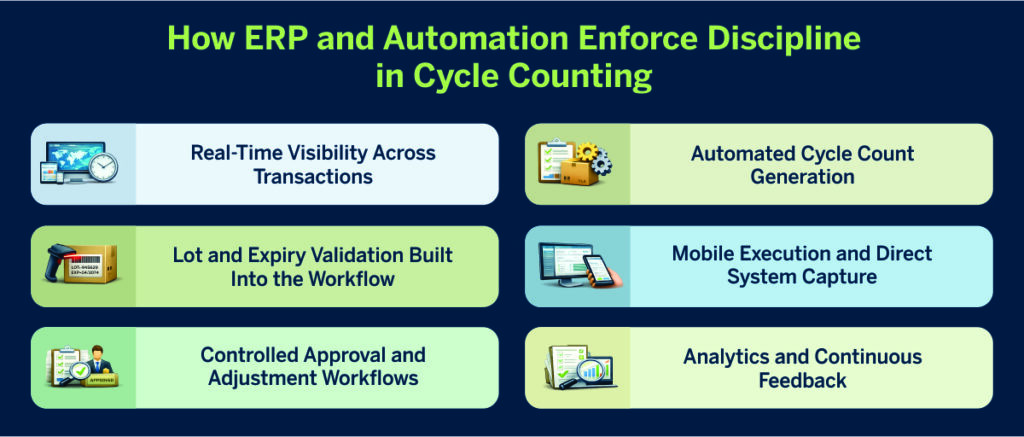
At some point, execution discipline cannot rely on individual effort alone.
Spreadsheets, paper sheets, and loosely managed count schedules may work in smaller environments. But as operations grow — more SKUs, more lots, more locations, more transactions — manual systems introduce friction, delay, and risk.
This is where ERP stops being a record-keeping system and becomes a control system.
Below are some of the key ways modern ERP systems embed discipline into the cycle counting process:
1. Real-Time Visibility Across Transactions
Inventory is not static. Materials are issued, transferred, staged, quarantined, consumed, and adjusted, often within the same shift. Without real-time synchronization between physical activity and system records, cycle counts become snapshots of a moving target.
Modern ERP platforms maintain live inventory visibility across transactions. When counts are performed and posted immediately, the system reflects operational reality and not yesterday’s approximation.
2. Automated Cycle Count Generation
Manual selection of count lists introduces inconsistency.
ERP-driven count logic allows organizations to generate schedules automatically based on ABC classification, historical variance, movement velocity, or risk profile.
This removes subjectivity from the process and ensures high-risk materials receive the frequency they require.
The system decides what needs attention — not memory or availability.
3. Lot and Expiry Validation Built Into the Workflow
In process manufacturing, lot integrity and expiry control are not optional.
An ERP that enforces lot-controlled transactions ensures that counts validate specific lots — not just aggregate quantities. Expiry-aware logic further ensures that materials nearing expiration are visible and controlled.
This reduces the risk of:
- Expired materials appearing available
- Misallocated lots disrupting production
- Compliance gaps during audits
4. Mobile Execution and Direct System Capture
Paper-based counting creates multiple handoffs.
Mobile scanning integrated directly into ERP workflows eliminates manual transcription. Counts are captured at the point of activity and immediately validated against system records.
This reduces:
- Data entry errors
- Posting delays
- Reconciliation friction
Execution becomes faster because the system is part of the workflow and not an afterthought.
5. Controlled Approval and Adjustment Workflows
Posting adjustments without oversight erodes financial integrity.
Modern ERP systems support controlled workflows with:
- Mandatory reason codes
- Variance thresholds
- Approval routing
- Audit trails
This ensures that discrepancies are reviewed before they alter inventory valuation.
6. Analytics and Continuous Feedback
ERP platforms consolidate cycle count data into actionable reporting.
Variance trends, high-risk materials, location instability, and repeat discrepancies can be analyzed centrally. Leadership gains visibility not only into “what changed” but into “why it keeps changing.”
This closes the loop between counting and improvement.
ERP does not replace process discipline but enforces it.
When automation governs scheduling, validation, posting, and reporting, cycle counting transitions from a manual corrective exercise into a structured operational control framework.
That is the difference between performing counts and building inventory reliability.
Cycle Counting Self-Assessment
Before evaluating ERP features or operational maturity, step back and ask:
Is your cycle counting program truly controlled or simply recurring?
Use the questions below as a practical diagnostic.
- Do you measure accuracy at the lot and location level, not just SKU totals?
- Is your count schedule system-generated based on risk or movement, rather than manually selected?
- Are discrepancies categorized by clear root causes and reviewed for recurring patterns?
- Are adjustments subject to defined thresholds and approval workflows?
- Can leadership see variance trends over time, not just the latest correction?
If these questions are difficult to answer confidently, cycle counting may still be operating as an administrative task and not a structured control system.
Inventory accuracy is not defined by how often you count. It is defined by how reliably your system reflects physical reality and how effectively discrepancies drive improvement.