📚 New Blog Posts
1. This Month in Process Manufacturing – August 2026
2. Inside a BatchMaster Implementation: 5 Lessons Learned
3. FSMA Compliance for Food & Beverage Manufacturers: Requirements, Risks and What to Do Now
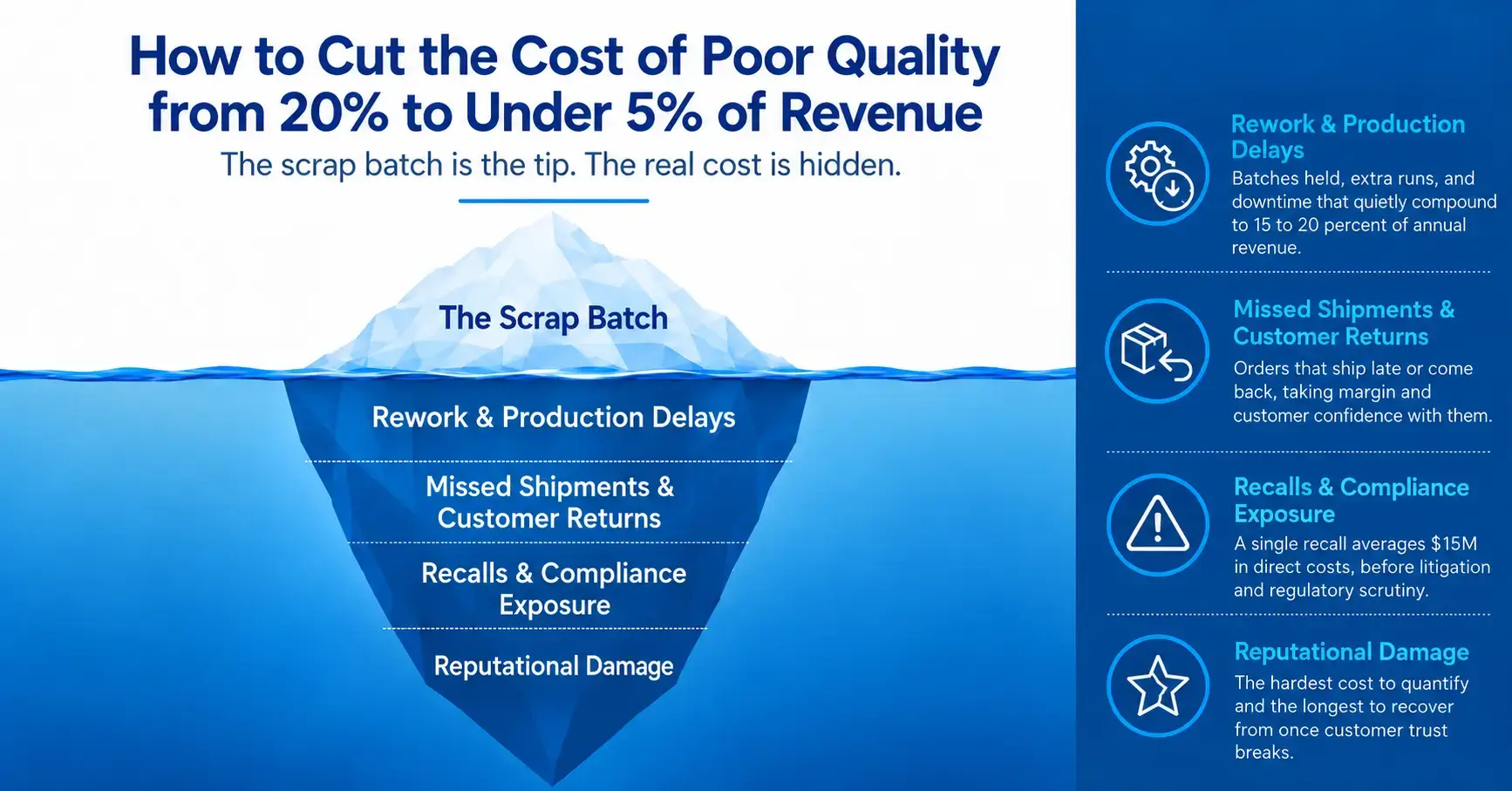
Every manufacturer knows what a scrap batch costs. It shows up on the daily production report and gets flagged in the morning stand-up. But the visible cost is the tip of the iceberg. The far larger mass sitting below the waterline is rework, production delays, missed shipments, customer returns, recalls, compliance exposure, and the reputational damage that follows a recall notice. That hidden mass is what actually sinks margin.
The cost of poor quality (COPQ) runs 15 to 20 percent of annual revenue for a typical manufacturer, while world-class operations keep it under 5 percent. Much of that gap comes down to how early quality issues are identified within the manufacturing workflow.
Poor quality usually shows up at four key stages: at receiving, on the production line, at shipment, and after the product has already left the building. Each stage compounds what the previous one missed, becoming harder to detect and more expensive to address. Understanding how quality risks evolve across these four stages can help manufacturers identify the right checkpoints and intervene earlier.
We recently held a live session, Cut Your Cost of Poor Quality with BatchMaster ERP, where we explored how quality workflows connect across four critical of process manufacturing. The session covered inbound quality control, in-process quality checks, pre-shipment quality gates, bidirectional lot genealogy, and CAPA workflows. This blog builds on that discussion, looking more closely at where he cost of poor quality builds up and how manufacturers can address it earlier in the process.
At the Dock: The Cost of Getting Inbound Quality Wrong
Receiving is the first opportunity to prevent a supplier quality issue from becoming a production problem.
When purchased materials moves directly into available inventory without proper quarantine and testing , quality issues can travel downstream before they are detected. By the time a problem surfaces during production or shipment, the affected material may already have been consumed, processed, or combined with other ingredients.
A strong inbound quality workflow establishes a clear quality gate before received materials are released for use:
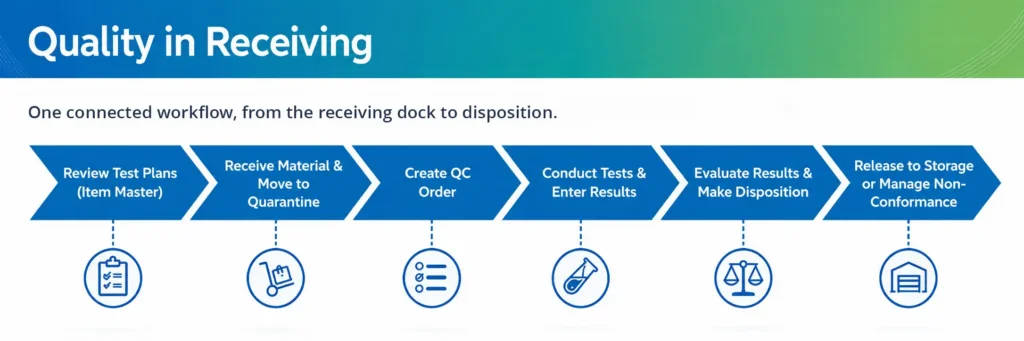
- Review the test plan: Define the required inspections, tests, specifications, and acceptance criteria for the material.
- Receive and quarantine: Place the received material in quarantine so it cannot be used until the required quality checks are completed.
- Initiate quality control: Create a QC order for the received lot to ensure the required testing is performed and documented.
- Conduct tests and record results: Capture numeric, alphanumeric, or pass/fail results against the defined specifications.
- Evaluate and determine disposition: Review the results and decide whether the material meets the established quality requirements.
- Release or manage non-conformance: Approved material moves into available inventory. Material that fails to meet specifications remains restricted and follows the appropriate non-conformance process, such as return to vendor, rework, conditional acceptance, or scrap.
This creates a controlled path from receiving through disposition, helping prevent unverified materials from entering production while maintaining a documented record of the decisions made along the way.
For many manufacturers, the challenge is maintaining this level of control when quality information is spread across spreadsheets, paper records, and disconnected systems. Test results can become difficult to trace back to the received lot, approvals may rely on manual handoffs, and retrieving the complete quality history can take valuable time. A structured, digital workflow helps keep test requirements, results, disposition decisions, and non-conformance records connected to the material throughout the receiving process.
Hear how Xseer Pharmaceuticals, a 503B outsourcing facility, moved away from paper-based processes to improve quality control and visibility.
On the Line: The Cost of Catching Quality Issues Too Late After Production
Quality issues are easier to contain when they are identified during production, while there is still an opportunity to intervene before the batch is complete.
Catching a problem only after production is finished is where scrap, rework, and downtime start to visibly eat margin. Scrap and rework alone can cost the average manufacturer up to 2.2 percent of annual revenue. At this stage, the manufacturer has already invested materials, labor, energy, equipment time, and overhead into the batch, increasing the financial impact of a quality failure.
An effective in-production quality workflow builds quality checks directly into the production process rather than relying primarily on final inspection:
- Define QC plans: Establish the required tests, specifications, and acceptance criteria for the manufactured item.
- Embed QC into batch operations: Associate required quality checks with the appropriate stages of the batch process.
- Execute production and capture data: Record production data as the batch progresses.
- Perform in-process QC checks: Capture critical readings at the appropriate production step. Depending on the product, these might include temperature, pH, viscosity, moisture, or weight.
- Quarantine non-conforming material: Restrict material when an in-process check identifies a potential quality issue.
- Conduct final QC: Perform the required finished-product tests and record the results.
- Evaluate results: Compare test results against established specifications and determine whether the finished material meets quality requirements.
- Release approved material: Make conforming material available for the next stage only after the required quality checks have been completed.
This approach creates quality checkpoints throughout production, allowing manufacturers to identify deviations closer to where they occur and maintain a documented quality history from production through final release. When material does not meet specifications, it can remain restricted while the appropriate non-conformance process determines its disposition.
Sumit Bansode, Solution Architect at BatchMaster, walks through the in-production QC workflow
At the Gate: The Cost of Letting Quality Issues Reach the Customer
The customer asking for a Certificate of Analysis is not the moment to start looking for one.
The final quality gate helps ensure that what is being shipped meets both product specifications and customer-specific quality requirements. A missing COA, incomplete test record, or unmet customer requirement at this stage can delay shipment, create questions about product quality, and affect customer confidence.
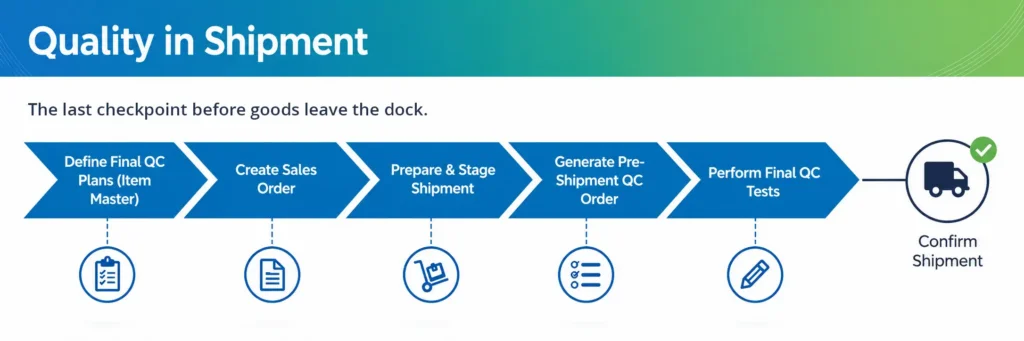
An effective shipment quality workflow creates a final checkpoint before the product leaves the facility:

- Define final QC requirements: Establish the tests, specifications, and acceptance criteria that must be satisfied before shipment.
- Create and prepare the order for shipment: Identify the specific product and lot being prepared for the customer.
- Initiate pre-shipment QC: Trigger the required quality checks before the shipment is cleared for dispatch.
- Perform final QC tests: Complete the required tests and verify the results against the defined specifications.
- Confirm shipment: Release the shipment only after the applicable quality requirements have been successfully completed.
Customer-specific requirements add another layer to this final quality gate. Different customers may require different tests, specifications, documentation, or Certificates of Analysis. Connecting these requirements to the specific product and lot being shipped helps ensure that the appropriate checks are completed and that the COA reflects approved test results for the actual shipment.
After It’s Gone: The Cost of Slow and Incomplete Traceability
When a quality issue is discovered after a product has left the facility, the ability to trace it quickly and precisely becomes critical.
Industry analysis of FDA recall data found that nearly 30% of FDA recalls were associated with quality management issues, underscoring how weaknesses in quality processes can continue to create risk even after a product leaves the facility.. Beyond the immediate cost of managing a recall, manufacturers may also face litigation, reputational damage, lost distribution, and disruption to customer relationships.
The effectiveness of a recall depends heavily on speed and precision. Manufacturers need to quickly determine which lots are affected, where those lots were used, which shipments contained the affected products, and which customers received them.
An effective traceability and recall process connects records across the entire product lifecycle:
- Trace forward: Starting with a raw material lot, identify the intermediate batches, finished products, shipments, and customers that may have been affected.
- Trace backward: Starting with a finished product, trace back through the materials, lots, suppliers, and production activity associated with it.
- Connect quality and batch records: Maintain test results, quality status, disposition decisions, and batch records alongside lot genealogy.
- Identify the scope: Determine the specific affected lots and customers so the recall can be targeted rather than unnecessarily broad.
- Retrieve records quickly: Keep traceability and quality information readily accessible for investigations, audits, and recall response.
Connected, bidirectional traceability gives manufacturers a clearer view of where a quality issue originated and where affected product went, helping them respond faster and define the scope of a recall with greater precision.
Sumit Bansode, Solution Architect at BatchMaster, demonstrates forward and backward lot traceability inside BatchMaster
Putting the Iceberg Back Together
Although receiving, production, shipment, and recall readiness represent distinct quality stages, what happens at one stage can directly affect the next. An incoming material issue that escapes detection can surface during production. A deviation missed on the line can carry through to finished goods. Incomplete quality checks or records can create problems at shipment, while gaps anywhere in the process can make investigation and traceability more difficult if an issue emerges after the product has shipped.
For manufacturers already dealing with cost of poor quality levels that can reach 15–20% of annual revenue, fragmented quality information can make the problem even harder to address. When test results, approvals, COAs, batch records, and traceability information are spread across spreadsheets, paper records, document repositories, and disconnected systems, maintaining a complete quality history becomes more difficult. Each manual handoff or reconciliation can create gaps in visibility and make it harder to identify where an issue originated and what it affected downstream.
Connecting quality processes within an industry-specific ERP designed for process manufacturing can bring receiving, production, shipment, non-conformance, and traceability information into a continuous quality record. Test results, disposition decisions, lot history, audit trails, electronic records, and CAPA documentation remain connected as materials move through the manufacturing lifecycle. This level of visibility and control can help manufacturers identify quality issues earlier, reduce the hidden costs that accumulate across the four stages, and work toward closing the gap between the 15–20% cost of poor quality seen in typical operations and the under-5% benchmark associated with world-class quality performance.
See It in Action
See how these quality workflows come together in practice. Watch the on-demand recording of Cut Your Cost of Poor Quality with BatchMaster ERP or a walkthrough of quality management across receiving, production, shipment, and traceability, including live demonstrations of the workflows discussed in this blog.