📚 New Blog Posts
1. This Month in Process Manufacturing | May 2026
2. Morehouse Foods Gains Real-Time Visibility and Recall-Ready Traceability with BatchMaster Web ERP
3. From Blueprint to Business Control: Solution Design & Execution Readiness in ERP Implementation
Most process manufacturers have a procurement problem they haven’t fully named yet. They order raw materials, receive them, pay suppliers, and close the books but those activities happen across disconnected systems, manual spreadsheets, and informal workarounds that nobody quite trusts. The purchasing team operates in one world; production in another, and finance reconciles the gap at month-end often weeks after the fact.
This is not a people problem. It’s a process problem, specifically, a broken Procure-to-Pay (P2P) cycle. The impact of a broken cycle is felt across every part of the business. Costs creep up, timelines slip, and the ability to make confident decisions gradually erodes often without anyone noticing until the damage is already done.
Understanding Procure-to-Pay in Process Manufacturing Context
The Procure-to-Pay process is the end-to-end workflow that connects production demand to supplier payment. It acts as the connecting bridge between production planning and financial control, spanning demand planning, purchasing, goods receipt, quality control, invoice matching, and outgoing payment. When it functions as a unified system, it becomes the operational and financial backbone of a manufacturing business. When it doesn’t, every link in that chain becomes a liability.

To explore exactly what that looks like in practice, we recently hosted a live session on the P2P process in process manufacturing, joined by Amir Banimostafavi, CEO of SIPCO Innovations, a family-owned Canadian manufacturer of environmentally friendly solutions, known for products like Hygrozyme, a leading horticultural enzyme formula. With two decades of experience across manufacturing, supply chain, and regulated production environments, Amir brought a perspective that goes well beyond theory. His real-world perspective on what breaks, what changes, and what the measurable impact looks like runs through each section below.
Why Procure to Pay Is More Complex in Process Manufacturing
Unlike discrete manufacturing, where defined components are assembled into a finished, countable product, process manufacturers transform raw materials through chemical, biological, or physical reactions into batch-produced outputs. The inputs are variable. Yield is not guaranteed. And incoming raw materials cannot simply be accepted into inventory on arrival. They must be tested, validated, and formally released before they can touch a single production batch.
This structural reality creates procurement complexity that general-purpose ERP systems are not built to handle. When any piece of the process isn’t properly connected, the entire flow gets impacted.
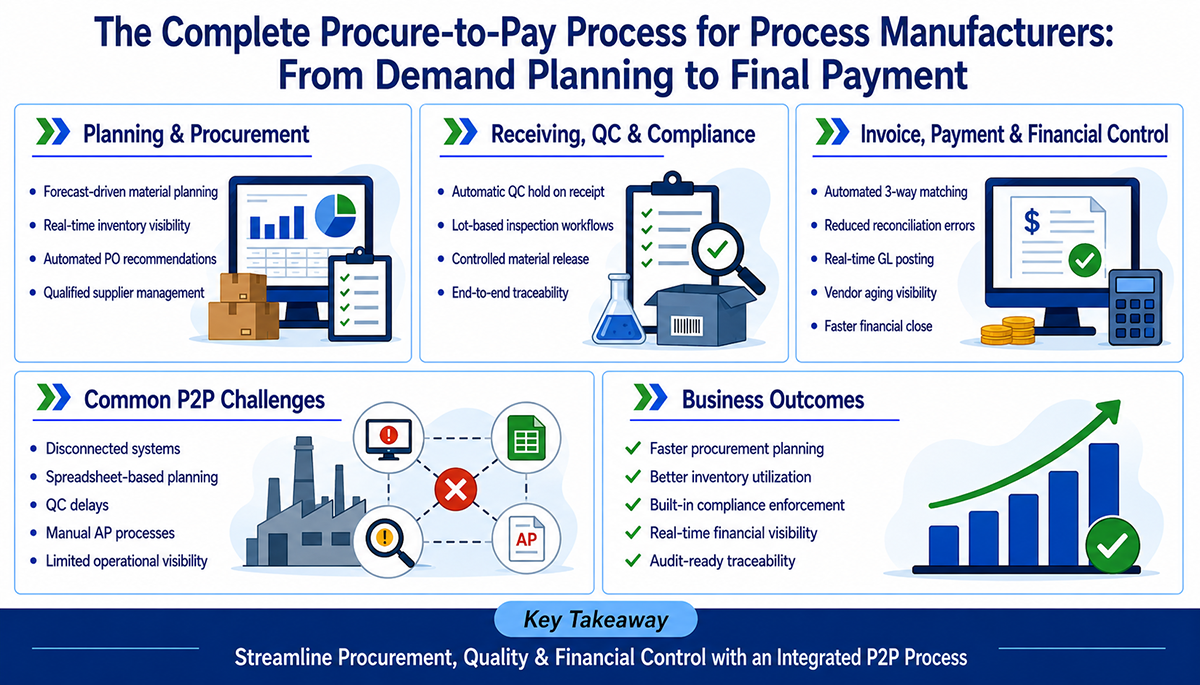
Here are the most common places where the P2P process breaks down in process manufacturing:
- Disconnected planning and procurement: Without real-time inventory or demand alignment, purchasing decisions are reactive rather than optimized. Buyers are responding to what has already happened rather than anticipating what is about to happen.
- Limited visibility across the process: Once a PO is raised, teams struggle to track where materials are at any given point: in transit, in QC hold, or available for production.
- Quality and compliance bottlenecks: When QC holds and approval workflows are not built into the procurement flow;
- Manual and error-prone invoice matching: Reconciling purchase orders, receipts, and invoices across separate systems manually leads to errors, delays, and persistent friction between operations and finance.
- Lack of end-to-end traceability: When systems are disconnected, tracking raw material from vendor to production becomes extremely difficult especially during audits or recalls, where speed and accuracy are non-negotiable.
These challenges don’t just slow down procurement but they also impact production, compliance, and overall business performance.
In this clip, Amir Banimostafavi, CEO of SIPCO Innovations, describes the reality of operating with two disconnected systems one for manufacturing, one for accounting an Excel-based planning process, and an isolated supply chain with no live data flow between functions.

A well-run P2P process isn’t complicated in concept but it does require five things to work together. When they do, the entire operation runs cleaner, faster, and with far less manual intervention.
- Demand-driven procurement: Purchasing is aligned with real-time planning. The right materials are ordered at the right time, based on actual demand and not any guesswork or historical reorder points.
- Built-in quality control: Quality should not be a separate step that happens on the side. It must be completely embedded into the process itself, so only approved materials can move forward into production.
- Controlled vendor management: Procurement is restricted to qualified and approved suppliers. That consistency matters for compliance, reliability, and ultimately the quality of the finished product.
- System-driven validation: Financial accuracy is enforced through automated checks like three-way matching, rather than relying on manual reconciliation across separate systems.
- Complete visibility and traceability: Every step is connected in one system, providing a full picture from PO to payment and an audit trail that is always ready.
Breaking Down the P2P Process: The Five Key Phases
Phase 1: Demand Planning and MRP
Effective procurement actually starts well before a purchase order is raised, it starts with a production plan.
The Master Production Schedule (MPS) translates sales forecasts and confirmed orders into a structured plan what to make, in what quantity, and when. MRP then works backward from that schedule to determine which raw materials are needed, accounting for current inventory, supplier lead times, and minimum order quantities. The result is a forward-looking purchasing plan, not a reactive one.
In practice, buyers work from color-coded planning dashboards that surface shortfalls and urgent orders immediately. MRP recommendations convert into purchase orders in bulk replacing the manual, line-by-line entry that consumes hours and introduces errors
Amir discusses the shift from static order-point planning to dynamic MRP, the value of the PO relationship map, and how bulk PO creation replaced a slow manual process.
Phase 2: Purchase Requisitions and Purchase Orders
Once MRP generates recommendations, the system needs guardrails to ensure orders go to the right vendors at the right price.
A compliant P2P process enforces vendor qualification at the point of purchase buyers can only order from pre-approved, qualified suppliers, which, in regulated industries, is both an operational and a regulatory requirement. One thing that Amir flagged as particularly valuable is the ability to assign a single internal item code to multiple qualified vendors, while maintaining each supplier’s own item codes in the system. So, if you need to switch suppliers for a raw material, there are no formula revisions or duplicate items to manage as the system handles it cleanly.
Amir explains how SIPCO manages multiple qualified vendors against a single item code and the compliance and operational burden this eliminates.
Phase 3: Goods Receipt and Quality Control
This phase is where process manufacturing diverges most from other industries and where disconnected systems create the greatest compliance risk.
When materials arrive, they cannot go straight into inventory. A compliant system automatically places them on QC hold upon receipt, logged and PO-updated, but unavailable for production until testing is complete. QC users are notified automatically, specifications are pre-populated, and the workflow moves through sample collection, testing, and results recording. If the lot passes, it’s released to inventory. If it fails, materials are either returned to the vendor or scrapped with full documentation tied back to the originating PO.
Amir walks through how QC enforcement has changed from a manual process to one structurally embedded in the system including lot status controls, automated notifications, and role-based authorization.
Phase 4: Invoice Processing and Three-Way Matching
When a supplier invoice arrives, AP records it against the original PO. The system then performs an automatic three-way match: Purchase Order vs. Goods Receipt vs. Invoice. When all three align within defined tolerances, the invoice proceeds to payment without manual intervention. When discrepancies exist such as a quantity variance, pricing difference, or item mismatch. It is flagged for review before any payment is authorized.
This is the primary financial control against overpayment, duplicate invoices, and billing errors. It also eliminates the manual reconciliation burden on AP teams. And because every matched invoice triggers automatic GL postings at the transaction level, the books reflect the business in real time, which means no batch uploads, no manual journal entries at month-end.
Phase 5: Payment to Vendor
Approved invoices move to payment via bank transfer, check, credit card, or cash, with each transaction automatically posted to the correct GL accounts. The vendor aging report, which gives a real-time view of outstanding payables by due date and payment terms, drives payment run decisions and gives finance leadership continuous visibility into cash obligations.
For SIPCO Innovations, automatic GL posting meant being able to run a P&L analysis right after month-end and see exactly how the business performed, a level of real-time visibility that changes how management makes decisions.
Amir covers how vendor aging visibility changed cash management at SIPCO, and the impact of automatic GL posting on month-end close and real-time P&L access.
The Relationship Map and End-to-End Traceability
A unified P2P system connects every document that touches a procurement transaction into a single, navigable view from the original requisition through PO, goods receipt, QC release, supplier invoice, and outgoing payment. Any document in the chain can be opened directly from that relationship map in the system.
For companies under GMP, FDA, FSMA, or ISO frameworks, this bi-directional traceability is a significant advantage, track forward from a vendor lot number through every production batch it touched, or backward from a customer complaint to every raw material consumed. What would otherwise be a multi-day manual exercise becomes an immediate, exportable audit trail for SIPCO Innovations.
The Business Case: What Changes When P2P Is Unified
When the full P2P cycle runs in one connected system, the impact is measurable:
- 50% reduction in procurement planning time – MRP-driven bulk PO creation replaces manual data entry and cross-platform copy-paste
- Up to 20% more cash released from inventory – Accurate demand planning eliminates the excess safety stock built around planning uncertainty
- Zero manual GL reconciliation – Automatic posting at every transaction event means the books are always current
- Foolproof QC enforcement – Non-compliant materials technically cannot enter production; the control is architectural, not procedural
- Real-time P&L – No waiting weeks after month-end to understand how the business performed
Amir consolidates the full business impact, planning time savings, inventory cash release, real-time P&L, and the compounding value of every function connected in one workflow.
KPIs to Track for Your P2P Process
Tracking the right KPIs is what turns a connected P2P process into a continuously improving one. Here are the six metrics that matter most for process manufacturers.
- PO cycle time -Tracks how quickly a purchase requisition converts into an issued PO. If this number is creeping up, it’s usually a sign that approvals or data entry are slowing things down.
- First-pass match rate – Measures the percentage of supplier invoices that clear the three-way match without exception on the first attempt. A declining rate typically points to misalignment between what was ordered, received, and billed that needs to be resolved at the source.
- Days Payable Outstanding (DPO) – Tracks how long it takes to pay suppliers relative to agreed terms. The goal is to optimize terms, capturing early payment discounts where available while protecting cash flow where they’re not.
- Raw material inventory turnover – Measures how quickly materials move from receipt into production. Low turnover often means you’re carrying more stock than demand requires, or that QC holds are creating unplanned delays that are worth addressing at the supplier or testing protocol level.
- QC first-pass rate – Tracks the percentage of incoming material lots that pass inspection on the first test. Chronic failures are a supplier quality signal, they should trigger development conversations or disqualification proceedings, not just repeated testing cycles that quietly absorb time and cost.
- Cost per invoice processed – Reflects the true overhead of your AP function, including the labor cost of exceptions and manual reconciliation. In a fully automated three-way match environment, this number drops substantially and the gap between your current figure and that benchmark tells you exactly how much manual work remains in the process.
Where Does Your P2P Process Stand?
A few honest answers to these questions reveal where the gaps are in your Procure-to-Pay process:
- Is your team planning a live MRP system or static reorder points and spreadsheets?
- Can buyers place orders only from qualified vendors, or from anyone in the master file?
- Do materials go on automatic QC hold at receipt, or does that depend on someone remembering?
- Is three-way matching automated, or is it a manual AP exercise?
Each gap is manageable. But together, they add up to a real drag on efficiency, compliance, and financial control. A well-connected Procure-to-Pay process is not just a back-office improvement. It’s the operational foundation for running a process manufacturing business that is profitable, audit-ready, built to scale.