For most breweries and distilleries, the biggest operational gap is visibility: one reliable answer to a few simple questions, such as how much is aging in which barrel, what each batch actually cost, and which customers received the lot that just failed a quality check.
Brewery manufacturing ERP software is designed to close that gap. This guide explains what brewery and distillery ERP does, which features matter most, which new AI capabilities are arriving, and how the leading brewery software options compare.
What is Brewery and Distillery ERP Software?
Brewery ERP software is a specialized system that manages the full production cycle for beer, spirits, and other fermented or distilled beverages in one database: recipes, raw materials, brewing and distilling stages, barrels and tanks, quality, compliance, costing, sales, and distribution.
Simple brew software or distilling software might handle recipe calculations or brew-day logs. However, a brewery ERP or distillery ERP goes further by connecting those records to purchasing, inventory, finance, and customer orders. Every stage, from grain receipt to bottled shipment, becomes part of one traceable record.
The distinction matters because beer and spirits are made in batches, through stages that can’t be undone. Ingredients are blended, fermented, aged, filtered, and packaged, and yields shift along the way. Brewery production software has to understand that reality natively, not through workarounds.
The Challenges Pushing Breweries Toward Dedicated Software
The brewing and distilling industries are under pressure from several directions at once:
- Demand for higher quality. Consumers increasingly seek premium beers and spirits, and batch-to-batch consistency is non-negotiable.
- Rising production costs. Escalating costs squeeze margins, especially when the true cost of each batch is unclear.
- Extending shelf life. Products must hold their quality over longer distribution windows.
- Fierce competition. A steady influx of new labels makes shelf space and loyalty harder to win.
Add reporting obligations to the Alcohol and Tobacco Tax and Trade Bureau (TTB) and state alcohol beverage control boards, and the familiar mix of spreadsheets and accounting software stops scaling. Data gets entered twice; barrel locations live in someone’s head, and audit preparation turns into a scramble. That’s usually when brewers start looking for brewery management software built for their industry.
Key Features of the Best Brewery Management Software
Strong brewery software and distillery management software should cover the following areas, grouped here by the problems they solve.
Recipe and Formula Management
- Recipe management with versioning, security, and approvals, so only approved recipes reach production
- Flavor profile definition and support for R&D and seasonal product offerings
- Ingredient statements, allergen management, and nutritional labeling generated from the recipe itself
Production Across Every Brewing Stage
- Support for blending, brightening, fermentation, filtration, and all stages of beer brewing
- Yeast management and filtration support
- Merging batches in barrels, or splitting batches to meet last-minute customer requirements
- Lot strength tracking for beer
Barrel, Tank, and Vessel Tracking
Good beer inventory software has to account for far more than finished cases. The right system lets brewers:
- Define and track barrels, bright tanks, fermentation vessels, and packaging materials
- See which beer is in each barrel and how long it has been aging, including barrel-aged products
- Run inventory balance reports by barrel, damages, and returns, and by process stage (brightening, fermentation, filtration, packing, WIP) with previous-month comparisons
This is where beer management software earns its keep: every tank and barrel becomes a known quantity rather than a guess.
Lot Traceability and Recall
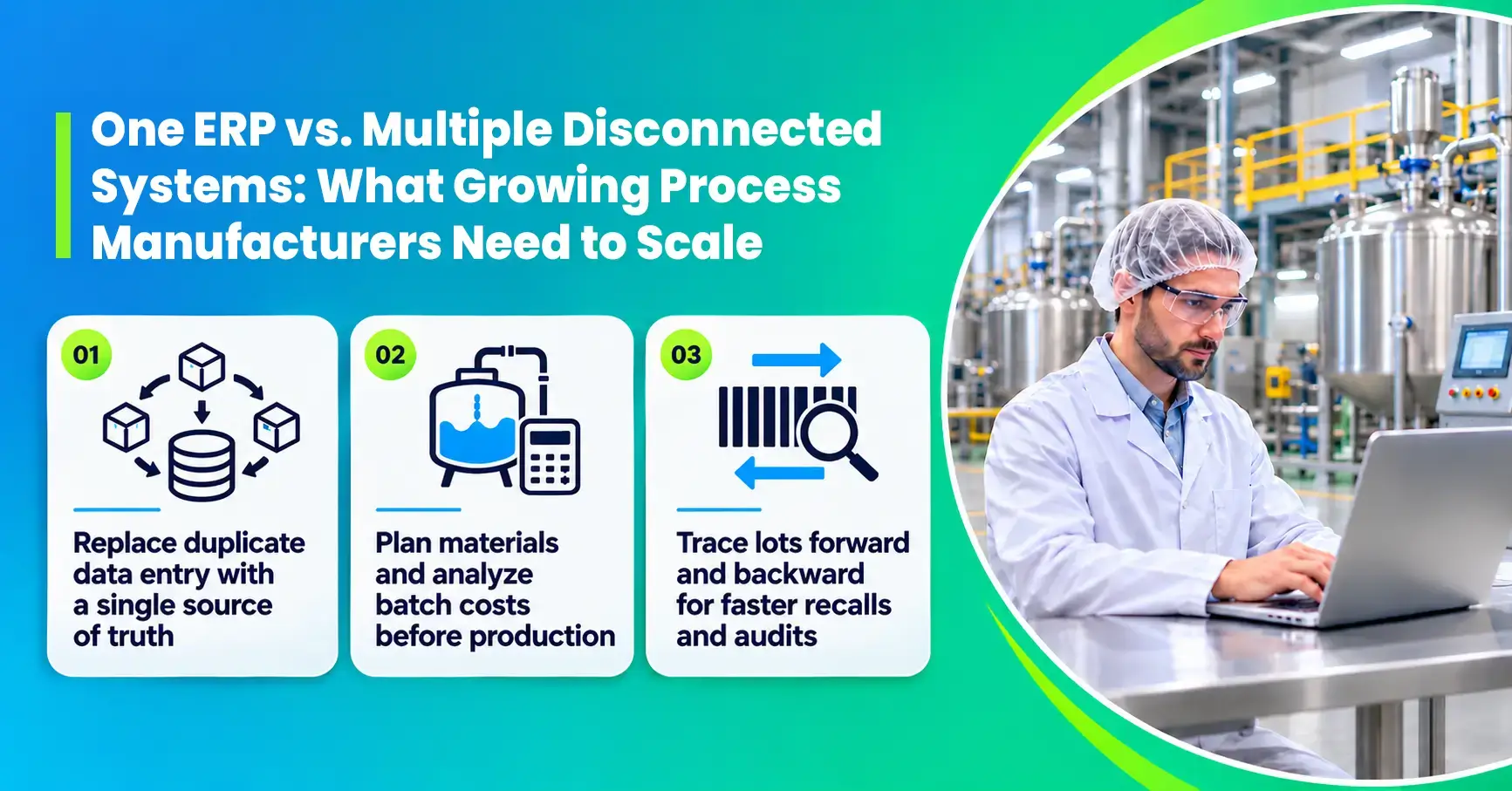
Bi-directional lot traceability follows every lot from vendor procurement, through batch production, to customer shipment. If a recall happens, affected lots and customers can be identified quickly instead of reconstructed from paper records.
Quality and Compliance
- Quality assurance and quality control throughout the supply chain, with inspection planning and inspection schedules
- Shelf-life determination
- Corrective and Preventive Action (CAPA) and non-conformance management
- Complaint handling
Planning and Costing
- Master Production Scheduling (MPS) and Material Requirements Planning (MRP) to align brewing schedules with demand
- Material and package costing, with the actual cost of production tracked at every stage
- Margin visibility on a per-bottle or per-barrel basis
Sales, Distribution, and Returns
For brewers who also distribute, check what the ERP already covers before adding standalone alcohol distribution software:
- Simplified handling of complex pricing matrices
- Management of returns and empties, bottle returns, and spoilage
- Supplier and vendor management on the purchasing side
How AI Can Help Breweries and Distilleries
AI in an ERP is most useful when it works directly on your own production, inventory, quality and sales data. For brewers and distillers, that means faster answers, less manual work and tighter control over every batch and barrel. When you evaluate vendors, ask how their AI will help your team in these areas:
- Faster, better-informed decisions. Brewers, cellar leads and owners should be able to get answers on batch status, barrel inventory, costs and margins as soon as the question comes up, without waiting for someone to build a report.
- Real-time visibility. AI should point out what needs attention while there’s still time to act. That could be a tank running behind schedule, a barrel nearing its target age, an ingredient running short or a lot drifting out of spec.
- Less manual work. Repetitive work like entering orders, preparing purchasing documents and compiling compliance records is a good candidate for automation. That gives your team more time for brewing and selling.
- More control. AI should work within your existing security roles and approval steps and keep a full audit trail. Final decisions stay with your people. That matters when TTB or state auditors ask how a record was created.
- Connected action across the business. The payoff grows when AI connects production, quality, warehouse, sales and finance. A demand spike or a supplier quality issue in one area should quickly lead to action in another, such as a revised brew schedule or a new purchase order.
Financial Integration and Deployment
Brewing and distilling create financial transactions at almost every stage: excise taxes when product leaves bond, keg and bottle deposits, distributor pricing, and costs that build up while beer conditions or spirits age. Your ERP should get those numbers into your books accurately, whether you keep your current accounting system or move everything to one platform. Here’s what to check:
- Accounting integration. If you plan to keep your current accounting software, confirm that inventory, production costs, and sales post to it automatically, with no double entry.
- Excise tax and TTB figures. Production and removal data should feed excise tax calculations and the numbers behind TTB reports, so finance and compliance work from the same records.
- Barrel and tank costing. Aging inventory ties up cash for months or years. Look for costing that tracks value as product moves through fermentation, conditioning, aging, and packaging, including losses along the way.
- Deposits and returns. Keg, bottle, and pallet deposits should post to the right accounts when containers ship and come back.
- Multiple locations and entities. If you run a production brewery, taprooms, or a separate distribution company, check how the system handles transactions between your companies and combined financial reporting.
- Deployment. A cloud system gives the brewhouse, cellar, warehouse, and office the same live view with no servers to maintain. Ask whether on-premises deployment is available if your IT policy requires it.
How to Choose the Right Brewery and Distillery Software
- Map your full process. List every stage from fermentation to aging and packaging and confirm the brewery software solutions on your shortlist handle each one natively.
- Test traceability live. Ask vendors to trace a lot forward and backward during the demo.
- Check compliance reporting. Confirm how the system supports TTB and state-level requirements.
- Cost a real batch. Ask vendors to cost one of your beers or spirits from grain to finished case, including aging losses and packaging, and show you the margin per barrel or case.
- Check integrations. Ask how the ERP connects with the other systems you rely on, such as brewery automation and control software on the brewhouse floor, taproom point-of-sale, and your online store, so production and sales data flow into one record.
- Plan for growth. Choose software for breweries that can scale from one site to many.
The Final Pour
Brewing and distilling have always been a balance of craft and control. The craft lives in the recipe, the yeast, and the patience of a barrel. The control is everything around it: knowing what is aging where, what each batch truly costs, and being able to prove compliance the moment someone asks. When that control lives in spreadsheets and memory, it quietly limits how far the craft can grow.
The right brewery and distillery software gives every barrel, batch, and bottle a clear history, so your team spends less time chasing numbers and more time making products people come back for. Start with how you actually brew, put vendors through real scenarios like a mock recall, and choose a partner that understands beverage production as well as it understands software. BatchMaster has been that partner for process manufacturers for more than 40 years, with Beverage Manufacturing ERP Software and AI-powered capabilities today.
Ready to see how it fits your brewery or distillery?
Frequently Asked Questions
Brewing software usually focuses on recipes and brew-day calculations. Brewery ERP software connects production with inventory, quality, compliance, costing, and finance in one system.
Yes, if it handles barrel tracking, aging visibility, blending, lot traceability, and TTB compliance, which matter to distilleries as much as breweries.
Many brewery and distillery ERP systems integrate with existing accounting software, such as QuickBooks, Sage, or Microsoft Dynamics 365 Business Central. You can add production, inventory, and quality management without replacing your accounting.