The Brief
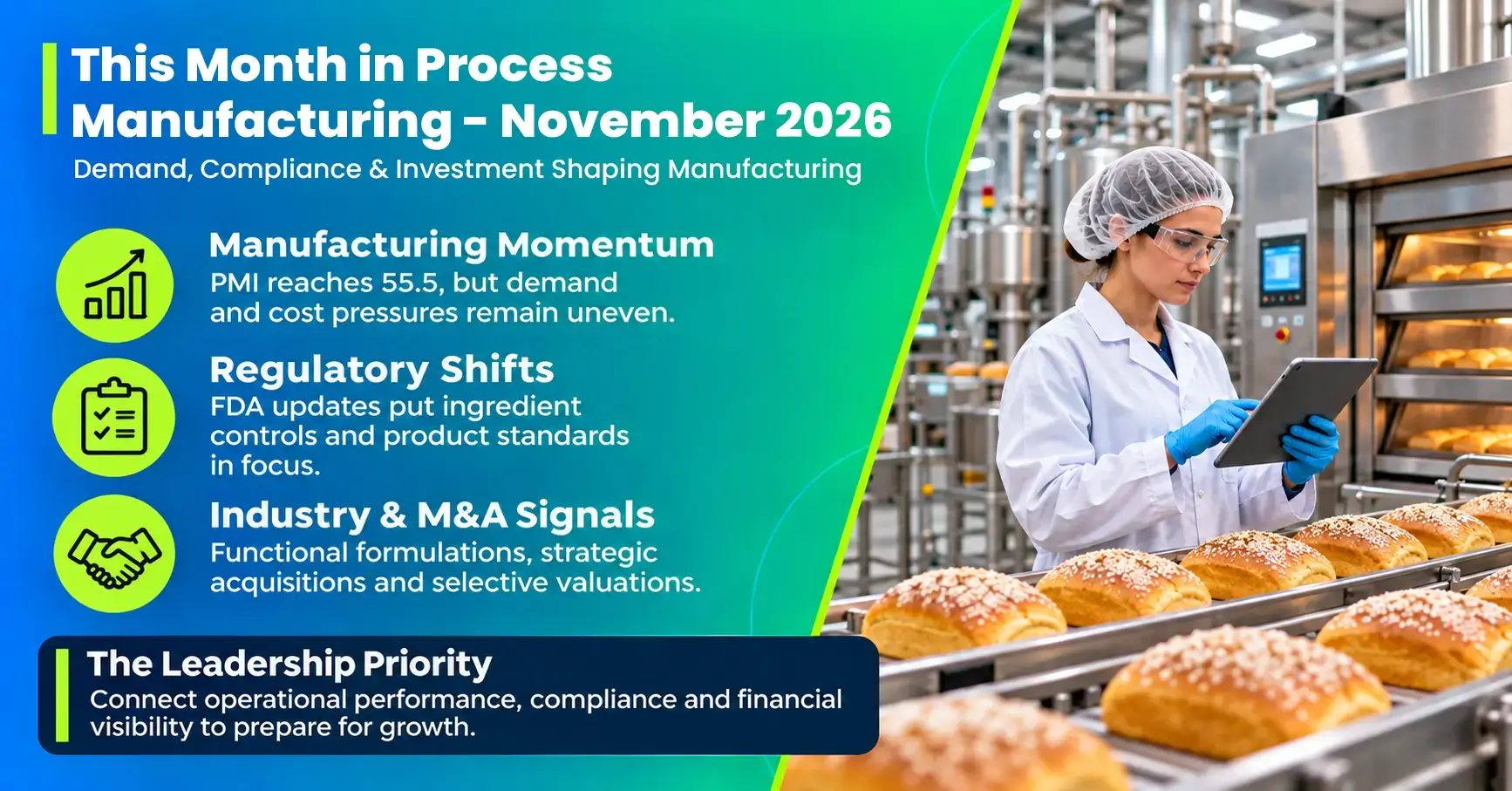
U.S. manufacturing activity strengthened in October, with the ISM Manufacturing PMI rising to 55.5 from 54.5 in September, marking the tenth consecutive month of expansion. Production reached 59.0, its highest level since November 2021. However, the Prices Index remained elevated at 75.2, while food, beverage and tobacco manufacturers reported softer new orders and production, pointing to an uneven recovery.
For process manufacturers, growth brings both opportunities and operational considerations. Changing demand, rising input costs, and production requirements are shaping business priorities. This month, three developments stand out: the growing impact of functional food formulations on production, new FDA actions affecting ingredient and product oversight, and strategic investments in specialized food manufacturing capabilities.
Compliance & Regulatory Watch
1. FDA Advances Heavy Metal Controls for Children’s Foods
The FDA advanced its Closer to Zero initiative with proposed action levels for cadmium in processed foods intended for babies and young children. The agency also released draft guidance on controlling chemical hazards under the Preventive Controls for Human Food regulation.
The guidance addresses how manufacturers can identify chemical hazards, establish appropriate preventive controls, and strengthen supply chain controls for ingredients.
For manufacturers of baby foods, cereals, purees, and other products intended for young children, the development reinforces the importance of ingredient-level risk assessment and documented supplier controls.
What manufacturers should watch: The proposed cadmium action levels are open for public comment until December 22, 2026. Comments for guidance on the draft chemical hazards are due January 21, 2027.
2. FDA Moves to Revoke Certain Color Additive Authorizations
The FDA announced actions to revoke certain authorizations involving substances used in color additives and their production.
The changes include the removal of methylene chloride as a diluent in inks used to mark fruits and vegetables, alongside the revocation of specified uses of methylene chloride, ethylene dichloride, and trichloroethylene in the production of annatto extract, paprika oleoresin and turmeric oleoresin.
The revocations are scheduled to take effect on January 11, 2027.
For food manufacturers using natural color ingredients, this is a timely reason to review ingredient specifications, supplier documentation, and the substances used in upstream ingredient processing.
3. Infant Formula Standards Enter a New Review Phase
The FDA proposed updates to infant formula nutrient requirements, marking the first comprehensive review of these standards since 1998.
The proposal addresses eight of the 30 required nutrients, including changes to vitamin A and vitamin D specifications and corresponding labeling requirements. The agency is also seeking input on nutrients that are not currently required but are commonly added by manufacturers.
The proposed changes are part of a phased review. The FDA intends to consolidate the final changes into one comprehensive rule, with a proposed compliance period of three years after its effective date.
For infant nutrition manufacturers, the development makes formulation flexibility, nutrient specifications, and regulatory documentation important considerations for longer-term product planning.
Industry Signals
1. Functional Formulations Are Changing Production Requirements
PMMI’s report, The Formulation Effect: Impacts on Food & Beverage Production, Equipment and Investment, highlights how protein-rich and functional formulations are influencing production operations and equipment investment.
The findings point to three important indicators:
- 47% of surveyed end users reported that enhanced nutritional or functional formulations account for more than 10% of their current production volume.
- 63% identified mixing and blending as the production processes most affected by these formulations.
- 51% expect to invest at least $500,000 in related processing or packaging equipment over the next three years.
The shift is creating new requirements for powder handling, dosing accuracy, sanitation, quality control, and packaging flexibility.
For manufacturers, product innovation is increasingly becoming an operations and capital-planning decision. Introducing a new protein blend or functional ingredient can affect equipment compatibility, batch consistency, cleaning procedures, and production scheduling.
2. Manufacturing Expansion Continues, but Cost Pressure Remains
October’s Manufacturing PMI reading of 55.5 indicates continued expansion across the broader U.S. manufacturing sector.
Five of the six largest manufacturing industries, including food, beverage and tobacco, and chemical products, were classified as expanding. However, the detailed industry readings also showed softer new orders and production for food, beverage, and tobacco manufacturers.
Meanwhile, the Prices Index remained firmly in increasing territory at 75.2, despite a 2.7-point decline from September.
This combination suggests that manufacturers cannot rely on broader economic expansion alone to determine their operating outlook. Demand visibility, material costs and production utilization remain important variables.
For leadership teams, the priority is to connect sales forecasts with procurement, inventory, and production plans before changes in demand translate into excess inventory or capacity constraints.
Strategic buyers and investors continued to reposition portfolios, acquire differentiated brands, and expand manufacturing capabilities across food and beverage.
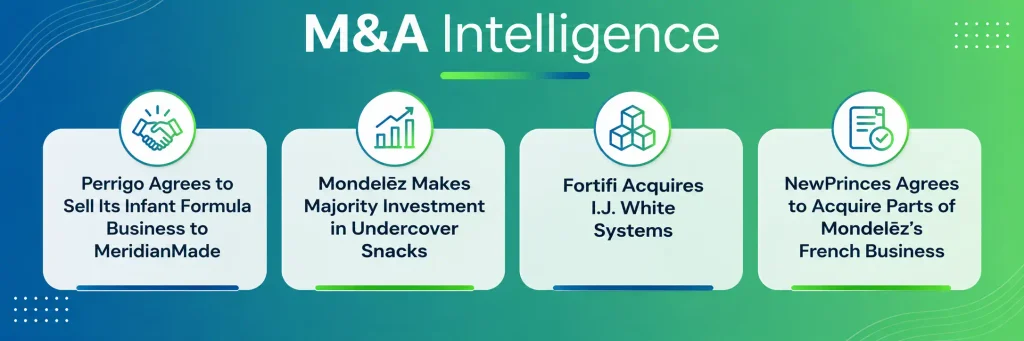
Four transactions from October and November illustrate where acquisition interest is emerging.
1. Perrigo Agrees to Sell Its Infant Formula Business to MeridianMade
October 29, 2026 | Transaction value: Up to $175 million
Perrigo entered into a definitive agreement to sell its infant formula business to MeridianMade, an American contract manufacturing platform focused on infant nutrition.
The proposed transaction includes $40 million in cash at closing and up to $135 million in additional consideration tied to performance milestones through 2030. Completion is expected in the first half of 2027.
Why it matters: The transaction highlights the role of specialized manufacturing platforms in attracting assets from larger consumer health businesses. It also reflects the strategic importance of manufacturing infrastructure and operational capabilities in regulated nutrition categories.
2. Mondelēz Makes Majority Investment in Undercover Snacks
October 30, 2026 | Financial terms undisclosed
Mondelēz International announced a majority investment in Undercover Snacks, a U.S.-based company producing chocolate-covered and frosted quinoa crisps.
The partnership is intended to support the brand’s growth, innovation, and distribution while allowing it to retain its existing leadership and operating identity. The transaction is subject to customary closing conditions and was expected to close in the first quarter of 2027.
Why it matters: The investment reflects continued interest in differentiated, better-for-you snack categories and established brands with room to expand distribution.
3. Fortifi Acquires I.J. White Systems
Food processing solutions provider Fortifi acquired I.J. White Systems, a manufacturer of spiral cooling, freezing, and conveying systems.
The acquisition expands Fortifi’s capabilities across bakery, dairy, prepared foods, protein, and seafood processing. I.J. White also brings expertise in proofing, hydro-chilling, hot-hold systems, and related sanitation solutions.
Why it matters: The acquisition demonstrates how processing equipment and specialized engineering capabilities are becoming strategic assets. Combining complementary technologies can help suppliers offer more integrated production solutions to food manufacturers.
4. NewPrinces Agrees to Acquire Parts of Mondelēz’s French Business
November 17, 2026 | Enterprise value: €80 million
Italian food processor NewPrinces, through its UK subsidiary Princes Group, agreed to acquire Mondelēz’s French bread-substitutes and cereal-bars businesses.
The transaction includes the Heudebert, Pelletier, Cracotte, and Grany brands, along with three manufacturing facilities in France. The acquisition is intended to strengthen NewPrinces’ presence across European markets.
Why it matters: The deal illustrates how established food manufacturers are using acquisitions to expand geographic reach, add manufacturing capacity, and strengthen their brand portfolios.
Valuation Signal
Food & Agriculture M&A: Buyers Remain Selective
PCE Investment Bankers’ Q3 2026 Food & Agriculture M&A update points to a more disciplined transaction environment.
The sector recorded 265 closed transactions on a trailing 12-month basis, compared with 390 in Q3 2025 and 473 in Q3 2024.
The report also highlighted:
- 8.42x: Median transaction enterprise value to EBITDA.
- 1.24x: Median transaction enterprise value to revenue.
- 81%: Transactions involving strategic buyers.
- 19%: Transactions involving financial buyers.
The figures indicate that strategic buyers continue to account for most transaction activity, while overall deal volume has moderated.
For privately held manufacturers considering an acquisition, investment or eventual exit, the message is clear: scale alone may not be enough to command buyer interest. Earnings quality, predictable margins, customer concentration, operational performance, and the ability to demonstrate sustainable growth all influence how a business is evaluated.
These sector-level multiples are benchmarks, not automatic valuations for individual companies. Actual transaction value depends on company size, profitability, product mix, growth prospects, and deal structure.
Final Takeaway
Manufacturing growth, changing product formulations, regulatory developments, and strategic acquisitions are shaping a more demanding operating environment.
For process manufacturers, the opportunity lies in connecting decisions across the business. Product innovation must align with production capabilities. Compliance must extend beyond finished-product checks to ingredient and supplier controls. Growth plans must be supported by reliable production, inventory, and financial information.
As manufacturers prepare for 2027, the ability to translate operational data into informed business decisions will remain an important differentiator.
Resources
- ISM – October 2026 Manufacturing PMI Report
- FDA – Color Additive Authorizations Update
- FDA – Infant Formula Nutrient Requirements
- PMMI – The Formulation Effect: Impacts on Food & Beverage Production, Equipment and Investment
- Perrigo – Infant Formula Business Divestiture to MeridianMade
- Mondelēz – Investment in Undercover Snacks
- Fortifi – Acquisition of I.J. White Systems
- Princes Group – NewPrinces Acquisition Announcement
- Reuters – NewPrinces and Mondelēz French Business Transaction
- PCE Investment Bankers – Q3 2026 Food & Agriculture M&A Update