
Most conversations about ERP modernization start with the new technology. Vanguard Paints and Finishes’ story begins with a clear-eyed look at what the company already does well, what it still does by hand, and which kind of system change would respect both.
Vanguard is a family-run manufacturer of OEM liquid coatings that competes with Sherwin-Williams and PPG. It has run BatchMaster since roughly 1990. Now, after about three decades on the legacy version, it is moving to BatchMaster Cloud ERP and, in the same step, retiring its separate financial system. The reasoning behind that decision offers a practical playbook for any process manufacturer facing the same crossroads.
Meet the manufacturer
Vanguard has been in business since 1939. Today it develops and manufactures liquid coatings, primarily OEM coatings formulated to each customer’s specific needs and the products they build. The portfolio spans both solvent-based and water-based coatings, at roughly a 60/40 split in favor of water-based.
Two details of this profile matter for the ERP story:
- Customer-specific formulation means the formula, and the history behind it, is the core intellectual asset of the business.
- A semi-analog shop floor. Vanguard’s production relies on hands-on work and large, older machinery that is not wired into computers. There is no automated data capture at every step of the process.
That second point shaped nearly every decision in the story that follows.
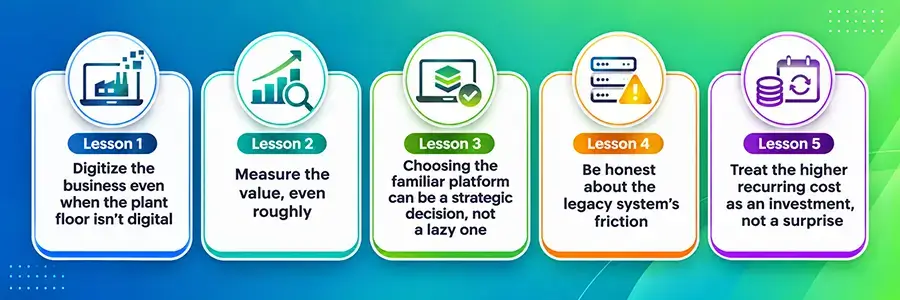
Lesson 1: Digitize the business even when the plant floor isn’t digital
When Vanguard first adopted BatchMaster, the company had no computer operations at all. The goal was straightforward: streamline processes and take less time to do them.
Over the years, BatchMaster grew into what the leadership team describes as the company’s digital backbone. It touches nearly every function:
- Purchase orders and sales orders
- Inventory management and close-out
- Formula management
- Batch ticket printing for production
- Invoicing
The key insight is the “bridge” role the system plays. Vanguard’s manufacturing is still comparatively analog, and the ERP lets the company operate efficiently with older equipment without waiting for a full plant-floor digitization project. Many small manufacturers assume they must modernize their equipment before they can modernize their information systems. Vanguard’s experience suggests the reverse can work: let the software absorb the gap, and let the plant evolve at its own pace.
Lesson 2: Measure the value, even roughly
Vanguard doesn’t have precise before-and-after metrics from the original rollout, which predates most of the current team. But the leadership team offered grounded, directional evidence of what the system delivered:
- Administrative headcount. The paper-based office once needed roughly six to eight people. Today, two to three handle inventory, purchasing, sales, and invoicing combined.
- Laboratory efficiency. Moving formulas onto the system gave the lab immediate access to current formulas and their full history, with notes and iterations centralized in one place rather than scattered across different handwriting and systems. The team’s estimate is at least a 50% efficiency gain in the lab.
- Quality and consistency. Entering, managing, and adjusting formulas in one controlled system improved quality and the overall flow of work.
The takeaway for other manufacturers: you don’t need a perfect ROI model to recognize value. Staffing levels, lab turnaround, and consistency are all observable. Capture them before a migration so you can compare afterward.
Lesson 3: Choosing the familiar platform can be a strategic decision, not a lazy one
Vanguard did evaluate other ERP systems. It stayed with BatchMaster for reasons that deserve attention, because they are rarely discussed in vendor comparisons.
- The cost of starting over. Building out an entirely new system carried a significant price and disruption.
- Assumptions baked into other systems. The alternatives Vanguard looked at tended to presume a highly digitized process-manufacturing environment, with strict quality-control gates and someone entering data into a computer at every step. Vanguard doesn’t operate that way. Adapting those systems to Vanguard would have been a much bigger lift than the reverse.
- Room to grow at your own pace. Vanguard uses BatchMaster for inventory today, tracking purchases and receipts, but has not adopted barcoding. Other systems seemed to treat barcoding as a prerequisite. BatchMaster lets Vanguard adopt capabilities piecemeal and control its own growth.
- Vendor familiarity. BatchMaster already understands how Vanguard works and why. That institutional knowledge reduces the explaining, translating, and re-teaching that a brand-new vendor would require.
The leadership team was also candid about a limitation: BatchMaster is all the company has ever known, so it has no direct comparison point for usability. That honesty is worth emulating. Familiarity is a real advantage, but it is also a bias, which is precisely why Vanguard still evaluated alternatives before committing.
Lesson 4: Be honest about the legacy system’s friction
The team described the desktop system as easy to learn. Newer employees, including leaders who joined within the last several years, found the learning curve fairly minimal once they understood the underlying logic. At the same time, they noted that setup requires entering information in multiple places, and that standard reports waste space and paper.
This kind of balanced assessment is the foundation of a good migration. Before changing systems, list what works, what’s tolerable, and what’s genuinely painful. Vanguard’s list became its requirements document.
Why move now: what the cloud version is expected to unlock
Vanguard’s decision wasn’t driven by a failing system. In the team’s words, there is nothing wrong with the old one; it is simply an older interface. Thirty years on the legacy system, running the same version for as long as it stayed running, was a strategy of changing only when absolutely necessary. The move to BatchMaster Cloud ERP reflects a deliberate shift toward staying current. Here are the main drivers.
1. Consolidating finance
For many years, Vanguard has run its accounting on Solomon alongside BatchMaster. The migration plan retires Solomon in favor of BatchMaster’s financial module. The expected benefit is less “piecing together” and no more moving between two systems. For a small team, reducing the number of systems to maintain and reconcile is a significant gain.
2. Faster, tighter order-to-invoice flow
Integrating sales orders and invoicing is expected to be significantly faster than the current process. Invoices will be emailed directly from the system, whereas today they are printed or saved to a file and then sent separately. These are small changes, but they add up to consistency and speed in everyday work.
3. Regulatory and safety data sheet (SDS) management
SDS handling was described as a big driving force. Vanguard uses a hybrid SDS solution alongside BatchMaster, and the team expects the new environment to substantially improve how SDSs and related regulatory information are created, processed, and handled. For a chemical manufacturer, regulatory documentation isn’t a side task; it is a core operating obligation.
4. Pricing agility in a volatile market
As a chemical manufacturer, Vanguard is highly exposed to raw material price swings, and the market has been unpredictable in recent years. Today the company uses a separate system to work out total costs and pricing. The hope is to bring costing and pricing into BatchMaster, so that cost increases can be reflected in prices much faster and more efficiently.
5. Reporting flexibility and consolidated data
The team expects more control over what reports print and how they are formatted, reducing wasted paper and space. They also plan to fold in equipment usage tracking, now handled in separate Excel files, so production records are expanded and easier to use in one place.
6. Mobility for field service
Vanguard’s lab personnel frequently go on site for service calls. Remote and web-based access is not something the company fully uses yet, but it is something it plans to grow into: BatchMaster on a tablet or laptop, available wherever the customer needs support.
7. A modern interface for the next generation of employees
Younger hires are used to modern, web-style interfaces. A contemporary interface should shorten the learning curve further, and it should help retire the remaining paper elements that make the current setup somewhat fragmented.
Lesson 5: Treat the higher recurring cost as an investment, not a surprise
For a company without a dedicated IT department and with limited financial resources, the annual expense of a cloud model gave the team pause. Under the old model, they could run a version essentially indefinitely and upgrade only when forced.
Their reasoning for moving ahead anyway is a useful framework:
- Always-current software. The subscription model replaces occasional, disruptive upgrades with continuous updates.
- Savings expected to outweigh the cost. The team believes efficiency gains will exceed the added expense over time.
- Pain points first. Their advice to peers is to identify the specific pain points in the current system and ask how much alleviating them is worth, even when there is no direct dollar figure attached.
- Pre-paying for growth. Spending now on capabilities that make future expansion cheaper and easier is a form of cost avoidance.
What a strong partnership looks like
The project is at an early stage and a few observations stand out:
- Same-vendor migrations are easier to reason about. Going from BatchMaster to BatchMaster means the vendor already understands the underlying data and processes.
- Good implementers ask hard questions. The team appreciated that BatchMaster probed how and why Vanguard does things, and suggested where the new system might offer better ways to do them.
- Responsiveness builds trust. Over the years, Vanguard says it has never had trouble reaching someone at BatchMaster for a new report or a question.
The strategic payoff: acting bigger than you are
Vanguard is a small company going up against industry giants like Sherwin-Williams and PPG. In the team’s view, a capable, adaptable ERP is what allows a company of its size to act much bigger than it actually is, through efficiency, responsiveness, and capability.
That reframes the ERP decision. It isn’t an IT purchase; it is a competitive lever.
Looking ahead
Vanguard’s journey from paper to desktop in 1990, and from desktop to cloud now, reflects a consistent philosophy: adopt technology that fits how the business actually runs, and let it grow in step with the company. As its cutover approaches, the team will be watching a handful of outcomes closely: faster order-to-invoice cycles, smoother SDS and regulatory work, faster price responses, and a more connected lab and production record.