
In Part 1 of this blog series, we focused on the KPIs that help $10–$50M process manufacturers grow enterprise value, metrics that improve earnings quality, cash flow, and scalability.
But growth alone does not secure valuation.
As manufacturers scale, buyers, lenders, and private equity firms begin asking a different set of questions:
- How stable are operations under pressure?
- How exposed is the business to quality, compliance, or customer risk?
- How predictable are outcomes as volume and complexity increase?
These questions determine whether enterprise value holds or gets discounted during diligence.
This is Part 2 of the blog series, focused on the KPIs that protect enterprise value, along with the supporting metrics and execution discipline buyers look for to validate operational maturity and reduce downside risk.
Together, the KPIs across both parts form a complete framework for manufacturers who want to grow confidently and defend valuation when it matters most.
KPIs That Protect Enterprise Value
KPI #1: Customer Concentration %
A direct measure of revenue risk.
Customer concentration shows how dependent you are on a small number of customers. When one customer represents too much revenue, the business becomes vulnerable to demand shifts, contract changes, delayed payments, or price pressure.
It tells you:
- how much revenue sits in the hands of a few customers
- which accounts create hidden financial risk
- how fragile or resilient your revenue mix really is
- whether you need to diversify to protect enterprise value
This is one of the first metrics investors and advisors ask for because if your top 1–2 customers represent >20%–25% of revenue, your valuation multiple can drop.
Formula
Customer Concentration % = Revenue from Customer A ÷ Total Revenue × 100
Repeat this for your top 5-10 customers.
As a rule of thumb:
- Above 20-25% = elevated risk
- Above 35-40% = high dependency
What to do in your ERP
- Ensure customer groups, accounts, and sales reps are mapped correctly in ERP
- Review sales by customer monthly to track shifts in dependency
- Identify customers that are growing too fast relative to the business and plan diversification
This is difficult to do accurately in spreadsheets over multi-year periods.
KPI #2: First Pass Quality (FPQ)
A clear view of how often your batches meet quality standards the first time.
FPQ shows:
- how consistently your formulas and processes perform
- how much time, labor, and material you save by avoiding rework
- where quality issues begin (ingredients, equipment, operators, or process steps)
- how stable your production is as volume grows
- how strong your compliance and customer trust really are
Higher FPQ means fewer delays, fewer deviations, fewer customer complaints, and a healthier margin.
Formula
FPQ = Batches Approved on First Attempt ÷ Total Batches × 100
Only count batches that pass all required QC tests without rework, adjustments, or retesting.
What to do in your ERP
- Record QC results for every batch so you can see which ones pass on the first try
- Log deviations and corrective actions to identify recurring issues faster
- Review FPQ by product, line, and shift to pinpoint where quality is slipping
KPI #3: Scrap & Rework Rate
Scrap is one of the biggest silent profit killers.
Scrap and rework show:
- how much material is wasted during production
- where processes, equipment, or training need attention
- which formulas or SKUs generate the most loss
- how yield issues impact margin
- how quality problems affect throughput and cycle time
Even small increases in scrap or rework can quietly erode profit, especially in material-intensive industries.
Formula
Scrap Rate = Scrap Quantity ÷ Total Quantity Produced × 100
Rework Rate = Reworked Quantity ÷ Total Quantity Produced × 100
You can track them:
- per batch
- per SKU
- per line or work center
- per shift or operator
What to do in your ERP
- Capture scrap quantities at batch close-out so loss is visible and traceable
- Record rework batches separately to see their true cost and frequency
- Review scrap and rework trends monthly to identify patterns linked to formulas, equipment, or operators
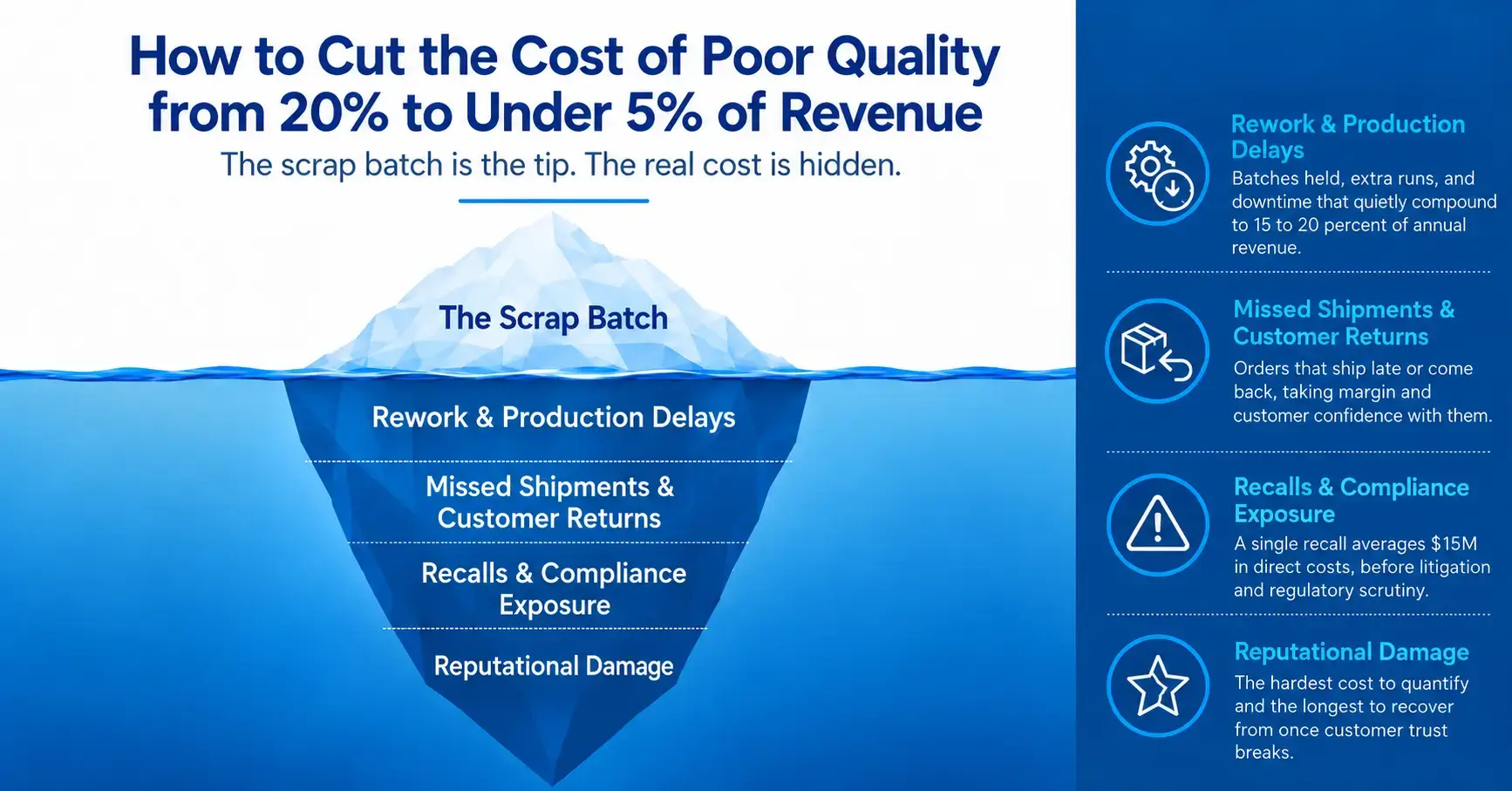
KPI #4: Cost of Poor Quality (CoPQ)
The most direct way to quantify how much money quality issues are burning inside the business.
CoPQ shows:
- how scrap, rework, and rejects are eroding margin
- the true financial impact of customer complaints and returns
- hidden costs that don’t appear on standard reports
- where unstable processes undermine profitability
- whether quality maturity is improving or stalling
High CoPQ signals margin leakage, operational instability, and customer dissatisfaction, all major red flags in valuation discussions.
Formula
CoPQ = (Scrap Costs + Rework Costs + Returns + Quality Failures) ÷ Revenue × 100
It captures both internal failures (scrap, rework) and external failures (returns, complaints).
What to do in your ERP
- Capture scrap and rework quantities with cost values during batch close-out
- Track returns with linked reason codes and associated financial impact
- Review CoPQ monthly by product and line to find the highest sources of margin loss
KPI #5: Return Rate (Customer Returns)
A direct signal of product quality, customer experience, and hidden margin loss.
Return rate shows:
- which products create recurring dissatisfaction
- which customers experience the most issues
- how quality problems flow into cost and revenue leakage
- where formulation, packaging, or handling issues originate
- whether service levels are slipping
High return rates reduce margin, increase CoPQ, and weaken customer relationships, all valuation risks.
Formula
Return Rate = (Units Returned ÷ Units Shipped) × 100
What to do in your ERP
- Record all returns with reason codes tied to product and customer
- Link returns back to specific lots or batches to find root causes
- Review monthly return trends to identify recurring issues early
KPI #6: Recall / Traceability Speed
How fast you can trace ingredients from supplier → batch → customer → store and the fastest way to prove how well you control your supply chain end to end.
Traceability Speed shows:
- how quickly you can track ingredients from supplier to batch to customer
- how prepared you are for audits, mock recalls, or real incidents
- how effectively you can contain a quality issue before it becomes costly
- whether your lot and batch controls are consistent across the plant
- how much risk and liability is tied to your current processes
Under 2 minutes = elite.
Over 10 minutes = operational risk → lower valuation.
Manufacturers with slow traceability face higher compliance risk and lose trust with key customers.
Formula
There is no fixed formula, but the most common KPI is:
Traceability Speed = Time Required to Complete a Full Forward and Backward Trace
Elite manufacturers complete full traces in under 2 minutes.
Over 10 minutes usually indicates process gaps.
Track:
- ingredient → batch → customer
- customer → batch → ingredient
- quantity, lot number, and date-flow accuracy
What to do in your ERP
- Ensure and leverage automated lot traceability and forward and backward trace reporting in your ERP system
- Capture lot numbers at every material movement: receiving, issuance, production, QC, and shipping
- Maintain accurate batch records with ingredients, quantities, and associated lots
- Run mock recall reports regularly to test real-world traceability speed and expose gaps
KPI Benchmarks That Protect Enterprise Value
| KPI | Red Zone | Healthy Zone | High Performer Zone |
| Customer Concentration % | Top customer > 30% | 15–25% | < 10–15% |
| First Pass Quality (FPQ) | < 90% | 90–95% | 96–99%+ |
| Scrap & Rework Rate | > 5% | 2–5% | < 2% |
| Cost of Poor Quality (CoPQ) | > 10% of revenue | 5–10% | < 5% |
| Return Rate (Customer Returns) | > 3% | 1–3% | < 1% |
| Recall / Traceability Speed | > 15 minutes | 5–15 minutes | < 2 minutes |
Supporting KPIs That Strengthen the Enterprise Value Story
These KPIs may not directly drive valuation multiples on their own, but buyers consistently review them to validate operational discipline, scalability, and risk management.
| KPI | What It Signals |
| Financial Leverage Ratio | Shows how much debt the business uses relative to equity or EBITDA, helping buyers assess balance-sheet risk and flexibility to support future growth or transactions. |
| Operating Leverage | Indicates how efficiently fixed costs are absorbed as revenue grows, revealing whether incremental growth will expand margins or strain profitability. |
| On-Time In-Full (OTIF) | Demonstrates delivery reliability and customer trust, a key indicator of revenue stability and the ability to support larger, more demanding customers. |
| Manufacturing Cycle Time | Measures how quickly raw materials convert into finished goods, highlighting throughput efficiency and the business’s ability to scale without adding excessive working capital. |
| Warehouse Storage Cost per Sq Foot | Reveals how efficiently inventory is stored and handled, helping buyers identify hidden cost drag and future facility or automation requirements. |
| Inventory Aging | Exposes slow-moving, obsolete, or at-risk inventory that can distort EBITDA and working capital if not actively managed. |
Turning KPIs into Enterprise Value (Not Just Reports)
Knowing the right KPIs is one thing. Making them work inside your business is what actually moves the needle and builds enterprise value.
Here’s how to move from KPI awareness to enterprise value impact:
1. Prioritize by intent, not volume
Start with the 5–7 KPIs that either grow or protect value based on your immediate priorities — margin improvement, cash flow, operational stability, or risk reduction.
2. Build review discipline, not dashboards
A KPI only creates value when it’s reviewed consistently and discussed honestly. Weekly or monthly cadence matters more than visual sophistication.
3. Fix the data before trusting the number
Inconsistent BOMs, missing batch reporting, inaccurate promised dates, or incomplete QC data undermine confidence. Buyers will spot this quickly.
4. Assign clear ownership
Every KPI should have one accountable owner, not a committee. Improvement follows ownership.
5. Track trends, not snapshots
Buyers and lenders care far more about direction than perfection. Momentum builds confidence and valuation.
6. Use ERP to connect cause and effect
The real advantage comes from seeing how decisions in production, quality, inventory, and supply chain compound into financial outcomes, in one system.
Your Move
Most mid-market manufacturers operate with partial visibility. They know revenue. Maybe gross margin. A handful of quality metrics. But they rarely have the integrated view that connects operations → cash flow → profitability → enterprise value.
The manufacturers who build these KPIs into their ERP aren’t just improving production. They’re strengthening the financial backbone of their business. They’re creating the transparency, data discipline, and operational maturity that command premium valuations, whether the goal is to scale, bring in a partner, or prepare for an eventual exit.
Here’s the question that matters:
If you ran a mock due diligence on your business today with a buyer asking for 24 months of KPI trends across margin, cash flow, quality, and operational reliability—would you have the data to tell a compelling story, or would you be scrambling to piece together spreadsheets that don’t quite match?