



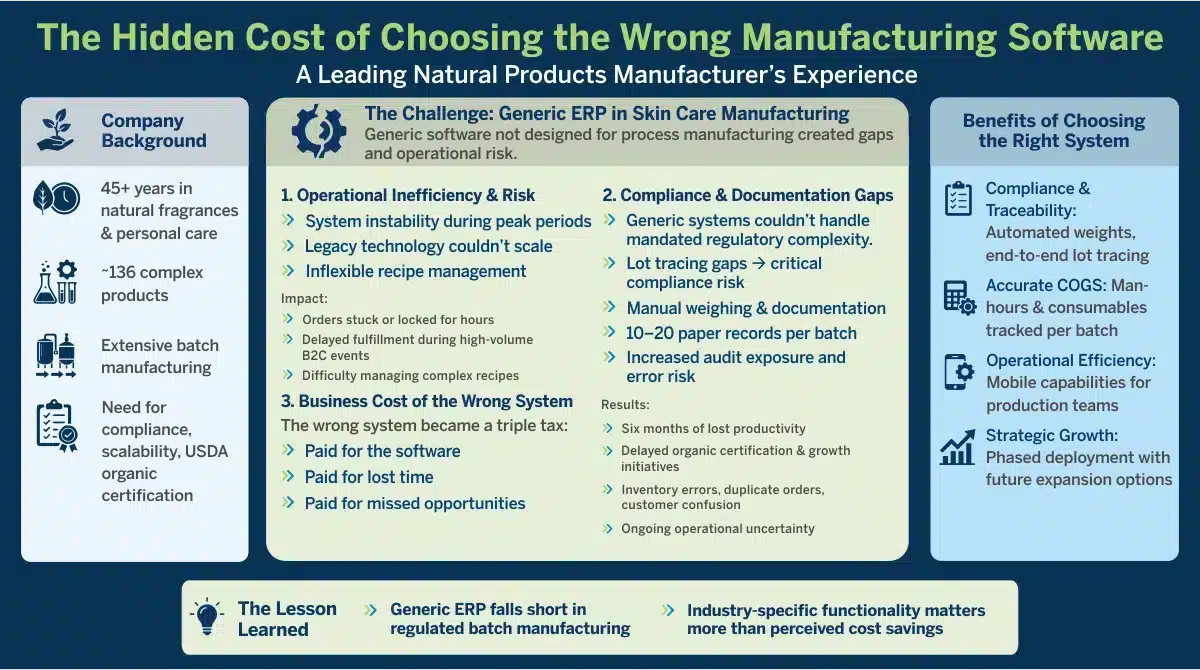
Kuumba Made, a leader in natural fragrances and personal care for over 45 years, recently made a critical operational decision to replace its existing software and implement a system built specifically for process manufacturing. This move was driven by the need for comprehensive compliance and a modern, reliable foundation to support continued growth and the pursuit of USDA organic certification.
The Challenge: Operating with a Generic System That Couldn’t Meet Skin Care Manufacturing Demands
Kuumba Made’s business is centered on producing approximately 136 complex products that require extensive batch manufacturing. They found that their previously adopted software, which was not explicitly designed for this nuance, created significant gaps and operational risks.
1. Operational Inefficiency and Risk
The lack of manufacturing specificity directly impacted speed and reliability, particularly in high-volume situations.
Key Takeaways:
- System instability during peak periods directly impacts revenue—especially critical for B2C brands during high-sales events.
- Legacy technology can’t scale with modern business demands and customer expectations.
- Inflexible recipe management limits your ability to respond to production needs and optimize formulations.
What Happened:
- System instability: The software, built on older technology, was unreliable, often getting stuck or locking an order for hours.
- Speed limitations: During peak periods, like Black Friday, when processing over 100 business-to-consumer (B2C) orders, the system would “linger for a few seconds,” leading to constant frustration and delayed fulfillment.
- Recipe limitations: The system used static data structures that made it difficult to manage complex recipes, especially when needing to make minor, controlled adjustments during a production order.
2. Compliance and Documentation Gaps
The core lesson learned was that generic systems cannot handle mandated regulatory complexity.
Key Takeaways:
- Lot tracing is non-negotiable for regulated industries; without it, you’re operating with critical compliance risk.
- Manual documentation creates a paper trail nightmare; 10-20 pieces of paper per batch multiplies error risk exponentially.
- Generic systems force workarounds that increase audit exposure and regulatory vulnerability.
What Happened:
- Lot tracing failure: For companies operating under USDA, FDA, cGMP, or ISO regulations, end-to-end lot tracing is non-negotiable. The previous system lacked the depth to easily track materials from a finished sales order back to the raw material used, creating a critical compliance risk.
- Manual weighing and documentation: The system lacked direct weighing scale integration. Operators were required to manually document the amount of product added to each batch, resulting in 10 to 20 pieces of paper per batch. This process was inefficient, error-prone, and complicated regulatory proof requirements.
3. The Business Cost of the Wrong System: How a Generic ERP Cost Kuumba Made Time, Money, and Growth
The decision to implement the wrong system came with tangible costs that extended far beyond the software license fees. The ripple effects of choosing a generic solution over an industry-specific one impacted every aspect of operations.
Key Takeaways:
- The wrong system is a triple tax: you pay for the software, pay for the lost time, and pay for the missed opportunities.
- Six months of operational disruption can set back strategic initiatives like organic certification and market expansion.
- Delayed fulfillment and inventory errors damage customer relationships and erode brand trust built over decades.
What Happened:
- Financial loss: Kuumba Made incurred direct financial losses from annual software costs that delivered no value, plus the costs of system migration and replacement.
- Time loss: The company lost a critical six months, three months on deployment, and three months on failed operation, during which they could have been pursuing USDA organic certification and other growth initiatives.
- Operational risks: Errors in order processing led to orders being sent out twice, resulting in inventory losses, customer confusion, and delayed fulfillment during critical selling periods. System instability created a persistent operational uncertainty.
Learned Lesson: The Business Value of an Industry-Specific Solution
The experience cemented the need to seek a Batch Manufacturing Process (BMP) solution, not just a generic Enterprise Resource Planning (ERP) system. The financial impact of the wrong choice, wasted software costs, lost productivity, compliance risks, and missed growth opportunities far exceeded any perceived savings from choosing a less specialized system.
The selection process prioritized a system that demonstrated an instant understanding of personal care products and process manufacturing. The chosen system offered a “Goldilocks” solution, providing the essential functionality for their industry without unnecessary complexity or high cost.
Key Benefits of Choosing the Right System for Your Business and Industry Needs
| Operational Area | Impact of the Right Solution |
| Compliance & Traceability | The system automatically records weights via scale integration, eliminating paper documentation and simplifying verification of USDA and FDA requirements. |
| Accurate COGS | The new system tracks and accounts for man-hours and the cost of consumables (such as gloves and pipettes) used in a batch, resulting in a more accurate Cost of Goods Sold (COGS). |
| Operational Efficiency | Supports mobile capabilities (Android scanners), reducing the learning curve and enabling production operators to perform tasks efficiently. |
| Strategic Growth | The system offers a phased deployment model, allowing the company to start with a core manufacturing solution and integrate with existing systems (like QuickBooks), with the option to add R&D or WMS modules later. This allows for testing the solution before making a significant, irreversible investment. |
Advice for Other Personal and Skin Care Product Manufacturers
Abhi Sharma, Director of Manufacturing, who led the system evaluation, offers clear guidance for others in the personal care industry:
- Search for Batch Manufacturing Process (BMP) solutions, not just ERP: “ERP solves the problem of operations, but BMP solves the problem of manufacturing under the regulated industry.”
- Make the demo a game changer: Do not settle for a generic first demo. Tell the vendor exactly what you do, and request a demonstration of how the software handles your specific process. It should demonstrate the required features, such as scale integration and lot tracing.
- Prioritize core needs: Focus on non-negotiable features like lot tracing and weighing scale integration before considering general features.