Why ERP Implementations Fail Late (and How a Hybrid Approach Fixes It)


Picture a project that seems to be going perfectly. Milestones are hit, meetings are friendly, and the schedule looks healthy. Then comes the final prototype session, the first time the customer sees the whole system working end-to-end from quote to cash. Within an hour, the team learns that ten critical processes simply will not work for their business.
By then, the damage is already done. Scope has to be reopened, the schedule slips, and the budget takes a major hit. Worst of all, a customer who was excited about the project becomes frustrated, and so does the team that spent months building toward launch.
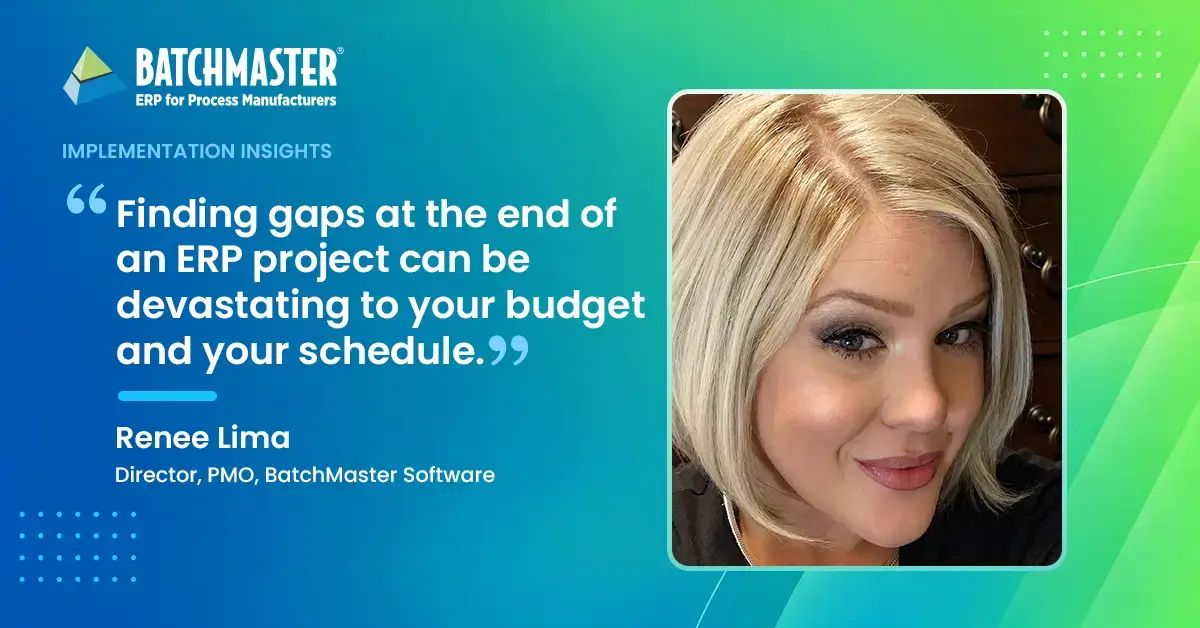
Renee Lima on the exact moment an ERP project falls apart during the final prototype session.
After decades of managing ERP implementations in process manufacturing, our delivery leaders have seen this scenario play out more times than they can count. It is not due to poor software or the people who use it. It is the predictable outcome of a rigid methodology that keeps the customer at arm’s length until the very end.
Here is what we have learned about the hurdles that derail implementations, and why we built a different approach to overcome them.
The Waterfall Problem in Process Manufacturing
Many ERP vendors run implementations as a linear, waterfall process, often segmented module by module. Each phase hands off to the next, and the customer typically sees the finished picture only at the end.
The critical flaw is that requirements gaps stay hidden until they’re most expensive to fix. In process industries, where complex batch formulas, multi-tier lot traceability, strict QA testing, and shelf-life requirements are non-negotiable, discovering a gap late in the game can halt an entire project.
Discovering these mismatches late damages budgets and schedules. It demoralizes everyone involved, especially on an aggressive timeline with no room to absorb surprises.
To be fair, traditional waterfall planning isn’t wrong everywhere. For a tightly scoped project with simple, static requirements, a sequenced plan can work well. The trouble starts when operational processes are complex or evolving. A linear plan gives those unique requirements no place to surface until it is too late.
Three Hurdles That Matter Most
When we look at what separates smooth ERP rollouts from painful ones, three hurdles come up again and again:
1. Underestimating the Value of True Partnership
An implementation is not just a dozen remote configuration meetings followed by a quick hand-off. Even in a fast, express implementation with minimal customization, success depends on being deeply involved with the customer from day one.
Our goal is to act as a trusted advisor. That means learning the ins and outs of your manufacturing operations, understanding your compliance pain points, and aligning with your growth plans so the solution supports both today’s goals and tomorrow’s scale.
2. Driving Genuine Customer Adoption
Anyone can install a software package. But if the operators, lab managers, and schedulers who use it daily had no part in designing it, they have little reason to embrace it.
We don’t deliver a pre-baked system and expect a manufacturer to bend their operational workflows to fit a generic platform box. Instead, we engage key stakeholders early, keep their subject matter experts (SMEs) involved throughout, and build a system tailored to how their plant actually operates. Adoption is far easier to earn when people help build the tools they are asked to use.
Why team members won’t use a system they didn’t help design.
3. Building a Cohesive SME Team
Skipping this step can be fatal for implementation quality. A business needs the right internal SMEs in place, not only to learn the system deeply, but to retain that knowledge in-house, train end users, and maintain operational documentation.
Just as importantly, the people managing day-to-day batch production, inventory, and quality need a real voice in the design process. When roles are unclear, or decision-makers are missing from the table, even the best project plan will stall.
The Hybrid Answer: Structure Meets Agility
To address these hurdles, BatchMaster developed a hybrid implementation methodology that blends waterfall structure with the flexibility of agile cycles.
- Waterfall planning provides linear structure, governance, and clear milestone accountability.
- Agile cycles introduce shorter work blocks with frequent check-ins, prototype reviews, and ongoing course corrections.
This hybrid approach maintains the timeline discipline complex ERP projects need while keeping regular customer engagement front and center to eliminate late surprises.
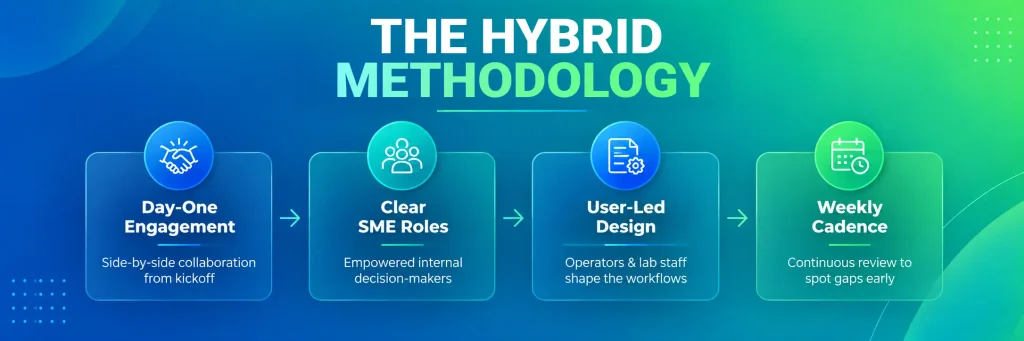
The underlying philosophy is simple: our customers are the builders. We bring decades of process manufacturing best practices to the table, but you remain in control of your operational outcome.
Renee Lima on putting customers in the builder’s seat.
Experience makes all the difference. BatchMaster’s implementation consultants and delivery managers average 15 to 20 years with our company, and many bring decades of direct hands-on industry experience. They understand formula management, batch scaling, lot tracking, and regulatory compliance because they have lived it.
What This Means for Your Next ERP Project
If you are evaluating ERP vendors, remember that software capabilities are only half of the equation. The other half is how that vendor will guide you from contract signing to a smooth go-live.
📋 Vendor Evaluation Checklist
Ask prospective ERP partners these key questions before signing:
- Visibility: When will our team first see the configured system take shape, and how frequently after that?
- Involvement: Will our subject matter experts actively help design workflows, or simply receive a pre-built template?
- Expertise: Who will lead our implementation, and what direct experience do they have in process manufacturing?
- Flexibility: How are requirement gaps and process mismatches handled when they surface mid-project?
The answers will quickly reveal whether you will be treated as a true project partner or merely a software recipient.
The lesson applies regardless of the platform you choose: the earlier your team sees, shapes, and owns the system, the fewer surprises remain at go-live.
Planning an upcoming ERP evaluation or migration? Talk to the BatchMaster team to see how our hybrid methodology ensures on-time, on-budget project delivery.